
The best way to deal with a negative work environment


How do you deal with a negative work environment?
To deal with a negative work environment, spot the warning signs early, then fix the root causes through better policies, leadership, and open communication.
- Watch for high turnover, burnout, and poor communication.
- Review company policies and evaluate leaders often.
- Support staff with healthy competition and stress relief.
Ever worked in a negative work environment? Happy employees are the key to happy customers. A 2019 study by Glassdoor shows that employee satisfaction links to customer satisfaction. So happy employees mean higher productivity and better service.
This shows most in client-facing industries. For example, retail, tourism, and real estate all feel it. However, as companies grow more competitive, some skip their employees’ welfare. As a result, bad work practices get ignored. Over time, they embed into the company culture.
Dealing with a negative work environment protects employee satisfaction. In addition, it helps you retain customer loyalty.
What is a negative work environment?
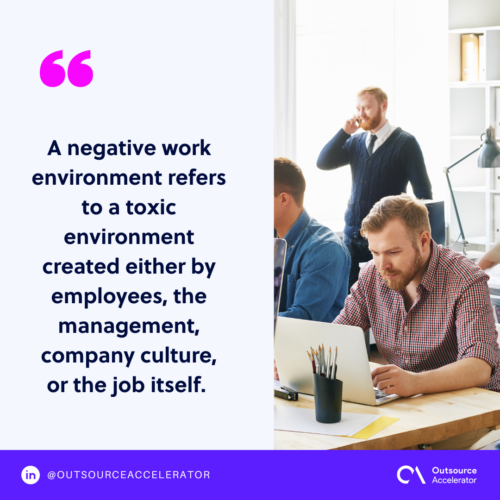
A negative work environment is a toxic space. It can come from employees, management, company culture, or the job itself.
A 2017 article once broke down how an average person spends a lifetime. Per those figures, out of nearly 80 years, a person spends about 13 years at work. That includes an extra year of unpaid overtime. Meanwhile, only around 328 days go to time with friends.
13 years is a long time to spend at work. Many people now work longer hours than ever. So companies should make employees more comfortable and satisfied.
Employees tend to leave a toxic workplace. This has cost global businesses about $223 billion in turnover, according to studies. As a result, the stakes are high for every business.
Effects of a negative work environment in an employee
A negative work environment takes a toll on staff. It hurts their productivity, health, and welfare.
A toxic space causes stress. Workers then carry that stress outside of work. So a domino effect begins. It hurts their relationships and personal lives. As a result, many leave the company, job hop, or switch careers.
What’s more, a toxic environment decreases employees’ productivity. A company should help staff stay productive and motivated. However, falling short brings real costs. It also harms the company’s reputation with future talent.
Signs of a negative work environment
Employers can be shortsighted about the workplace. Not everyone can spot a toxic culture at first. However, it can grow and spread fast. It even reaches employee-oriented organizations.
A negative work environment shows up in two ways. It appears on the employees and on the company itself. The following signs mean something needs to change. Left alone, these become clear toxic workplace behavior.
Signs on the company
Workplace negativity often comes from unchecked culture. So watch for the following signs.
High turnover
High turnover is unusual for most companies. Does an organization have high employee turnover and a suspiciously active hiring window? Then something may be wrong with its management or culture. A focus on employee retention often reverses this trend.
Lack of potential for employees’ growth
Most employees want to grow with their company. Admittedly, some jobs are considered stepping stones for building skills. That is natural. What is unusual is a stable company blocking growth. For example, staff may face long hours, huge quotas, and tasks above their pay grade.
Lack of proper internal communication
Each team has to properly communicate with each other for a company to work. This matters most on a shared project. So managers must check each teammate’s performance. They should also share positive and negative feedback.
The same goes for employees. They should feel free to give feedback. As a result, they can help solve problems and improve processes. Teams that lack transparency hurt company performance and customer satisfaction.

Reports of inappropriate actions
A company can look good on the outside. Meanwhile, it may hide shady actions inside. Employees could face bullying, harassment, and exploitation. These drag down physical and mental health. Worse, HR and management often downplay or ignore the reports. Nobody wants to face a massive employee walkout over this.
Bad leadership
Mainly, all the signs above trace back to bad leadership. A senior role does not permit leaders to treat people poorly. However, bad managers often carry negative attitudes toward staff. It shows in small acts, like the cold treatment. It also shows in big ones, like grabbing credit for an employee’s work.
Signs on the employees
The signs above can quietly reflect on employees’ health. So here are some signs to watch for.
Severe burnout
It is normal to complain about short weekends. However, constant dread of work is different. It can be a sign of burnout. Most companies try to avoid having employee burnouts. Still, some neglect it.
Office gossips and rumors
Simple chatter helps people connect. However, rumors and gossip can be destructive. This is worse among peers. Being part of office gossip is a serious sign of a toxic space. It destroys peer trust. It can also hurt the target’s health and credibility.
Too much competition/low engagement
It is natural for employees to compete. Yet in a toxic space, they go to extremes to reach the top. For example, they work longer hours or become the boss’s “favorite.” At worst, they sabotage teammates. Meanwhile, low employee engagement signals burnout or fear of speaking out.
Getting overworked
Getting overworked often causes severe burnout. This usually comes from employees having too many workloads, quotas, or deadlines to worry about.
Taking work problems home
Lastly, employees should not be taking their work problems home. Many people romanticize this as normal. However, it can be a serious sign of a negative environment. The cause may be the culture or the employees themselves.
How one can deal with a negative work environment
Both management and employees should act to keep a positive workplace. So here are some good tips for everyone.
- Review company policies. Poor policies can fuel a negative work environment. So management must review policies and update what needs work.
- Evaluate the leaders. Leaders should embody the company’s mission and vision. So use exit interviews of past employees to gain insight into their performance.
- Initiate stress-relieving activities. A Zoom happy hour helps staff relax after a week of deadlines. So let employees enjoy a simple get-together or virtual activity.
- Ensure healthy competition among employees. A team should collaborate and empower each other. So set realistic goals and help teammates who fall behind.
- Avoid initiating or participating in office gossip. Steer away from employees who start gossip. Instead, report them to management or a team leader.

Staying positive in a negative work environment
Are you directly affected by a negative work environment? Then keep your head up and stay positive through the day. The following advice may help you get through it.
- Find people that feel the same way. Keep a few friends or confidantes to talk to. So find someone who feels the same and check on each other often.
- Stay focused on your work. Try some mindfulness techniques. For example, use deep breathing and list your work tasks.
- Practice work-life balance. Always keep a strong work-life balance. Whatever your workload, check on yourself and protect your personal time.
- Speak up. Do not be afraid to speak up when the negativity affects you. Still, stay respectful and mindful with your words.
- Know your worth. Lastly, know when enough is enough. So give yourself time to find better opportunities and plan your next steps.
In the end, avoiding a negative work environment is a two-way move. Employees should stay civil with coworkers, customers, and the company. Meanwhile, employers should keep the workplace employee-oriented. As a result, this can help increase their customer satisfaction. After all, the company’s level of care will translate to its employees.
Frequently asked questions about a negative work environment
What are the first signs of a negative work environment?
Early signs include high turnover and frequent burnout. Poor communication and constant gossip also show up. In addition, staff may dread coming to work. So watch for these patterns early.
Who is responsible for fixing a toxic workplace?
Both leaders and employees share the job. Management sets policies and models the culture. Meanwhile, staff can speak up and stay civil. So real change takes effort from both sides.
How does a negative work environment affect a business?
It drives up turnover and lowers productivity. It also harms the company’s reputation with talent. As a result, hiring and customer service both suffer. So the costs add up fast.
Should I quit a toxic job right away?
Not always, but know your worth. First, try to speak up and find support. However, if the harm continues, plan your exit. So give yourself time to find a better role.
Key takeaways
- A negative work environment can come from people, culture, or the job itself.
- Common signs include high turnover, burnout, gossip, and bad leadership.
- Toxic culture costs businesses billions in turnover each year.
- Managers fix it with better policies, honest reviews, and open feedback.
- Employees cope by setting boundaries and protecting work-life balance.






 Independent





