
Accent conversion technology set to revolutionize call centers

What is accent conversion technology, and why does it matter for call centers?
Accent conversion technology uses AI to soften or match a speaker’s accent in real time, so offshore call center agents sound clearer to customers and reduce communication friction.
- Sanas built a real-time tool that turns heavy Indian or Filipino accents into an American accent.
- It runs with no complex install, needs no extra hardware, and works with a simple on-off button.
- Clearer calls can lift customer satisfaction while keeping offshore cost savings.
A Silicon Valley company, Sanas, has created an accent conversion technology set to reshape millions of Filipino and Indian call center jobs.
The software needs no complex install or hardware. So it can turn heavy Indian or Filipino accents into an American accent, and it activates with a simple on-off button. In addition, the technology works in real time with zero audible lag. It is also compliant with all data security standards.
The founders of Sanas.ai spun the company out of the Stanford Artificial Intelligence Lab (SAIL). Meanwhile, it is funded by Village Global, which is itself backed by technology luminaries such as Mark Zuckerberg, Jeff Bezos, and Bill Gates. Maxim Serebryakov, Sanas CEO, said the technology “will add enormous value to call centers where ‘accent matching’ can effortlessly reduce communication friction and increase customer satisfaction.”
>> Sanas podcast interview: Listen to the full interview with Sanas co-founder, Andrés Pérez Soderi. Download (iTunes, Spotify, Stitcher) the Outsource Accelerator podcast (ep. 325) or access the episode and notes here.
The area is still relatively new. However, Sanas has developed impressive proprietary technology, helped by leading minds in the audio and speech space. So this simple-to-use product could transform, in a positive way, millions of jobs across the global call center industry. For context, both the Philippine call center sector and Indian BPO companies employ millions of voice agents.
What is an accent worth?
Sanas claims that accent mismatches can produce, or cost, over $37,000 of value per agent each year. It calculates that a typical US-based agent costs $25 an hour. Meanwhile, an Indian or Philippine agent costs a typical $12 an hour. Not all of the benefit comes from accent alone. Still, there is a large gap of over $37,000 between the two options.
- US agent: $25 per agent per hour
- Offshore agent: $12 per agent per hour (S.E. Asia)
- Cost delta: $37,440 per agent per year
An accent mismatch is often a red flag to weary customers. So if it can be removed, it opens real chances to improve interactions. As a result, teams can raise CSAT (customer satisfaction) ratings while still using cost-effective resources.
The proof is the product
Of course, it is impossible to hide behind fake results when it comes to accent conversion. So in the case of Sanas, the product speaks for itself.
So we got Sanas to share three quick recordings for you to hear. Then let us know what you think.
Advantages of accent conversion
Overall, Sanas has shown that a matched accent can improve a call center’s results in several ways.
- Improve customer experience. Often, accent mismatches make customers mistrust an agent, hang up, or feel less happy with a call.
- Decrease average handling time. Greater understanding is shown to lift satisfaction and shorten calls. So it also supports better first call resolution.
- Make your agents happy. Sanas lets agents speak naturally, rather than forcing an accent.
- Have a competitive edge. American-sounding agents at offshore prices would be a first in the industry.
- Use accents to your advantage. Working for a foreign company? Then use an accent to match.
These gains matter across many call center services, from sales to support. In fact, they build on wider advances in voice processing.
About Sanas
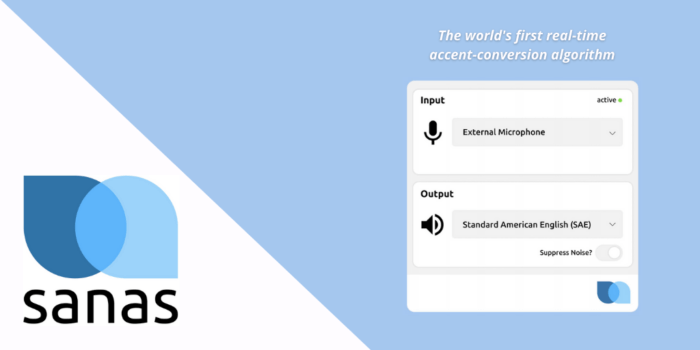
Sanas was founded by three Stanford students and spun out of the acclaimed Stanford Artificial Intelligence Lab (SAIL). Its mission is to help the world understand and be understood. In addition, its end goal is to grow job opportunities worldwide and reduce voice-based discrimination.
The Sanas platform allows for accent conversion. For example, it can turn an Indian English accent into a Standard American English accent in real time. As a result, understanding improves sharply, with over a 40% increase in fluency. Sanas’ real-time accent modulation solution is a world-first. It was also built with some of the brightest minds in the audio tech space.
The next horizon for Sanas is customer service centers. So its goal is to raise customer satisfaction and cut average handling time by removing mismatched accents.
Limited partner opportunity
Sanas has offered two BPOs, one in India and one in the Philippines, the chance to use its product for free. For example, it has provided 12-month trials with zero tie-ins.
In return, it works in partnership with the successful call centers to publish co-branded case studies and white papers.
If interested, reach out to Outsource Accelerator to see if you qualify. Email: [email protected], Subject: SANAS.
Frequently asked questions about accent conversion technology
How does accent conversion technology work?
First, it uses AI speech models to reshape a speaker’s voice as they talk. So a heavy accent can be matched to a target accent in real time. The agent keeps speaking naturally, while the listener hears a clearer version.
Does accent conversion replace call center agents?
No. It supports agents rather than replacing them. In fact, it lets skilled offshore agents be understood more easily. As a result, teams keep human judgment while improving clarity.
Is accent conversion the same as accent neutralization training?
Not quite. Traditional training asks agents to change how they speak over weeks or months. Accent conversion technology, by contrast, adjusts the audio in real time. So it works instantly with a simple on-off button.
Can accent conversion improve customer satisfaction?
Often, yes. Clearer calls reduce misunderstandings and repeated questions. Because of this, handling time can fall and CSAT scores can rise. Results still vary by team and use case.






 Independent






