
The best and most popular distributed workforce companies


What are the best distributed workforce companies?
The best distributed workforce companies are firms like Automattic, Zapier, Buffer, GitLab, and Stack Overflow, which run fully or mostly remote teams across many countries.
- They hire talent from anywhere, not just one city or country.
- They rely on tools like Slack, Trello, and shared docs to stay in sync.
- They cut office costs while they keep people productive and happy.
Not long ago, many businesses were unsure about letting staff work from home. Much like early business process outsourcing, the idea felt new. Some had heard worrying stories about freelancers or remote hires.
However, online tools and software have changed that. As a result, hiring and managing remote teams is now much easier.
Many enterprises adopted a distributed workforce model early on. Still, not all of them managed it well at first. Today, more small businesses use remote staff, and modern entrepreneurs keep growing their share of the market.
Because of this, remote work has proven that it is here to stay.
What is a distributed workforce?
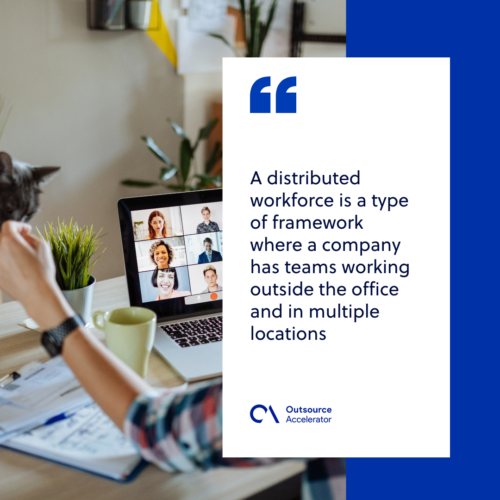
A distributed workforce is a setup where teams work outside the office and across many places. Some firms keep a small in-house core team that guides remote staff. Others run fully remote.
Despite the distance, these teams stay linked on one network. So, even without a shared office, they use the right tools to talk and work together.
Reasons to set up a distributed workforce
For decades, big companies have used distributed teams. As a result, staff could work from home or anywhere they wished.
IBM helped pioneer this practice before they brought their workers back to the office in 2017. Meanwhile, with software as a service (SaaS) tools, startups and tech firms now find remote work simple to run.
There are several reasons why companies choose remote work.
Cut costs on resources.
In the past, IBM thought it might be better for them to sell their office buildings and have their employees work remotely to cut costs.
Today, the same is true for small firms and startups. They work on a tight budget, so saving on resources comes first. For example, they save on office space and desks. As a result, many hire remote teams instead.
Hire better talents.
In 2013, Diebold, a US financial solutions firm, found it hard to hire near its office in Canton, Ohio. So its former CEO, Andy Mattes, decided to hire remote workers because the company was “fishing in a small pond.”
This still holds true now. In short, remote hiring lets firms tap a global talent pool and pick the best people from many places.
Make employees highly productive.
A Stanford professor ran a two-year study with Ctrip, the largest travel agency in China. It looked at how working from home affects output.
As a result, the team saw a great productivity boost in the employees. They worked full shifts with shorter breaks, fewer sick days, and less time off.
So the research shows that a distributed workforce lifts output, raises job satisfaction, and improves retention.
Promote a more diverse and inclusive workforce.
A study from McKinsey found that diversity plays a role in the growth and profitability of a company.
Remote work, meanwhile, focuses on results. In other words, it values what a person delivers, no matter their gender or location.
Offshoring companies like Remote Employee provide distributed staff so firms can judge people fairly. As a result, a distributed model builds a better workplace for all.
Companies with remote workers
Times have changed, and so has the way we manage people. Today, many startups and SaaS firms run part or fully remote teams with success. Here are some of the best-known distributed workforce companies:
Automattic

Automattic, the parent company of WordPress and Tumblr, runs as a 100% remote company.
Its CEO, Matt Mullenweg, shared on a TED episode that remote work was their choice from the start. He believes it is the best way to build a business, because “talent and intelligence are distributed equally throughout the world.”
How do they do it?
Since the company began in 2005, it has leaned on strong collaboration tools. As a result, teams stay in the loop.
Today, they use Slack for chat and P2, a WordPress theme that works like a shared timeline. In addition, Automattic gives staff an allowance to work from home, a coworking space, or a favorite coffee shop with wifi.
Zapier

Zapier, an automation tool, also runs on 100% distributed teams. Its CEO and co-founder, Wade Foster, says remote work lets them hire smart people from many places. Meanwhile, it gives staff a healthy work-life balance and more time with family.
Today, Zapier’s team spans many countries and time zones.
How do they do it?
Zapier staff enjoy perks such as flexible hours, profit sharing, a retirement match, and health coverage.
They also track work through apps like Trello and Slack. In addition, they use an internal blog in place of email.
Buffer

Another fully distributed firm is Buffer, a social media tool. Its team works remotely across many countries.
With remote work, per Courtney Seiter, they build trust and support fairness across the company.
How do they do it?
Buffer has tested many ways to improve its culture and work. For example, it has tried in-office, hybrid, and fully remote setups.
They also fine-tune their perks over time. Today, Buffer offers three weeks off a year, strong health benefits, free therapy for staff and families, and paid retreats.
GitLab
GitLab, a DevOps platform, is proud of its all-remote team, with staff in dozens of countries.
As an open-core company, it shares its work openly on its site. In short, it believes every contribution helps move human progress forward.
How do they do it?
True to its open-core roots, GitLab runs a flexible team without rigid rules.
Per its remote manifesto, staff set their own hours, share ideas in open documents, and access open information. As a result, everyone can take part.
Time Doctor

Time Doctor is a SaaS firm that builds tools for remote teams. So it makes sense that it runs fully remote too.
Its team spans many countries, all working from home or on the move. As founders Liam Martin and Rob Rawson put it, they want people to work well wherever they are.
How do they do it?
The company works in real time. So teams share ideas and catch up on daily tasks and projects.
When a new hire starts, they get a project due in three weeks. This shows if they enjoy the work and how they handle remote life.
Their teams work anywhere. Still, the founders host an annual meet-up so they can connect in person.
DuckDuckGo
DuckDuckGo, a private search engine, aims to set a new bar for safe search. Its fully remote team helps drive that goal.
They value fresh ideas and look for people who care about the work. As a result, their team keeps growing across many countries.
How do they do it?
The company hires people who can work well with the team and get things done.
Instead of long interviews, they use small paid projects on flexible hours. In this way, applicants can see if remote work fits them. The firm then offers part-time or full-time roles with strong perks.
Doist

Doist, the maker of Todoist and Twist, also runs a fully distributed team. It started with zero funding, yet millions of people now use its products. Today, its staff work across many countries and time zones.
How do they do it?
A global mindset is baked into the company. In fact, CEO Amir Salihefendic started it in Chile.
He hired his first staff through forums like GitHub and Reddit. So they rely on diverse talent, which brings many views to each project.
This shows in their products and support. For example, the app works in many languages, and support covers several more.
Stack Overflow
Last but not least, Stack Overflow is the largest community for tech talent and startups. The company values the perks of remote work.
So it built those perks into its team too. Besides hiring top talent, it promotes diversity and keeps improving for its people.
How do they do it?
Stack Overflow follows a “remote-first” policy. As a result, staff get a home office paid for by the company. It also covers costs like internet and supplies.
For teamwork, they use Google Docs, Slack, Hangouts, and Trello. In addition, they run meetings through screen sharing.
Top websites to hire remote employees
Before these firms found success, they had to plan a lot first. For example, they set up their tools, roles, and workflows with care.
Those who want to build a remote team or hire their first online workers often start with popular freelance sites.
However, some sites focus only on remote hiring. So they can help even more. These are:
FlexJobs
On FlexJobs, employers can hire part or fully remote staff. As a result, you can work with people in person for a set time if needed.
You can also hire local or offshore, based on your needs. In addition, FlexJobs offers both free and paid posting plans.
We Work Remotely
We Work Remotely is one of the largest sites for hiring remote staff. It posts thousands of jobs and draws millions of visitors worldwide.
Posting runs on a paid monthly plan. Meanwhile, you can upgrade to get featured on the search page.
Remotive
Another top remote-work site, Remotive, lets employers post jobs on a paid plan. Membership adds Google Jobs listings and weekly newsletters. It also offers discounts for nonprofits and for firms with several postings.
Working Nomads
Working Nomads lists remote jobs, mostly in software, marketing, creative, and admin roles. So it helps remote workers and employers connect.
A single ad comes with 30-day visibility, a social post, and newsletter inclusion.
Wellfound (formerly AngelList Talent)
Unlike other sites, posting a remote job on Wellfound is free. Employers just create a free account to start.
The site aims to link startups and remote staff and help them build their brands. In addition, it offers paid plans for more features.
Remote.co
More than a job board, Remote.co also shares guides on remote work, hiring, and managing a team. It covers many roles, from accounting to virtual assistant jobs. The platform charges a flat fee for a 30-day ad.
RemoteOK
Besides job posts, RemoteOK partners with other sites for added perks. For example, workers can learn how to become a digital nomad via Nomad List.
Employers, meanwhile, can add benefits for their teams through Safety Wing. A single ad has a set fee, with optional add-ons for more leads.
Toptal
Toptal keeps only the top 3% of remote workers in web and software work, project management, and finance. As a result, employers can hire strong staff in days.
To match you, Toptal asks a set of questions. Then it connects you with qualified people within hours.
Frequently asked questions
What are distributed workforce companies?
Distributed workforce companies run teams across many places, not one office. In short, staff work from home or anywhere with a good connection.
What tools do distributed workforce companies use?
Most use Slack for chat, Trello for tasks, and shared docs for open editing. In addition, video calls keep teams close.
Why do companies build a distributed workforce?
They cut office costs and reach a wider talent pool. As a result, they often see higher output and better retention.
Are distributed and remote teams the same thing?
They are close, but not quite the same. A remote team works away from the office. A distributed team spreads across several places and time zones.
Where can I hire remote employees?
You can start with FlexJobs, We Work Remotely, Wellfound, or Toptal. For managed offshore teams, providers like Remote Employee can help.
Key takeaways
- Top distributed workforce companies include Automattic, Zapier, Buffer, GitLab, and Stack Overflow.
- They hire globally and rely on shared tools to stay in sync.
- Remote setups cut costs and lift both output and retention.
- Sites like FlexJobs, Wellfound, and Toptal make remote hiring simple.
- Clear tools, open communication, and trust keep distributed teams strong.






 Independent





