
In house payroll vs. outsourcing dilemmas answered

In-house payroll vs. outsourcing: which is the better choice?
For most businesses, outsourcing payroll wins on cost, accuracy, and compliance, while in-house payroll suits only firms with strong internal systems and simple needs.
- Outsourcing gives you modern software, trained staff, and built-in compliance.
- You keep full control, since providers seek your approval before any payment.
- In-house makes sense only when your team and tools are already solid.
Payroll is perhaps the most essential duty of a business owner. Like most business processes, payroll can now be outsourced. So owners now weigh the pros and cons of in-house payroll vs. outsourcing.
Still, many myths cloud the choice. Global Process Manager, a leading Philippines outsourcing supplier, shares their insights here. This guide answers the main questions about the gap between in-house payroll processing and outsourced payroll solutions. With it, you can make the best choice for your company.
Which is more expensive? Is there an affordable payroll service?
Payroll costs depend on many factors. These include company size, current tech, staff skill, and payroll complexity. So there is no single price that fits everyone.
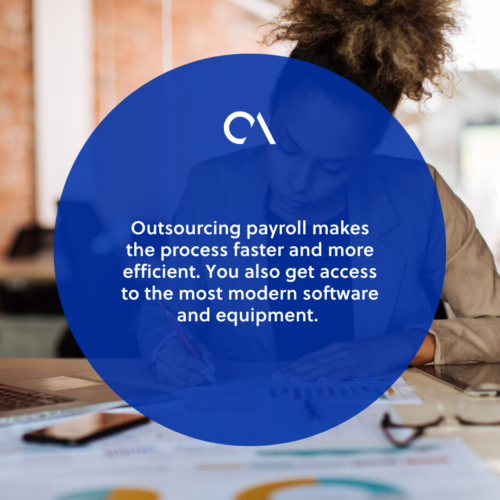
Outsourcing payroll makes the process faster and more efficient. You also get access to modern software and equipment. On top of that, outsourcing helps you stay compliant with current labor laws. Good payroll software drives much of this gain.
It depends on your short-term and long-term business goals.
Cost-effectiveness also depends on your short-term and long-term goals. For example, keeping payroll in-house may save on provider fees. Still, there is a catch. If you fix payslips every payday due to weak staff and old systems, the hidden cost adds up fast. So in the end, outsourcing is often the more affordable route. It also helps you avoid costly trial-and-error.
How much control do I lose when I avail of an automated payroll service?
Many owners fear they lose control when they use outsourced payroll providers. The worry grows if company policies change often. In that case, some say in-house payroll saves money on repeated edits.
You still have complete control.
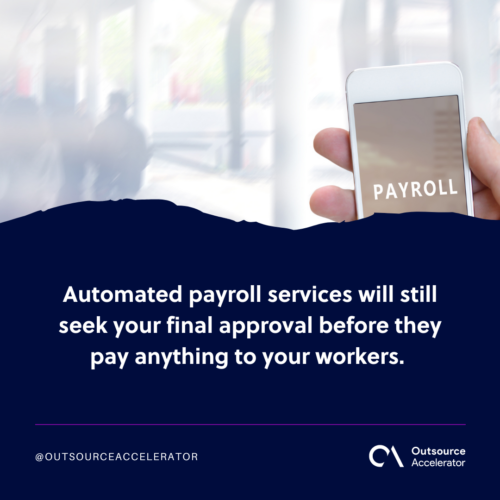
The truth is you never lose control as the owner. Why? Because an automated payroll service still seeks your final approval before it pays anyone. So you get to double-check everything before release. Moreover, outsourcing firms are specialists. They offer well-trained payroll staff and modern equipment that keep payroll on time and accurate. For broader needs, many firms pair payroll with financial outsourcing.
Do I risk my data when I outsource?
Another worry about automated payroll is data abuse or data loss. In reality, this risk exists on every route. That is why risk management and contingency planning teams exist. After all, there is no such thing as zero risk.
Still, good providers take data security seriously. For example, they use encryption, strict access controls, and signed confidentiality agreements. They also keep audit trails and back up records often. So in many cases, a specialist protects your payroll data better than a small in-house team can. Payroll often sits alongside other back-office functions under the same safeguards.
What qualities to look for in outsourced payroll providers?
Here are the qualities to look for when you weigh business payroll services.
Transparency
The best partnerships rest on trust. Working with payroll outsourcing providers is no different. Transparency, or even a clear willingness to be open, builds confidence. In turn, trust leads to a better workplace, higher efficiency, stronger service, and lasting success.
Domain expertise
Never hire a payroll service provider that lacks domain expertise. After all, that expertise is the reason you are outsourcing payroll in the first place. Domain expertise means fast, accurate payroll with no wrong or late filings. Expert providers will even promise to absorb any fines or penalties. They can, because they work hard to avoid mistakes.
Organized workflow
Hire a payroll outsourcing firm that has a set, structured workflow. This kind of care shows the team knows what it is doing. When you choose, ask for a copy of their workflow. Then let them walk you and your team through it. From there, you can pick the best fit. Good payroll management depends on it.
Flexible outsourced payroll solutions
Finally, find a provider with flexible payroll solutions. The best ones adapt to your company’s needs. No two firms are the same, so you want a partner that caters to your requirements. When you choose between in-house payroll vs. outsourcing options, the second often wins. Expertise, convenience, and reliability are the promise of a strong payroll outsourcing provider. Take advantage of it.
Global Process Manager is a leading outsourcing supplier. It specializes in payroll services and other verticals.
Frequently asked questions about in-house payroll vs. outsourcing
Here are quick answers to common questions about in-house payroll vs. outsourcing.
Is it cheaper to outsource payroll or keep it in-house?
It depends on your size and systems. For many firms, outsourcing is cheaper over time. It cuts errors, late filings, and the cost of software and training. In-house can win only when your team and tools are already strong.
Do you lose control when you outsource payroll?
No, you keep control. The provider still sends payroll to you for final approval. So you review every run before any money moves. In short, you gain a specialist without giving up oversight.
Is outsourced payroll data safe?
Yes, with a good provider. They use encryption, access controls, and signed confidentiality agreements. They also keep audit trails and regular backups. As a result, data often stays safer than with a small in-house setup.
When does in-house payroll make sense?
In-house fits firms with simple payroll and skilled staff. It also helps when policies change a lot and you want full hands-on control. Otherwise, outsourcing usually saves time and money.






 Independent






