
8 Essential functions of accounts payable


What is accounts payable and what does it do?
Accounts payable (AP) is the money a company owes its suppliers, and the AP team makes sure each invoice gets checked, approved, and paid on time.
- AP tracks what a business owes vendors for goods and services already received.
- The team manages invoices, payments, and cash flow to avoid costly errors.
- Strong AP work keeps vendor ties healthy and the books accurate.
Managing accounts payable can feel complex and heavy. In-house AP teams juggle many tasks at once. For example, they track invoices, monitor payments, and guard cash flow, all without slip-ups.
One study found that 93% of mid-sized businesses still use manual steps for their finance work. They know the limits, yet the habit stays.
Meanwhile, the need for speed and accuracy keeps growing. As a result, many AP teams struggle to keep up.
So this article breaks down the key functions of AP. Each one helps streamline work and improve how a business manages its money.
Definition of accounts payable
Accounts payable (AP) is the money a company owes its vendors or suppliers. It covers goods or services the firm has already received. On the balance sheet, it counts as a short-term liability.
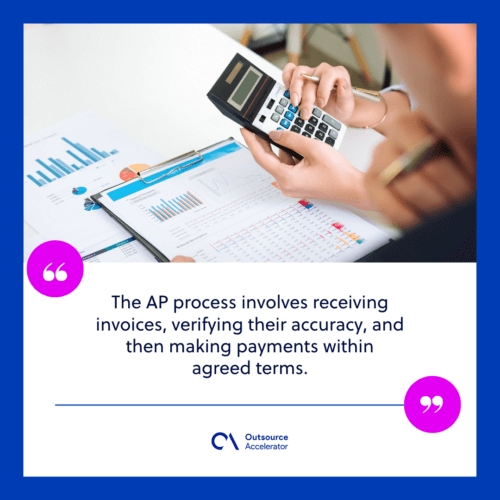
The AP process has a clear flow. First, the team receives invoices. Next, they check that each one is correct. Then they pay within the agreed terms. In this way, a firm can rank its bills and stay stable.
In addition, good AP work matters for many reasons. It keeps vendor ties strong, guards cash flow, and helps avoid late fees. In short, it is a core part of controlling a company’s finances.
How accounts payable process is done
The AP process often runs in four steps. Together, they help a team pay invoices in an accurate way.
Invoice capture
First, the team enters invoice details into a system. This includes vendor data, amounts, and ledger codes. Because this step is often manual, it can lead to errors.
Invoice approval
Next, the AP team reviews the invoice and gets sign-off. Often, this means routing the invoice around the office. Only then is it logged and marked as a cost.
Payment authorization
After that, the team gains approval to pay. This step sets the payment method, the amount, and the timing.
Payment execution
Finally, the team processes the payment. This may be by check, ACH transfer, or credit card. Then remittance details go to the vendor, and the invoice is filed and closed.
This full process keeps money under control. As a result, supplier ties stay smooth and clear. Firms that want more capacity can also weigh accounts payable outsourcing for these steps.
8 Key functions of accounts payable
The AP department does a lot of vital work. It builds supplier ties, tracks spend, and keeps the books in check.
Here are eight key functions that shape a well-run AP process.
1. Invoice management
First, the AP team receives, reviews, and checks supplier invoices. Before payment, they confirm the goods or services arrived and the amounts are right. Smooth invoice processing keeps this step fast.
2. Data entry
Accurate data entry is very important. AP staff input invoice details such as vendor names, invoice numbers, amounts, and codes. As a result, the records stay clean and easy to search.
3. Approval workflow
Before any payment, invoices go through an approval flow. The AP team makes sure the right manager reviews and clears each one.
4. Vendor communication
Regular contact with vendors keeps things clear. AP staff work with suppliers to fix issues. For example, they sort out overdue invoices or wrong charges.
5. Payment processing
Once an invoice is approved, the AP team pays it. This may be by check, ACH, or wire transfer. The choice depends on company policy and vendor preference.
6. Payment scheduling
The team plans payments with care. In this way, they avoid late fees and protect cash flow. They watch due dates so every bill is paid on time.
7. Expense tracking
AP tracks each payment and sorts it into the right account. As a result, the records stay current and ready for reports.
8. Reconciliation
Finally, AP matches payment records with bank statements and internal reports. This check confirms that all entries line up. So no gaps or errors slip through the books.
It also helps to know how AP differs from what a firm is owed. For a quick primer, compare accounts payable and accounts receivable.
Offshore accounts payable for enhanced internal process
Partner with Clark Staff to optimize your AP department! Focus on strategic activities while your trusted offshore partner handles routine AP tasks like:
- Invoice processing
- Data entry
- Vendor communication
With expertise in offshore AP solutions, Clark Staff can help you scale your operations and improve financial accuracy without the burden of additional overhead. Many firms pair this with broader outsourced accounting support too.
Contact Clark Staff today to explore how its featured offshoring solutions can benefit your business!
Frequently asked questions about accounts payable
What is the main role of accounts payable?
The main role is to manage what a company owes suppliers. The team checks invoices, gets approvals, and pays on time. As a result, the firm keeps strong vendor ties.
What is the difference between accounts payable and accounts receivable?
Accounts payable is money the company owes to others. Accounts receivable is money that others owe the company. In short, one is a bill to pay, the other is a payment to collect.
What are the steps in the accounts payable process?
The process has four main steps. First, capture the invoice. Next, get approval. Then authorize payment. Finally, execute the payment and file the record.
Why do companies outsource accounts payable?
Outsourcing frees in-house staff for higher-value work. It also lowers cost and boosts accuracy. So many firms hand routine AP tasks to a trusted offshore team.
How does accounts payable affect cash flow?
AP controls when a firm pays its bills. Good timing helps avoid late fees and keeps cash on hand. Because of this, smart scheduling protects daily cash flow.






 Independent





