
The impact of outsourced software development in healthcare


How does outsourced software development impact healthcare?
Outsourced software development lets healthcare organizations build secure, compliant apps faster and at lower cost, so their own teams can focus on patient care.
- It cuts the cost of hiring and training in-house developers.
- It brings in experts who know HIPAA, GDPR, and FDA rules.
- It speeds up delivery, so new tools reach patients sooner.
Technology now sits at the core of modern healthcare. It shapes how providers deliver care and how patients reach medical services. Smart software, from telemedicine to mobile health apps, drives better results and more efficient work.
However, building these tools in-house can be costly and slow. So many healthcare organizations turn to outsourced software development in healthcare instead. This lets them tap the skills of specialist developers. As a result, their own teams stay focused on quality care. In this article, we look at how this practice has reshaped the healthcare industry.
Importance of technology in modern healthcare
Modern healthcare has fully embraced new technology. In 2026, the digital health industry is projected to reach about $181 billion. So the shift toward digital tools shows no sign of slowing.
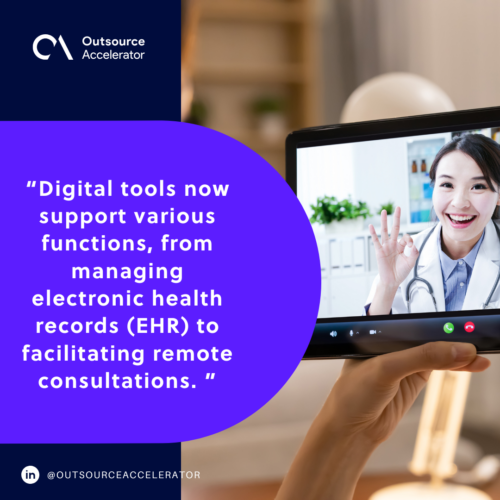
Healthcare technology has changed both patient care and admin work. Digital tools now support many tasks. For example, they manage electronic health records and power remote consultations. As a result, they cut errors, boost efficiency, and lift patient engagement.
New apps also push providers to work faster and more accurately. Still, demand for fresh software often outpaces the internal teams that build it. So the gap keeps growing. This is where healthcare IT solutions from outside partners can help.
5 Advantages of outsourced software development in healthcare
Outsourced software development has become a smart move for healthcare organizations. It helps them lift patient care and streamline work. Below are five key advantages that make it so appealing.
1. Cost efficiency
Healthcare providers often face tight tech budgets. Outsourcing removes the need to hire, train, and keep an in-house team. On top of that, you skip costly infrastructure. The partner brings the tools and tech instead. As a result, you cut costs while you still get high-quality results. Many providers also compare this with broader healthcare BPO options to save even more.
2. Access to specialized expertise
Healthcare software comes with strict rules. For example, it must meet HIPAA, GDPR, and FDA guidelines. Outsourcing lets you work with pros who specialize in healthcare technology. So these experts know how to design secure, easy-to-use, and compliant apps. As a result, your product fits the healthcare sector from day one.
3. Faster time to market
Outsourcing partners often use agile methods. So they deliver projects faster. With dedicated teams and tidy processes, you launch software sooner. As a result, you respond quickly to patient and market demands.
4. Scalability and flexibility
Outsourced development scales with your project. Partners can adjust their services fast when app features or technological trends shift. So you meet changing needs without a big internal team. That way, you avoid a long-term staffing commitment.
5. Enhanced focus on core activities
Outsourcing frees your team to focus on its main mission. That mission is better patient care and stronger medical research. When specialists handle the build, your staff stays on clinical and operational work. As a result, both patients and providers see better outcomes. For complex builds, outsourcing software development keeps timelines tight.
Maximizing benefits with outsourced software development
Here are a few ways to meet the challenges and get the most from outsourcing.
Choose the right partner
Success depends heavily on the partner you pick. So look for a provider with a proven record in healthcare software, such as Orangesoft. A strong partner knows the industry well. Their portfolio should also show high-quality work.
Prioritize security and compliance
Data security and compliance are critical in healthcare software. A breach can be deadly, with 2024 hitting nearly $10 million USD in average costs. So make sure your partner follows strict security protocols. They should also know industry rules inside out. Regular audits and data security in outsourcing checks help protect sensitive patient data.
Establish clear communication
Good teamwork between provider and partner is key. So set up clear communication channels early. Also define project milestones to prevent mix-ups. That way, the app meets expectations. Regular updates and feedback loops keep everyone aligned.
Leverage post-development support
The benefits of outsourcing go beyond the build. Good partners offer ongoing maintenance and support services. So your app stays functional, secure, and up to date. This matters most in healthcare, where software reliability shapes patient care.
Outsourced software development through Orangesoft’s services
Build healthcare software with the help of Orangesoft. Orangesoft offers tailored solutions for your healthcare organization. So you get secure apps that lift patient care. With over 13 years of experience, Orangesoft has become a trusted tech partner for complex projects.
Orangesoft’s healthcare software developers cover all parts of care delivery. For example, they bring expertise in:
- Telemedicine solutions
- Internet of Medical Things (IoMT) solutions
- Healthcare AI solutions
- Fitness and wellness applications
- Mental health applications
- Women’s health applications
Orangesoft stands ready to tackle healthcare app development. So it helps organizations and startups reach their vision. Contact them today.
Frequently asked questions
What is outsourced software development in healthcare?
It means hiring an outside team to build healthcare software for you. The team may build apps, platforms, or tools. So your own staff can stay focused on patient care.
Is outsourced healthcare software secure and compliant?
It can be, with the right partner. Good providers follow HIPAA, GDPR, and FDA rules. They also use strict security protocols and regular audits.
What types of healthcare software can be outsourced?
Many types can be outsourced. Examples include telemedicine, EHR systems, and mobile health apps. Teams also build AI tools and wellness apps.
How does outsourcing speed up healthcare projects?
Partners use agile methods and dedicated teams. So they deliver in shorter cycles. As a result, new tools reach patients sooner.
How do I choose a healthcare software partner?
Look for a proven record in healthcare and strong compliance know-how. Check their portfolio and security protocols too. Then confirm they offer post-launch support.






 Independent






