
6 reasons why outsourcing in the Philippines should be your top business priority


Why should you consider outsourcing in the Philippines?
Outsourcing in the Philippines gives businesses a skilled, English-speaking workforce at a lower cost, backed by a strong BPO industry and government support.
- The country has a large, well-trained talent pool.
- Labor costs are a fraction of Western rates.
- The BPO sector keeps growing year after year.
Business process outsourcing (BPO) helps firms run their work smoothly with help from another party. So a business hires a contractor to handle parts of its work. These can include recruitment, digital marketing, graphic design, finance, and animation.
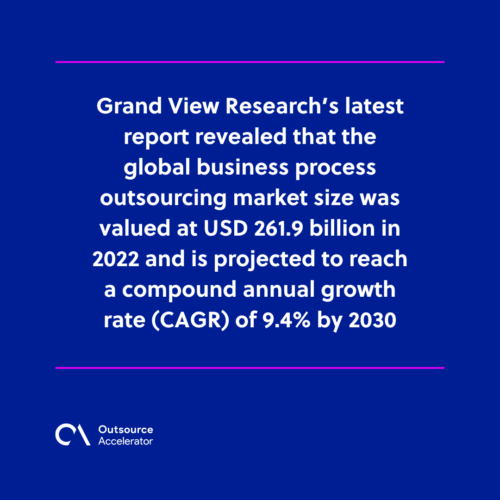
The contractor does the work. Meanwhile, the main firm focuses on other ways to grow. Grand View Research’s latest report valued the global BPO market at USD 261.9 billion in 2022. It also projects a compound annual growth rate (CAGR) of 9.4% by 2030.
In the Philippines, BPO is one of the top sectors. In fact, the IT-BPM industry earned about $38 billion in 2024, and revenue has since passed the $40 billion mark. So it remains a major part of the economy. Over the past few decades, the industry has grown fast and won a large share of the global market.
You may wonder what the Philippines has to offer to the worldwide market. So here is a guide on why you should consider outsourcing in the Philippines. It has also become the top outsourcing destination for many global firms.
6 reasons why you should consider outsourcing in the Philippines
1. Highly-skilled workforce
The Bureau of Labor Statistics expects about 389,400 openings for customer service representatives each year. So demand for skilled support staff stays high.
Today, about 1.82 million people work in the Philippine IT-BPM industry. Meanwhile, hundreds of outsourcing firms operate across the country. The government also runs a short-course program through the Technical Education and Skills Development Authority (TESDA). Its goal is to prepare people for contact center jobs.
The training builds skills in communication, problem-solving, and customer handling. In addition, most contact centers give strong training before agents start. For example, they cover product details, call handling, call flow, and industry standards. As a result, outsourcing in the Philippines gives you a large, skilled workforce. So it is a great choice for SMBs and startups. To see what work fits best, review the top roles outsourced to the Philippines.
2. Affordable labor costs
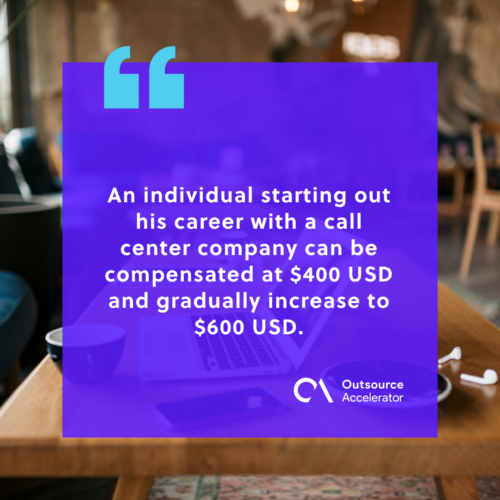
An agent starting a call center career may earn around $400 per month. Over time, pay can rise toward $600. So any foreign firm that outsources in the Philippines pays only a fraction of Western rates.
By contrast, a professional in the US or UK often earns $20 to $50 per hour. That depends on their skills and experience. Even so, Filipino staff bring a strong edge. In fact, many speak English with a neutral or light accent. For a full breakdown, see the average salary in the Philippines.
3. Linguistic ability
As noted above, Filipinos can speak in a near-native tone. In fact, some reach C2 level in the CEFR (Common European Framework of Reference for Languages).
The Philippines ranked 27th spot in 2020’s English Proficiency Index (EPI), according to Education First (EF). Still, the country remains one of Asia’s strongest English hubs. This edge comes from decades of close ties with the United States. As a result, cultural affinity runs deep. Voice accounts also make up a large share of the outsourcing revenue.
4. Continuous industry growth
The local IT-BPM sector keeps growing each year. Revenue has climbed past $40 billion, and headcount keeps rising. So the trend points firmly upward.
The Philippines has also ranked among the world’s top outsourcing spots. For example, Manila once overtook Mumbai in a global ranking of outsourcing cities. This shows that outsourcing in the Philippines is a favored choice for foreign investors. In fact, it is one of the world’s top call center destinations. Big names like Accenture, American Express, and JPMorgan Chase have set up shop there. Many firms also build a dedicated outsourced Philippines team to scale fast.
5. Cost-effectiveness
Once a deal is signed, a foreign firm can focus on its core work. So it does not need to support the offshore team directly. In fact, the contractor prepares the workers’ needs. These include medical insurance, retirement plans, government benefits, loan help, and payroll.
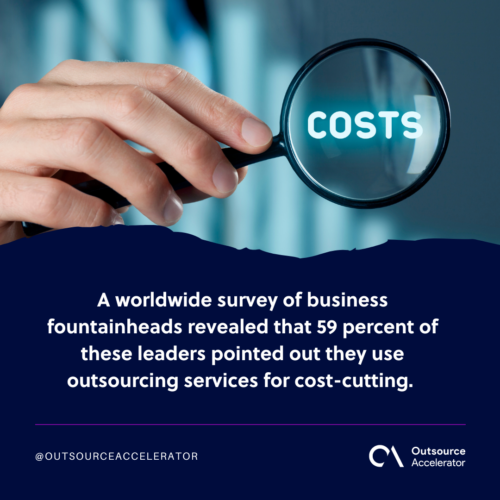
The contractor also handles recruitment, training, and staff development. As a result, you run your business while you avoid extra costs. In fact, a global survey found that most leaders outsource to cut costs. Other top reasons are to solve capacity gaps and to focus on core work.
The Philippine government also supports foreign firms. For example, Republic Act 7916 lets qualified BPO firms cut costs. It exempts them from some national and local taxes. In return, the firm pays only 5% of its gross income as tax.
6. The progressive economy
The Philippine economy has improved a lot over the years. It has shifted from farming toward labor and manufacturing. Today, BPO earnings rival the remittances sent home by overseas Filipino workers.
The economy keeps growing and ranks among the emerging markets. So investor confidence stays strong. In a nutshell, outsourcing in the Philippines is a very credible choice for any investor who wants real growth. With a clear edge over other outsourcing countries, the country has proven it can adapt. Firms hiring solo help can also start with a skilled Filipino virtual assistant.
Frequently asked questions
Why is the Philippines a top outsourcing hub?
It has skilled, English-speaking staff at low cost. In addition, the government backs the sector with training and tax perks.
How much can you save by outsourcing in the Philippines?
Savings are large. In fact, local pay is often a fraction of US or UK rates. So many firms cut labor costs sharply.
What work do companies outsource to the Philippines?
Common tasks include customer support, finance, marketing, and design. Meanwhile, IT and back-office work keep growing too.
Is English widely spoken in the Philippines?
Yes. English is used in schools and business. As a result, many workers speak it with a neutral accent.
How big is the Philippine BPO industry?
It is one of the country’s biggest sectors. In fact, it earned about $38 billion in 2024 and now employs roughly 1.82 million people.
Key takeaways
- Outsourcing in the Philippines pairs skilled talent with low cost.
- The IT-BPM sector earns over $40 billion and employs about 1.82 million people.
- Strong English skills make the country a top choice for support work.
- Contractors handle payroll, benefits, training, and recruitment for you.
- Government tax perks and steady growth keep investor confidence high.
To stay updated on Philippine outsourcing trends, The Source blog offers reliable articles, research, and statistics.






 Independent





