
Why should you outsource software development to Nepal?

This article is a submission by AppSkill. AppSkill is a subsidiary of STUDY AND WORK, a highly reputable and successful recruitment company based in Australia.
Why outsource software development to Nepal?
You should outsource software development to Nepal because it offers skilled IT talent at a much lower cost than India or the Philippines.
- Nepal has a large pool of qualified IT graduates.
- Costs can run near 25% of a traditional in-house build.
- The best results come from an interactive, team-based model.
To thrive in a tough market, most businesses now rely on outsourcing. Nepal is an emerging software development outsourcing destination. It offers lower staffing and running costs than older hubs like India and the Philippines. So it draws firms that want strong offshore software development at a fair price.
What’s the software development skill base like in Nepal?
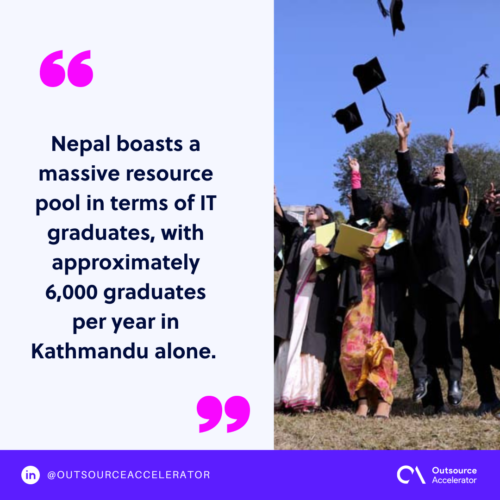
Nepal has a large talent pool of IT graduates. Kathmandu alone produces roughly 6,000 graduates each year.
The Nepalese government has welcomed universities from the US, the UK, and Australia. As a result, these schools now train top-tier developers on local campuses.
So businesses can pick the best talent by offering above-market pay. The available skills cover JS, Java, Python, PHP, Node, Ruby, C/C++, Scala, .Net, UX/UI, DevOps, Testing, SAP, BI, and mobile apps.
Ensuring software development specialists’ skillfulness in Nepal
First, use standard tests to check each team member’s skill level upfront. Nepal offers a diverse pool of software developers with solid qualifications and real work experience.
Still, it helps to assign a supervisor for daily stand-ups. So the team stays on track and delivers as planned. In addition, offer strong support and ongoing training as part of each contract.
How does Nepal compare price-wise?
Let us consider a simple case. Say you run a regular business with a team of four developers on your software, including a:
- Software architect
- Lead developer
- Non-lead developer
- Test engineer
In that case, your monthly build cost could reach $40,000 to $45,000 AUD.
However, if you outsource to a partner in Nepal, the total spend drops to around $10,000 AUD per month. That is about 25% of a traditional project cost. So the savings are large.
In comparison, outsourcing to India or the Philippines could cost at least $20,000 AUD per month.
Challenges in outsourcing software development to Nepal
Outsourcing software development to Nepal has some drawbacks too. Here are the main ones to watch.
Software quality depends on specifications
The software is only as good as the project specs. If the specs are unclear or incomplete, results can miss the mark. As a result, you may face confusion and rework.
Difficulty in knowing everything upfront
It is hard to document every detail at the start. Needs and priorities often shift as work moves on. New insights also appear during development. So rigid documents can block flexibility.
Communication challenges
Traditional projects with offshore teams often hit communication snags. Time zone gaps, language barriers, and weak tools can slow things down. As a result, you may see delays and misunderstandings.
Legal implications
Sometimes unmet expectations lead to disputes. So lawyers may step in over “break fees” and “penalty costs.” This adds cost and complexity to the project.

How can you make the project a success in Nepal?
In the past, outsourcing often drew a cold response from Australian firms. The old methods caused many projects to fail from the start.
For example, teams handed over long specs and waited weeks for the intellectual property (IP). This approach has clear flaws. The quality depends only on the specs provided.
In addition, it is very hard to know and document every detail upfront. Communication during these projects is often weak. So the final result only shows up when the customer gets the IP. This gap often pulls lawyers into breach fees and penalty costs.
To avoid these problems, do not judge the whole project only at the end. Instead, use an interactive, highly communicative, and low-friction method. So you can assess progress and make choices all through the project. As a result, the customer can share concerns at every step.
Ideal software development outsourcing business model in Nepal
For strong results and good profit, skip some old outsourcing habits. A model close to staff augmentation works best. Here are some tips.
Engage developers as part of your in-house team
Do not hand off the whole project. Instead, treat developers as part of your own team, much like a dedicated development team. So you get better teamwork, clearer talk, and smoother workflows.
Retain project management responsibilities
Own your project by keeping the management inside your company. As a result, you keep direct control and oversight of progress and results.
Maintain accountability for project deliverables
Appoint an in-house project lead to oversee every deliverable. Your partner can supply skilled staff. Still, they must answer to your lead for the goals they were hired to meet.

Utilize your own software management methodology
Use your own method, ideally based on agile development. It also helps to map the work across the software development life cycle. Then ask your partner to follow your process. So you keep things consistent and work together well.
These steps improve control and teamwork between your staff and the outsourced specialists. As a result, you lift both work quality and profit.
Software development outsourcing success stories in Nepal
Here are some of the biggest software development outsourcing companies in Nepal:
- Deerwalk Inc.: A US-based IT company in MedTech and healthcare products. They offer machine learning, cloud computing, web, and mobile app services.
- Fusemachines: A US-based company known for AI and automation software. They run a strong team of AI engineers and support talent through fellowships.
- Leapfrog: A leader in the Nepali outsourcing scene. They serve digital transformation, AI, healthcare, EdTech, and design.
- Cotiviti: Formerly Verscend Technologies, Cotiviti is a well-known firm in Nepal. They focus on healthcare IT and decision analytics.
- EB Pearls: A full-service IT provider with offices in many countries. They handle large e-commerce, web, and mobile app projects.
- Braindigit: Known for ventures and digitization, Braindigit serves startups and large firms. They also run an academy called Brainnovation.
- CloudFactory: One of the largest IT firms in South Asia. CloudFactory builds cloud-based solutions and invests in training.
- Javra: A software firm based in the Netherlands that delivers offshore services from Nepal. They are known for R&D and major partnerships.
- F1Soft International: The leading fintech firm in Nepal, serving financial institutions with custom tools. They focus on digital finance.
- Logpoint: A cybersecurity firm in SIEM with offices in many countries. It is a promising software company.
These firms bring wide expertise and proven records in software development.
Outsourcing software development
Appskill stands out with a unique “staff expansion” approach to software development outsourcing. Its core focus is to extend a customer’s IT team rather than take over the whole project.
So Appskill fits right into the customer’s team. It uses their tools and follows their project method. As a result, the customer keeps the flexibility and control needed for smooth project management.
Frequently asked questions
Why should you outsource software development to Nepal?
Nepal offers skilled IT talent at low cost. As a result, you can build quality software for far less than a local in-house team.
How much does it cost to outsource software development to Nepal?
A four-person team can cost around $10,000 AUD per month. That is roughly 25% of a traditional build in Australia.
What skills do Nepali developers have?
Nepali developers cover JS, Java, Python, PHP, Node, Ruby, .Net, DevOps, UX/UI, and mobile apps. Many trained at international university campuses.
What are the main challenges of outsourcing to Nepal?
The main challenges are unclear specs, upfront planning gaps, and communication issues. A team-based, agile model helps solve them.
How can I make a Nepal software project succeed?
Treat developers as part of your team and keep project management in-house. Then use an interactive, agile process for the best results.
Key takeaways
- Nepal is a strong, low-cost destination for software development outsourcing.
- Kathmandu produces about 6,000 IT graduates each year.
- A Nepal team can cost near 25% of a traditional in-house build.
- Success depends on clear specs, in-house control, and an agile method.
- A staff expansion model keeps flexibility and control with the customer.






 Independent





