
A guide to the minimum wage in US states

What is the minimum wage in each US state?
The federal minimum wage is $7.25 per hour, but most states set their own higher rate, which in 2026 ranges from the $7.25 federal floor up to $17.13 per hour in Washington.
- The federal minimum wage is $7.25 per hour and has not changed since 2009.
- Twenty states still use the $7.25 federal rate, while others climb to $17.13 in Washington.
- Tipped workers have a lower federal base of $2.13, and the employer must top it up to reach $7.25.
- Alabama
- Alaska
- Arizona
- Arkansas
- California
- Colorado
- Connecticut
- Delaware
- Florida
- Georgia
- Hawaii
- Idaho
- Illinois
- Indiana
- Iowa
- Kansas
- Kentucky
- Louisiana
- Maine
- Maryland
- Massachusetts
- Michigan
- Minnesota
- Mississippi
- Missouri
- Montana
- Nebraska
- Nevada
- New Hampshire
- New Jersey
- New Mexico
- New York
- North Carolina
- North Dakota
- Ohio
- Oklahoma
- Oregon
- Pennsylvania
- Rhode Island
- South Carolina
- South Dakota
- Tennessee
- Texas
- Utah
- Vermont
- Virginia
- Washington
- West Virginia
- Wisconsin
- Wyoming
As a core part of labor law, the minimum wage sets the lowest legal pay that employers must give their workers.
If you are new to this, it can be a surprise to learn that the minimum wage varies by US state. Each state takes its own approach, which reflects local economic factors and social priorities.
This guide covers the reported minimum wage in each US state and the background behind it. It also touches on some overtime rules. For a look at how overtime pay works in other countries, you can visit this article.
A brief overview of minimum wage in the USA
The minimum wage is the legally required lowest hourly pay. So it acts as a basic labor standard that helps ensure fair pay across industries and regions.
In the United States, the minimum wage is set at both the federal and state levels. Each state can set its own rate to fit local conditions. The only rule is that it must meet or beat the federal minimum.
The Fair Labor Standards Act (FLSA) gives working citizens the right to a minimum wage. The Department of Labor’s Wage and Hour Division enforces it.
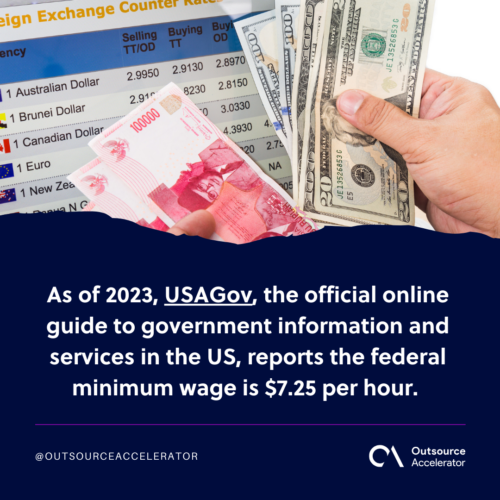
USAGov, the official guide to government information and services, reports the federal minimum wage is $7.25 per hour. There is also a lower base for tipped employees of $2.13 per hour. If tips do not bring the total to $7.25 per hour, the employer must pay the difference.
For many companies, these rates are part of a wider labor cost picture. So it helps to compare them with offshore options using tools like this employee cost calculator, or to weigh the broader question of outsourcing costs and value. For a global view, you may also visit this article.
Minimum wage in the US per state
Take a look at the minimum wage in US states below. These rates reflect the figures in effect in 2026.
Note: States with no minimum wage law require employers subject to the Fair Labor Standards Act to pay the federal minimum of $7.25 per hour.
1. Alabama
Minimum wage: No state minimum wage law (federal $7.25 per hour applies).
The federal rate applies to most employees in Alabama. Some exceptions include tipped workers, student workers, and certain jobs.
2. Alaska
Minimum wage: $14 per hour
The Alaska Department of Labor has approved a voluntary flexible work plan. Under this plan, employers may run an eight-hour day and a 40-hour week with premium pay after eight hours. Overtime pay does not apply to employers with four workers or fewer. The rate is also set to keep rising in the coming years under a voter-approved measure.
3. Arizona
Minimum wage: $15.15 per hour
Arizona raises its minimum wage each year to keep pace with inflation. As a result, the rate climbs steadily rather than in large jumps.
4. Arkansas
Minimum wage: $11 per hour (for those with at least four employees)
Arkansas set its rate through a voter-approved increase. Employers covered by both federal and state law must pay the higher minimum wage.
5. California
Minimum wage: $16.90 per hour
California Labor Code section 510 says any work over eight hours a day qualifies for overtime pay (one and one-half times the regular rate). Work over 12 hours a day qualifies for double-time pay. Some cities set higher local rates, and fast-food workers have a separate $20 rate.
6. Colorado
Minimum wage: $15.16 per hour
In Colorado, the minimum wage and overtime rules apply to these industries:
- Retail and service
- Commercial support service
- Food and beverage
- Health and medical
Some cities, such as Denver, also set their own higher rates.
7. Connecticut
Minimum wage: $16.94 per hour
Connecticut now ties its minimum wage to the federal employment cost index. So the rate adjusts each year based on that measure.
8. Delaware
Minimum wage: $15 per hour
Delaware reached $15 per hour through a phased, multi-year plan. Should the federal minimum ever rise above the state rate, Delaware will adopt the federal figure.
9. Florida
Minimum wage: $15 per hour
Florida reached $15 per hour on September 30, 2026 under a voter-approved amendment. After this final step, the rate will adjust each year for inflation.
10. Georgia
Minimum wage: $5.15 per hour state rate; federal $7.25 applies to covered employers
The state rate of $5.15 applies only to employers not covered by the FLSA. Most workers are covered, so they receive the federal minimum of $7.25 per hour.
11. Hawaii
Minimum wage: $16 per hour
Hawaii has a plan to keep raising its rate in the years ahead. The state law does not cover employment subject to the FLSA when the federal wage is higher than the state’s.
12. Idaho
Minimum wage: $7.25 per hour
Workers under 20 can be paid a training wage of $4.25 per hour for their first 90 days. Employers can also pay full-time students 85% of the state minimum for up to 20 hours a week at certain jobs.
13. Illinois
Minimum wage: $15 per hour (for those with four or more employees, excluding family members)
Illinois reached $15 per hour through a scheduled series of annual increases. Tipped workers receive 60% of the state minimum.
14. Indiana
Minimum wage: $7.25 per hour (for those with two or more employees)
Indiana has not increased its minimum wage since 2008, when it added a $0.60 raise.
15. Iowa
Minimum wage: $7.25 per hour
The Iowa minimum wage is set to match the federal rate if it is ever set below that level.
16. Kansas
Minimum wage: $7.25 per hour
Kansas state law does not cover any employment that is subject to the FLSA.
17. Kentucky
Minimum wage: $7.25 per hour
Kentucky overtime law requires employers to pay staff who work seven days in one week. The required rate is one and one-half times the regular rate. The state also matches the federal minimum if the federal rate exceeds the state rate.
18. Louisiana
Minimum wage: No state minimum wage law (federal $7.25 per hour applies)
Louisiana has no state minimum wage law. So employers covered by the FLSA pay the federal rate of $7.25 per hour.
19. Maine
Minimum wage: $15.10 per hour
Maine adjusts its state minimum wage each year based on a set formula. If the federal rate rises above the state rate, the state rate must match it on the same day.
20. Maryland
Minimum wage: $15 per hour
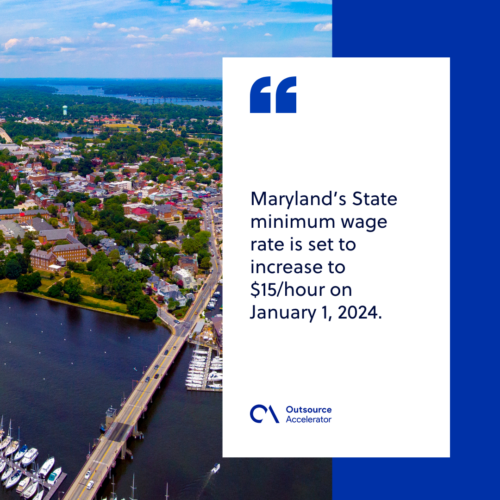
Maryland’s state rate was set to increase to $15/hour, and that rate now applies to all employers regardless of company size.
21. Massachusetts
Minimum wage: $15 per hour
Massachusetts law states that the state minimum wage must never be less than $0.50 above the federal rate.
22. Michigan
Minimum wage: $13.73 per hour (for those with at least two employees)
Michigan’s rate now sits at $13.73 per hour and is set to keep rising under the current schedule. An earlier ballot plan to lift the rate faster was paused before the courts weighed in.
23. Minnesota
Minimum wage: $11.41 per hour
Minnesota now uses a single statewide rate, adjusted each year by a set formula. Minneapolis and St. Paul set their own higher local rates.
24. Mississippi
Minimum wage: No state minimum wage law (federal $7.25 per hour applies)
Mississippi has no state minimum wage law. So covered employers pay the federal rate of $7.25 per hour.
25. Missouri
Minimum wage: $15 per hour
Missouri reached $15 per hour through a voter-approved measure. State law does not cover federal employment, and it exempts retail or service businesses with annual sales below $500,000.
26. Montana
Minimum wage: $10.85 per hour (for businesses with gross annual sales over $110,000); $4 per hour (for businesses with gross annual sales of $110,000 or lower)
If a business has an employee who produces or moves goods between states, that worker must get the higher of the federal and state rate.
27. Nebraska
Minimum wage: $15 per hour (for those with four or more employees)
After passing Initiative 433, Nebraska raised its rate in steps to reach $15 per hour. From here, the rate will adjust each year for inflation.
28. Nevada
Minimum wage: $12 per hour
Nevada set new rules for its minimum wage. As a result, there is now a single rate of $12 per hour for all employees, regardless of health insurance.
29. New Hampshire
Minimum wage: $7.25 per hour
The New Hampshire minimum wage rises to match the federal rate whenever the state rate is set below it.
30. New Jersey
Minimum wage: $15.92 per hour
New Jersey adjusts its minimum wage each year by a set formula. Seasonal workers and small employers (fewer than six staff) follow a lower rate on a separate schedule.
31. New Mexico
Minimum wage: $12 per hour
The New Mexico minimum wage rose steadily under a 2019 state law. Advocates continue to push for further increases.
32. New York
Minimum wage: $16 per hour; $17 per hour (for New York City, Long Island, and Westchester)
New York has hospitality rules that give overtime pay to residential workers. Overtime applies to those who work at least 40 hours a week, down from the previous 44. Premium pay also applies to roles that require 24 hours of consecutive rest when staff work during that period.
33. North Carolina
Minimum wage: $7.25 per hour
North Carolina employers must pay premium rates after a 45-hour week for seasonal amusement or recreation businesses.
34. North Dakota
Minimum wage: $7.25 per hour
North Dakota follows the federal standard. A bill to raise the rate in steps toward $15 per hour did not pass in the state House.
35. Ohio
Minimum wage: $11 per hour (for larger employers); $7.25 per hour (for smaller employers)
Ohio adjusts its rate each year for inflation. Smaller employers below the annual gross-receipts threshold may pay the federal rate.
36. Oklahoma
Minimum wage: $7.25 per hour (for employers with ten or more employees at one location or annual gross sales over $100,000); $2 per hour (for all other employers)
Oklahoma’s state law does not set current dollar minimums. So the state applies the federal minimum wage.
37. Oregon
Minimum wage: $15.05 per hour (standard state rate); $16.30 per hour (Portland metro area); $14.05 per hour (non-urban counties)
Oregon adjusts its rates each July by a set formula. Employers must also pay premium rates after ten hours a day for staff in these settings:
- Non-farm canneries
- Driers
- Packing plants
- Mills
- Factories
- Other manufacturing, excluding sawmills, planing mills, shingle mills, and logging camps
38. Pennsylvania
Minimum wage: $7.25 per hour
Pennsylvania still follows the federal rate. Lawmakers have pushed a measure to raise the state minimum wage to $15 per hour.
39. Rhode Island
Minimum wage: $16 per hour
Rhode Island has separate laws that require time-and-a-half premium pay for work on Sundays and holidays. This applies in retail and certain other businesses.
40. South Carolina
Minimum wage: No state minimum wage law (federal $7.25 per hour applies)
South Carolina has no state minimum wage law. So covered employers pay the federal rate of $7.25 per hour.
41. South Dakota
Minimum wage: $11.85 per hour
South Dakota adjusts its rate each year for inflation. It also sets a separate, lower minimum wage for workers who receive tips.
42. Tennessee
Minimum wage: No state minimum wage law (federal $7.25 per hour applies)
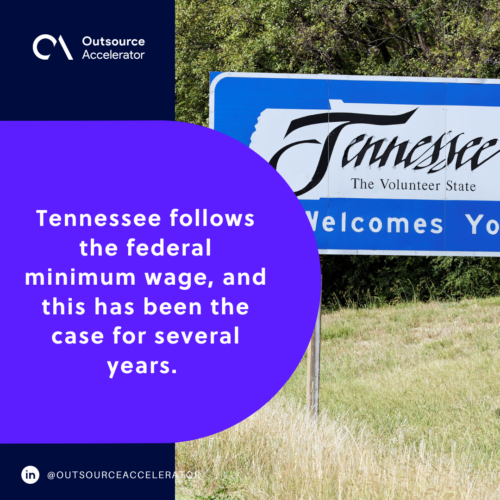
Tennessee follows the federal minimum wage, and this has been the case for several years.
43. Texas
Minimum wage: $7.25 per hour
Texas applies the federal rate, since it does not set current dollar minimums. Any worker under federal employment is exempt from state law coverage.
44. Utah
Minimum wage: $7.25 per hour
Utah applies the federal rate, since it does not set current dollar minimums. Any worker under federal employment is exempt from state law coverage.
45. Vermont
Minimum wage: $14.42 per hour (for those with at least two employees)
Should the federal minimum wage rise above Vermont’s rate, the state rate automatically climbs to match it.
46. Virginia
Minimum wage: $12.77 per hour
Virginia legislation raised the minimum wage in steps starting in 2021. The rate now sits at $12.77 per hour, with further increases tied to future action.
47. Washington
Minimum wage: $17.13 per hour
In Washington, premium pay can be swapped for time off in some cases. The state also adjusts its minimum wage each year by a set formula. Some cities, such as Seattle, set higher local rates.
48. West Virginia
Minimum wage: $8.75 per hour (for those with at least six employees at one location)
West Virginia has not increased its minimum wage since 2016, when it added a $0.75 raise.
49. Wisconsin
Minimum wage: $7.25 per hour
Wisconsin has matched the federal standard since 2009. There are ongoing pushes to increase it to $15/hour to reflect inflation and a rising cost of living.
50. Wyoming
Minimum wage: $5.15 per hour state rate; federal $7.25 applies to covered employers
Employers in Wyoming covered by the FLSA must pay staff the federal minimum wage of $7.25 per hour.
Minimum wage and the case for offshoring
Rising state minimum wages are one reason many firms look offshore. When local labor costs climb, outsourcing can keep roles affordable without cutting quality.
Before you compare, it helps to look at the full picture of pay abroad. For example, this guide to the cost of living in top offshoring destinations shows how wages line up with daily costs. It is also worth asking whether offshore outsourcing is cheap labor or something more. For context on one leading hub, see this overview of Filipino workers’ salaries.
Frequently asked questions about minimum wage in US states
What is the federal minimum wage in 2026?
The federal minimum wage is $7.25 per hour. It has stayed at this level since 2009, so any higher pay comes from state or local law.
Which state has the highest minimum wage?
Among the 50 states, Washington has the highest rate at $17.13 per hour. Some cities, such as Seattle, set local rates that are higher still.
Which states follow the federal minimum wage?
About 20 states use the $7.25 federal rate, including Texas, Pennsylvania, and Wisconsin. A few, such as Alabama and Louisiana, have no state minimum wage law at all.
Do tipped workers earn a different minimum wage?
Yes. The federal tipped base is $2.13 per hour. If tips do not bring a worker up to the full minimum, the employer must pay the difference.
Why does the minimum wage vary by state?
Each state weighs its own cost of living, economy, and politics. So some index their rate to inflation each year, while others stay at the federal floor.






 Independent






