
Medical scribing: Enhancing efficiency and patient care


What is medical scribing and why does it matter?
Medical scribing is the real-time documentation of a patient visit by a trained scribe, which frees doctors to focus fully on patient care.
Medical scribing is a core process that helps providers give the best patient experience. In fact, documentation is key in healthcare, so scribes play a vital role.
Here is why medical scribing matters:
- More focus. Doctors spend less time on notes and more on patients.
- Better records. Scribes keep charts full and accurate.
- Faster visits. Practices can see more patients each day.
Medical scribing may sound simple. But it takes real skill and care. Read on to learn how the process works and why it lifts both efficiency and patient care.
Understanding medical scribing
Medical scribing is the process where a trained pro, called a medical scribe, records a patient visit in real time. As a result, providers can focus fully on care.
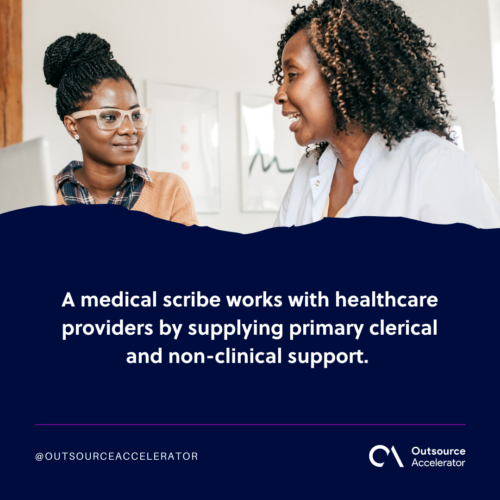
In addition, a medical scribe gives clerical and non-clinical support to providers. Scribes record patient visits by shadowing the provider or noting from a patient’s electronic medical record (EMR) or electronic health record (EHR). They may be certified medical assistants, medical students, or documentation pros. To learn more, see this guide to electronic health records.
Responsibilities of medical scribes
First, a scribe’s main job is to record the visit between a provider and a patient. So the most important things they note are a patient’s:
- Medical history
- Diagnoses
- Examination findings
- Treatment plans
- Medications prescribed
In addition, medical scribing covers admin tasks. For example, scribes may schedule appointments and manage records.
Qualifications and training required for medical scribes
There are a few requirements for a medical scribing role:
Education
First, the minimum requirement is a high school diploma or its equal. Still, many employers prefer a college course or a related certification.
For this reason, sourcing from a professional firm like Connext will ensure that you receive a fully-capable offshore worker.
Training
Next, scribes can take online or on-site programs. These programs teach basic medical knowledge and terms. As a result, candidates can do medical scribing well.
Certification
Certification is not required to be a scribe. But it gives an edge when you apply for a role. Here are some certifications one can earn:
- Certified Medical Scribe Associate (CMSA)
- Certified Medical Scribe Specialist (CMSS)
- Medical Scribe Certification and Aptitude Test (MSCAT)
- Certified Medical Scribe Professional (CMSP)
- Apprentice Medical Scribe Professional (AMSP)
- Healthcare Documentation Integrity Specialist (HDIS)
- Health Information Technology Professional (HITP)
- Electronic Health Records Professional (EHRP)
Skills
Medical scribing calls for a few key skills. To succeed in the role, a scribe needs:
- Computer skills
- Organizational skills
- Attention to detail
- Exceptional bedside manner
- Medical knowledge
- Superb interpersonal skills
- Physical stamina
3 types of medical scribes
There are a few types of medical scribes, including:
Traditional medical scribes
First, traditional scribes work on-site and in person with providers.
Virtual medical scribes
Virtual medical scribes do the work remotely. In most cases, they handle EMR and EHR systems. A virtual medical receptionist can support the same team.
Emergency department medical scribes
Finally, these scribes work in fast-paced emergency settings.
The medical scribing process
The medical scribing process usually follows these steps:
Introduction
First, the scribe joins the provider to meet the patient. Then the provider introduces the scribe and explains their role.
Documentation
Next, the scribe records the visit using shorthand and EMR software. Meanwhile, they note anything of value that the provider says to the patient.
In addition, the scribe may help with admin tasks. For example, they can schedule follow-up visits.
Review
Finally, after the visit, the provider reviews and approves the scribe’s notes.
Coding and billing can also be part of the process. This makes sure the visit is documented for payment. A medical billing virtual assistant can take on this step.
How medical scribing boosts efficiency and patient care
High-quality care is vital in healthcare, and medical scribing lifts those odds. Here are the main ways it helps both providers and patients:
Increases patient flow
Outsourcing the scribing task is a game-changer for busy practices. It takes on admin work that used to eat up time. As a result, providers can focus on care. Many clinics fold this into wider healthcare outsourcing plans.
Improves revenue and patient access
When patient flow rises, a practice can earn more. This is because scribing helps it see more patients. As a result, patients get better access to care, with shorter waits and fewer backlogs.
Better documentation
Medical scribing sharpens the documentation process. As a result, care improves. In addition, scribes can keep notes full and accurate. So they ease the load on providers.
Enhanced patient satisfaction
Meanwhile, scribing cuts the admin distraction for providers. As a result, patients feel more heard and cared for during each visit.
Medical scribing promotes an excellent patient experience
Overall, medical scribing aims to give the best patient experience. As a result, it hands providers more time to focus on care.
So it is a key part of the healthcare process. Anyone in the medical field should think about using it to improve services. For firms that want to scale, top medical scribe companies offer trained, ready teams.
Frequently asked questions about medical scribing
What does a medical scribe do?
A medical scribe records a patient visit in real time. They note history, diagnoses, findings, and treatment plans. As a result, the provider can focus on the patient.
Do you need a certification to be a medical scribe?
No. Certification is not required. But it gives a strong edge when you apply. So many scribes earn one to stand out.
What is the difference between a scribe and a virtual scribe?
A traditional scribe works on-site with the provider. A virtual scribe does the same work remotely through EMR and EHR systems. Both keep the record full and accurate.
How does medical scribing improve patient care?
It frees providers from note-taking. So they can give patients their full attention. In addition, better records support safer, faster care.
Key takeaways
- Medical scribing is real-time documentation of a patient visit by a trained scribe.
- Scribes can work on-site, virtually, or in emergency settings.
- Good scribing lifts patient flow, revenue, records, and satisfaction.
- Outsourcing scribing lets providers focus on what matters most: patient care.






 Independent





