
5 Customer support training ideas to empower your offshored team


How do you build effective customer support training for an offshored team?
Effective customer support training gives your offshored team clear communication skills, deep product knowledge, and real practice, so they can solve customer issues with confidence.
- Good training lifts quality, speed, and customer satisfaction.
- It covers products, communication, problem-solving, and culture.
- A strong BPO partner can run much of this training for you.
Offshoring customer support can bring big benefits. Still, it is not without its challenges. For example, you may face language barriers or gaps in service quality. So businesses must fix these hurdles to keep support running well.
However, the right tools and guidance can make a real difference. Top BPOs like SixEleven can give you the expertise and support you need. In addition, strong customer support training helps your offshored staff reach their full potential.
In this article, we share five customer support training ideas for your offshored team. Use them to handle customer concerns, build stronger relationships, and boost satisfaction.
How effective training equips offshored customer support teams
Good training prepares offshored teams to handle many challenges and deliver top service. As a result, trained teams feel more confident. They also represent your brand with real professionalism. To go further, review these best practices for offshore teams.
Here is how it works:
- Improves communication skills. Training helps offshored teams speak clearly and concisely. So it is easier to connect with customers, even across language barriers or time zones.
- Builds product knowledge. Good training gives deep knowledge of your products and services. As a result, remote agents can help customers faster.
- Enhances problem-solving. Training builds critical thinking and troubleshooting skills. In turn, teams can fix customer issues quickly and well.
- Boosts customer satisfaction. With the right tools and knowledge, trained teams give steady, high-quality support. Because of this, customers stay loyal.
- Increases team confidence. Well-trained teams handle hard situations with ease. So errors and escalations drop.

5 Customer support training ideas for your remote team
Training your remote team is key to steady, high-quality service. In short, it keeps your standards high no matter where your agents work. Here are five customer support training ideas for your remote team.
1. Product knowledge workshops
First, a deep grasp of your products is key for any support team. So run regular workshops on features, benefits, and troubleshooting steps. As a result, your team can help customers with real confidence.
2. Communication skills training
In addition, clear communication matters when you talk with customers. For example, train your team on tone, clarity, active listening, and empathy. In turn, they can get their message across by text or phone.
In addition, teach them how to handle hard conversations. This way, your team stays calm and professional under pressure. These are some of the core customer service skills every agent should build.
3. Role-playing scenarios
Role-play lets your team act out real customer interactions. As a result, they get hands-on practice with tricky situations. This builds problem-solving skills, lifts confidence, and prepares them for tough calls. It also helps them tackle common customer service challenges before they happen.
4. Time management and multi-tasking
Meanwhile, remote teams often juggle many tasks at once. So train your staff on time management and how to rank customer issues. As a result, they stay organized and handle concerns well, even in busy periods.
Teach them to balance speed and quality too. This way, support stays fast without any drop in standards. Regular call center coaching techniques can reinforce these habits over time.
5. Cultural sensitivity and adaptability
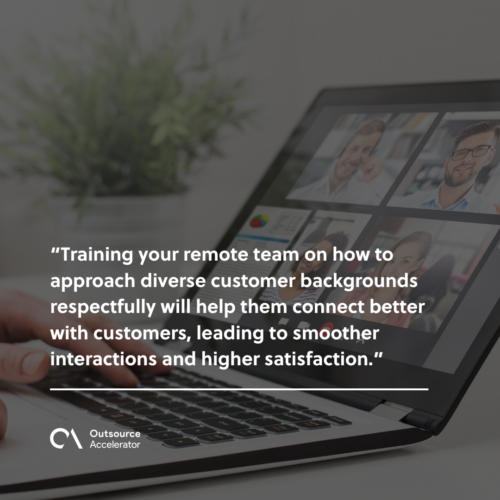
Your team is offshored, so cultural nuance matters. Train your remote staff to approach diverse customers with respect. As a result, they connect better, and interactions run more smoothly. In turn, this helps drive customer satisfaction across every market you serve.
Work with top-tier customer support agents through SixEleven
SixEleven gives growing firms the chance to work with skilled, trained, and experienced customer support agents. Each one is committed to delivering great service.
Its expert teams handle all customer inquiries with professionalism and care. As a result, your clients enjoy a smooth, seamless experience.
Do you want to raise your customer service? Then you can rely on SixEleven’s expertise and offshore solutions. Get in touch with SixEleven to get started and enhance your overall customer experience!
Frequently asked questions about customer support training
How long does it take to train an offshored customer support team?
It depends on your products and the role. Basic onboarding often takes two to four weeks. However, product and soft-skills training should continue month to month. In short, the best teams treat training as ongoing, not a one-time event.
What skills matter most for offshored support agents?
First, clear communication tops the list. Beyond that, product knowledge, problem-solving, and empathy matter a lot. Cultural awareness helps too, since your agents serve customers from many markets.
How do you measure if customer support training works?
Track a few simple metrics. For example, watch customer satisfaction scores, first-contact resolution, and average handle time. If those numbers improve, your training is working. If they stall, adjust the program.
Can a BPO handle customer support training for me?
Yes. In fact, a strong BPO partner runs much of the training in-house. For instance, SixEleven trains and coaches its agents before they join your account. As a result, you get job-ready staff without building a training team yourself.
How often should you refresh support training?
Refresh it on a regular cycle. Many teams run monthly workshops and quick updates after each product change. This way, your agents stay current and keep service quality high.






 Independent






