
How to successfully onboard an offshore team


This article is a submission from The Remote Group, a full-service BPO providing customized offshore staffing solutions across various industries and areas of expertise. The Remote Group builds offshore teams that integrate seamlessly into client operations while remaining aligned in standards, accountability, and performance.
How do you successfully onboard an offshore team?
You onboard an offshore team by giving it a clear role, a staged training plan, a real link to your culture, and set communication channels from day one.
- Clarity, not talent, is what most offshore teams lack early on, so spell out roles and goals before day one.
- Structured onboarding lifts productivity, keeps people longer, and prevents the slow drift that follows a weak start.
- Treat onboarding as a program with steps and owners, not a single orientation call.
Why limit your talent search to one city when the world is full of skilled people? In fact, hiring an offshore team is one of the best ways to grow your business. You get access to strong professionals, you cut costs, and you add capacity faster than local hiring allows.
But here is the thing. Hiring is only half the job. Still, how you onboard your offshore team decides whether that money pays off or quietly drains your time and budget.
Many businesses treat offshore onboarding like hiring a local employee. For example, they send a contract, share a few files, book an orientation call, and assume things will click. They rarely do.
The most common problems with offshore teams are not about skill. They are about clarity, and clarity is something only you can give. When offshore staff lack a clear picture of their role, your process, or how your team works, things break down fast.
As a result, miscommunication becomes a daily headache. As a result, expectations get misread. Meanwhile, productivity takes weeks longer than it should. And when people feel cut off in those early weeks, they leave, often before they hit their stride.
The good news? All of this is avoidable with the right onboarding process. This guide walks you through a clear offshore team onboarding process: what to do, when to do it, and why it matters more than most businesses think.
Why onboarding matters more for offshore teams
Think about your first week at a job. If no one explained what was expected, where to get help, or how things worked, how long before you doubted your choice?
For offshore staff, that feeling is even stronger. They work in a different time zone, often in a different culture. Also, they cannot walk to a colleague’s desk to fill the gaps. So what they know on day one is mostly what you give them.
For offshore teams, and the many based in the Philippines, a structured onboarding process shapes three key areas. Getting these right early is one of the clearest best practices for managing offshore teams.
Productivity
When offshore staff know their role, their tools, and what success looks like, they stop second-guessing. As a result, they spend more time delivering.
For example, companies that run standard onboarding programs report up to 20% faster integration into workflows. That lift feeds straight into efficiency and client satisfaction.
Communication
Communication is harder in offshore setups because of time zones and cultural nuance. So the early rules matter a lot.
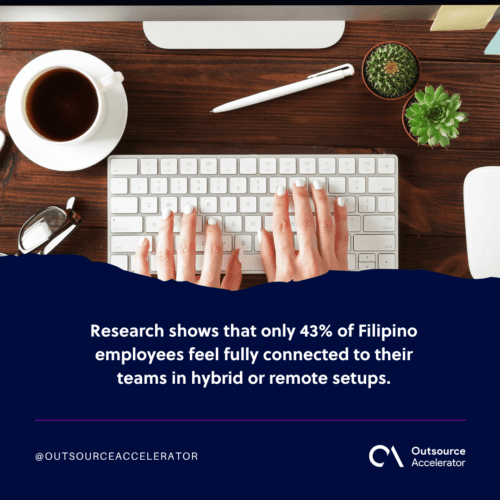
Research shows only 43% of Filipino employees feel fully connected to their teams in hybrid or remote setups. This gap often traces back to poor onboarding. The communication norms and workflow rules were never set from the start.
Without a clear process, people are left to work it out alone. As a result, small confusions pile up over time.
Retention
People do not leave jobs. They leave situations where they feel unclear, unsupported, or undervalued. Because of this, the first weeks carry real weight.
Attrition in Philippine BPOs can reach 30 to 40% a year. Much of that is driven by staff feeling lost in their roles early on. Many of these common retention problems start on day one.
In addition, businesses that invest in structured onboarding report up to 50% better retention. That is a real saving once you count recruiting and retraining costs.
The step-by-step offshore team onboarding process
A good onboarding process does not happen by accident. It is designed. The firms that get the most from offshore teams treat onboarding as a program, not a one-time call. Strong onboarding practices for new hires apply here too.
Here is what that looks like in practice.
Step 1: Define roles and set clear expectations
Before your offshore staff logs in on day one, be clear about what you expect. In fact, vague job descriptions lead to vague output.
First, prepare these:
- A detailed job description that lists daily tasks, not just broad duties
- Key performance indicators (KPIs) or clear goals for the first 30, 60, and 90 days
- Reporting lines: who they report to, and who reports to them if that applies
- Working hours and overlap with your local team
When you hire offshore members through a staffing partner in the Philippines, the provider often helps align the role during pre-boarding. So take full advantage of that help.
Step 2: Build a structured training plan
You cannot train an offshore employee the way you would walk a local hire around the office. Instead, training needs to be written down, repeatable, and easy to reach remotely.
A good training plan includes:
- Standard operating procedures (SOPs) for key tasks, written clearly, with screenshots or short recordings where they help
- A day-by-day schedule for the first two weeks
- Access to tools and systems, with logins ready before they start
- A point of contact, such as a buddy or team lead, who can answer questions in real time
Avoid the common mistake of dumping everything at once. Instead, stagger the training so people can absorb and apply it bit by bit.
Step 3: Introduce them to your company culture
Still, this step is often skipped, and it should not be. Offshore staff who grasp your values, mission, and way of working feel more engaged. As a result, they align better with your goals.
However, you do not need a formal culture seminar. You just need to share, on purpose:
- What your business does and why it matters
- How your team works: are you fast-paced, collaborative, or detail-focused?
- Your communication norms: is it fine to ask questions freely, and how do you like feedback?
- Your company values or principles
For example, a short welcome video from a company leader, or a personal note from the direct manager, goes a long way.
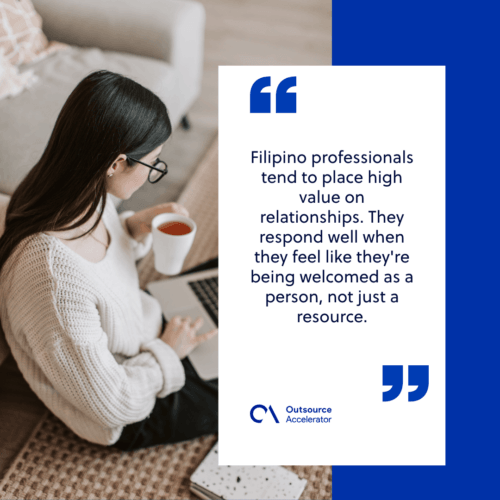
Filipino professionals tend to value relationships highly. So they respond well when they feel welcomed as a person, not just a resource. Over time, this helps you integrate remote staff into the wider team.
Step 4: Set up the right communication channels
Poor communication is the number one reason offshore teams underperform. So fix this early.
From day one, your team needs to know:
- Which tools you use and what each one is for
- Expected response times, especially across a time zone gap
- What counts as urgent and what can wait
- A regular check-in schedule, such as weekly one-on-ones or team meetings, to keep connection and catch issues early
Do not assume your offshore team knows how you like to communicate. Instead, write it down. Treat it as part of onboarding, not an afterthought. Good offshore team management keeps these habits alive well past the first month.
References:
6IJEBM-JUL20233-TheTransformation.pdf
https://www.aihr.com/blog/employee-onboarding-statistics/
https://www.sowflow.io/blog-post/master-the-30-60-90-onboarding-plan-for-effective-team-integration
https://www.hr-consulting-group.com/hr-news/building-a-30-60-90-day-plan
Frequently asked questions about offshore team onboarding
How long should onboarding an offshore team take?
Plan for a staged 30, 60, and 90 day path rather than a single week. The first two weeks cover tools and core tasks. The next weeks build depth and independence. A clear 90 day plan gives you check-in points to fix gaps early.
Who should own the onboarding process?
A named manager or team lead should own it, with support from your staffing partner. One clear owner prevents the gaps that appear when onboarding is split across many hands. The owner also becomes the first point of contact for early questions.
What tools help most when onboarding remote offshore staff?
A shared SOP library, a chat tool, a video tool, and a simple task tracker cover the basics. Screen recordings also help new hires learn steps at their own pace. The goal is quick access, not a long tool list.
How do you keep offshore staff engaged after onboarding?
Keep regular one-on-ones, give clear feedback, and recognize good work in public. Because many Filipino professionals value relationships, personal check-ins matter. Steady contact keeps people connected long after week one.
Should a staffing partner handle onboarding for you?
A good partner handles pre-boarding, logistics, and local HR support. Still, you should own role clarity, culture, and daily direction. The best results come when both sides share the work with clear handoffs.






 Independent





