
Global compliance in outsourcing: Navigating regulations

What is global compliance in outsourcing?
Global compliance in outsourcing means meeting the labor, data, tax, and product rules of every country you and your outsourcing partner operate in, so your work stays lawful, ethical, and low-risk.
- It covers labor, data privacy, financial, and product standards across borders.
- It protects your staff, customers, and brand while cutting legal risk.
- Clear joint policies and good records make compliance far easier.
Have you ever felt you are tiptoeing through a regulatory minefield in outsourcing? You are not alone. Many agree that global outsourcing brings a lot of compliance challenges. So this article gives you a clear roadmap for global compliance in outsourcing.
We cover the major regulatory frameworks that help you assess and manage risk. In addition, we include country-specific rules and real examples. As a result, you can build more proactive measures.
By the end, you will have more than knowledge. You will have a strategic toolkit. This helps your outsourcing endeavors meet standards and give your business an edge. Let’s begin.
Understanding global compliance, best practices, & implications
In short, global compliance refers to the international standards, rules, and guidelines businesses and outsourcing partners must follow. It lets them operate lawfully and ethically in every country they serve. In addition, it keeps staff, customers, clients, and stakeholders safe.
Global compliance covers a wide range of areas. So we will guide you through each layer.
I. Labor & employment regulations
One perk of an outsourcing partner is access to the global talent pool. If you lack certain skills in-house, they can provide them. In return, you must follow all local and international labor laws. This ensures companies respect employees’ rights and treat them fairly and ethically.
Coca-Cola sets a good example. Its workplace rights guide covers the labor laws and standards it follows to protect employee wellbeing.
The company also follows safety and health laws. As a result, it can offer a secure, healthy, and productive workplace.
Before you sign a partnership, check if the outsourcing firm follows labor laws and ethical sourcing. For example, do they give reasonable hours, sick leave, and fair wages? Reviewing their labor policies and handbooks is one way to verify. You can also request compliance certifications, such as:
- Fair Trade certification
- Carbon Trust Standard
- Fair Labor Association (FLA) Accreditation
- SA8000 (Social Accountability International Standard)
- ISO 45001 (Occupational Health and Safety Management System)
Best practices: Create joint policies
Outsourcing partners represent your brand worldwide. So your business must align with them in every way. You can create joint policies to ensure they share your commitment to high standards.
Joint policies spell out the legal and ethical standards both sides must meet. For example, they may cover security, data privacy, and industry norms. You can also build business assessments to set clear expectations. These cover deliverables, quality, performance, and job matching. Sound technical due diligence helps here too.
Use centralized document repositories to house all joint policies. For example, you can use cloud-based document management systems (DMS) or compliance systems. You can also build a knowledge base on your shared platform. As a result, files are easier to find and share. Here are 2 good options.
OnlyOffice
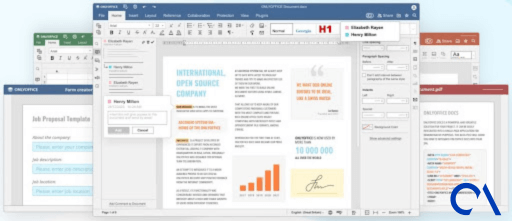
OnlyOffice is a strong DMS choice. So you can work with your outsourcing partners on many documents. It provides 5 editors: a document editor, a spreadsheet editor, a presentation editor to make presentations, fillable forms, and a PDF editor. All are secure. In addition, the software meets international security standards and uses 3 levels of encryption.
Tettra
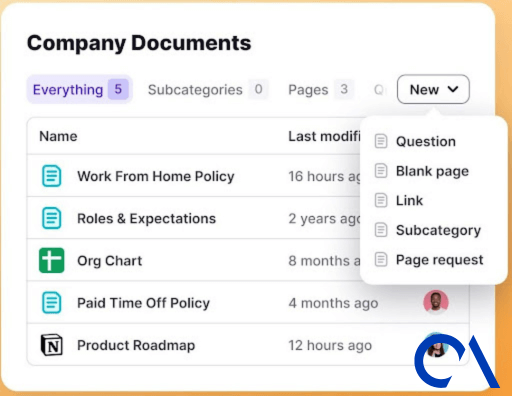
Tettra is your go-to option for a knowledge base. You can build one through its simple editor or a Google Docs file. It also uses AI to answer staff questions through the app or Slack.
Do these options not fit? Then you can always look at OnlyOffice and Tettra alternatives. So you can find a platform that matches your team’s size and goals. When you explore alternatives, weigh the following too:
- Search functionality
- Collaboration features
- Customization options
- Interface’s user-friendliness
- Access controls and security
II. Data protection & privacy laws
Each country has its own Data Protection Authorities (DPAs). Their main job is to supervise how businesses collect, process, store, use, and transfer personal data. They can fine companies that fail to meet the standards. Strong data security in outsourcing is central to this.
Most DPAs require a privacy policy on your website or app. The exact content of the privacy policy depends on your business and your legal markets. You can start with a general privacy policy if you meet any of these:
- Data collection has minimal impact on users
- Collects basic information (ex., name and email)
- No interactive features are available on the website
- Doesn’t use third-party services that collect additional user data
- The website does not require account creation or registration for users
Sokisahtel OÜ’s Sockdrawer, a modern design hosiery and socks seller, is a great example. It uses only a general privacy policy because it asks for basic details at signup. It also uses those details for communication, risk prevention, and invoices. Finally, it uses no third-party services, since it only collects data through its website.
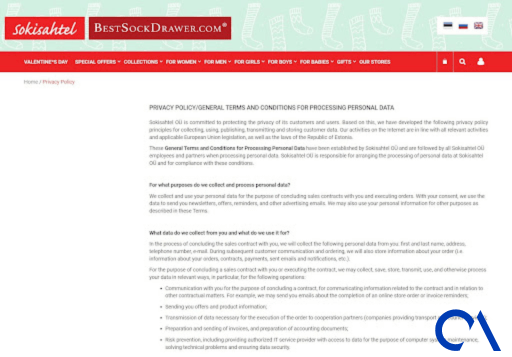
Sokisahtel OÜ uses a general privacy policy. Still, it answers the most common consumer concerns, such as:
- How long will we keep your data?
- When will we ask you for consent?
- Who else has access to your data?
- In what other ways can we use your data?
However, data privacy laws like GDPR and CPRA require a more detailed privacy policy if you run a website, desktop app, or mobile app. For example, eCommerce must add this kind of policy on all platforms. Shop Solar, a complete solar and storage solutions provider, is a great example.
Beyond the basics, Shop Solar also explains how it uses data in marketing. As a result, it must follow the California Online Privacy Protection Act (CalOPPA) and give users an opt-out. So it provides an opt-out notice and a link to make the request.
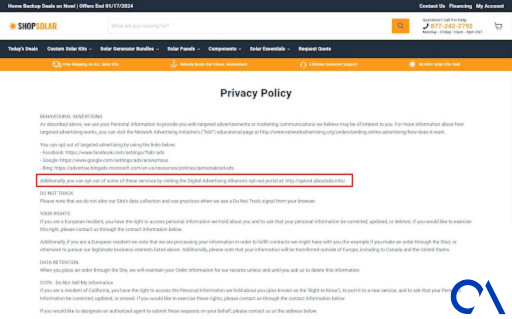
Shop Solar also follows the General Data Protection Regulation (GDPR), since it sells within the European Union. So its notice focuses on data sharing outside the EU, Canada, and the U.S.
Best practice: Always add children’s online privacy protection notice
Everyone can access the internet now, including minors. So privacy laws like GDPR and COPPA require business owners to inform parents and guardians about their practices. You can do this with a direct notice on the homepage or wherever you collect data.
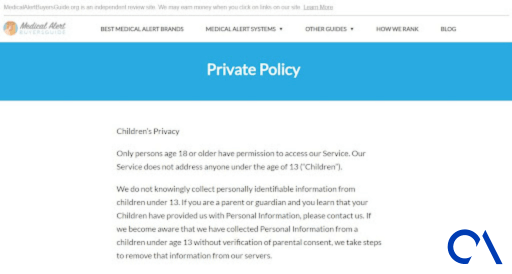
There is no set format for the notice. MedicalAlertBuyersGuide.org, for example, explains that its service is for people age 18 and older. It focuses on the elderly, since its service centers on researching and comparing personal emergency response systems. It also shares travel and lifestyle tips. Still, those are meant for older adults and AARP members.
The site asks parents and guardians to reach out if their children share data by mistake. In that case, it removes the data from its servers right away.
III. International financial & tax compliance
Making smart financial decisions is key to supply chain work. First, learn the financial and tax systems of your home country and your outsourcing destination. This helps you find opportunities and cut compliance risks. Here are the elements to know:
- Processes
- Filing due dates
- Withholding tax considerations (coordinate with tax authorities)
- Tax compliance requirements (i.e., corporate income tax, value-added tax)
- Forms and documents (i.e., financial statements, transfer pricing documentation)
We recommend you coordinate with your outsourcing partners. So you can agree on shared policies and set up a solid planning process. Financial and tax compliance is not just a legal duty. It is also an excellent strategy to manage risk and use available incentives, credits, and deductions.
These can have a real impact on your bottom line. However, you should understand the credits and incentives in each jurisdiction. You should also keep up with the latest tax law changes.
Skip this, and you could face the same fate as Apple Inc. (Apple State Aid Case). The company came under scrutiny after claims it received illegal tax breaks in Ireland. The case swung back and forth for years. In the end, Apple faced a bill of more than 13 billion euros in back taxes.
Best practice: Do proper documentation
Tax filings involve many records, transactions, and forms. So businesses should keep accurate and complete documentation. As a result, you will not miss anything important. Good records also help with:
- Audit trails
- Dispute resolution
- Serve as evidence in legal proceedings
- Continuous improvement (performance metrics and feedback loops)
Records also show if the outsourcing setup matches your home country’s standards. So they give you the insight to manage global compliance. As a result, each side can quickly spot fraud with this transparency.
IV. Service & product standards
Service and product standards are guidelines and criteria that guarantee reliability in delivery, performance, and quality. For example, when services and products meet these standards, they build positive experiences for customers.
They also help owners set a baseline. So they can quickly see what works and what needs improvement.
The International Organization for Standardization (ISO) is the most common body here. It assures consumers that products and services are safe, reliable, and high quality. Its standards are grouped by purpose or industry.
- ISO 13485: Medical devices industry
- ISO 37001: Prevent, detect, and address bribery
- ISO 50001: Development of an energy management system (EnMS)
- Foreign Corrupt Practices Act: Compliance with anti-corruption laws
- ISO/IEC 17025: Testing, sampling, or calibration of all types of laboratories
Some products or services can cause injury or death. So the Consumer Product Safety Commission (CPSC) protects the public from these risks. It also covers several statutes to strengthen consumer protection.
a. Consumer product safety ACT (CPSA)
Authorize the agency (CPSC) to ban products that may cause harm and to pursue recalls.
b. Refrigerator safety act (RSA)
Requires manufacturers to install a door mechanism on refrigerators. So the door can open from the inside.
c. Labeling of hazardous art materials act (LHAMA)
Mandates a warning label on all art materials that can cause chronic health hazards.
Best practices: Evaluate suppliers & vendors using product & service standards
Owners make product and service standards a key test when picking suppliers and vendors. As a result, they choose partners who uphold the same high quality and safety.
Clear communication also smooths these relationships. So owners can share expectations and quality needs with ease. They can use it to give performance feedback too.
Some suppliers share their compliance laws through communication channels. Others, like Vivion, use their product pages instead.
Vivion is a reputable wholesale supplier of quality ingredients. It combines all its compliance documents into one file. In this way, it shows a commitment to ethical business. One example is its Calcium Carbonate product page.
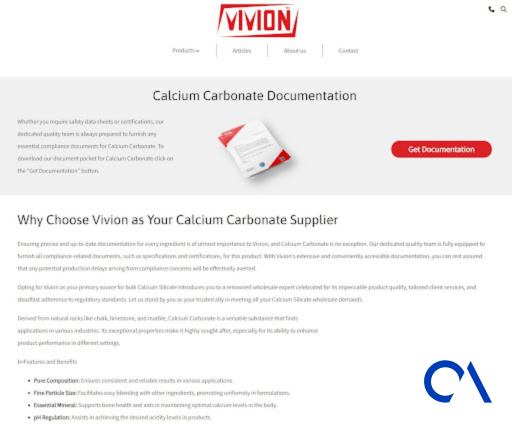
Below the product specs, you will find the document ready to download. Just click the “Get Documentation” button and add your name and email. Then they send it to you. Some suppliers also add compliance details as fine print on order forms.
You can do this too. For example, create custom order forms and add your compliance details as fine print. Add the agency’s logo to keep it simple and easy to read.
Outsourcing & compliance trends to watch in 2024
Stay current with industry trends so your outsourcing meets the latest rules. So we gathered a few highlights below. As a result, you can redesign your global outsourcing plans. Many of these trends also shape the wider benefits of outsourcing.
1. It outsourcing market
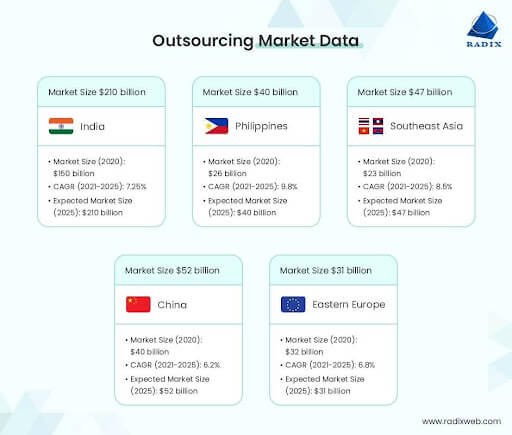
Information Technology (IT) remains the top market to outsource. The reason is the fast growth of AI, robotic process automation (RPA), and cloud tech. Today, most corporate platforms and business intelligence (BI) tools use several technologies at once.
Take a metrics intelligence platform, for example. Data is now the most valuable business asset for smart decisions. So companies find great value in this kind of tool. A metrics intelligence platform captures, analyzes, and turns data into clear insights.
A. Encryption, access control, etc.
Security technologies to protect the data.
B. Big data frameworks
Handle the processing and analysis of large datasets.
C. Data warehouses or cloud-based storage solutions
Store large volumes of structured and unstructured data.
D. Extract, Transform, Load (ETL) tools
Integrate data from many sources and turn it into a standard format.
Regulations for AI use
AI use has grown fast, so laws are still catching up. The EU reached a provisional deal on the The AI Act proposal. It has since been adopted and now takes effect in phases.
Each country’s law is different. So check your home country and outsourcing destination to learn their AI rules. Here are the key elements to look for in the obligations:
- Security
- Fairness
- Accuracy
- Accountability
- Transparency
2. Dropshipping market
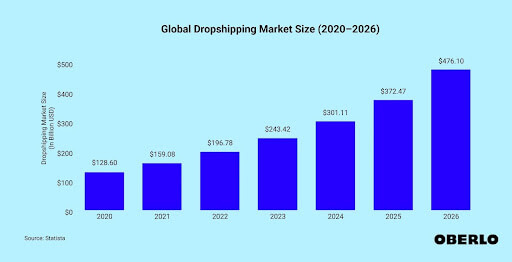
The dropshipping market keeps growing. In fact, it is forecast to reach up to $301.11 billion in 2024. So it has become one of the most popular business models. Still, weigh a few key factors before you adopt it.
Conducting thorough market research is the first step. Here, you can find profitable niches with strong demand and manageable competition. Once you pick one, you can start your search for suppliers.
Look for dropshipping suppliers with a track record of consistent quality, timely shipping, and worldwide service. They should also prove they follow trading laws. Finally, pick dropshipping suppliers that work with many Ecommerce platforms software for easy integration.
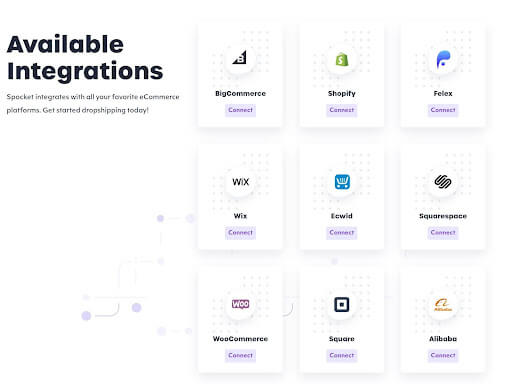
Remember to watch market trends too. So you can update your offers to match customer preferences. Also invest in a user-friendly eCommerce platform. Make sure your site is easy to navigate, with clear descriptions and high-quality images.
Regulations for dropshipping
Like most models, dropshipping businesses should get a business license. This makes it easier to file taxes and prove you are legitimate. You should also follow the law of each country you sell to. For example, if you dropship in New Zealand, you must follow its trading law, which includes:
- Privacy
- Fair trading
- Consumer guarantees
In the U.S., you must follow copyright, email marketing software (CAN-SPAM Act), and licensing laws. In addition, more rules may apply based on your state.
3. Combating anti-money laundering & counter-terrorism financing
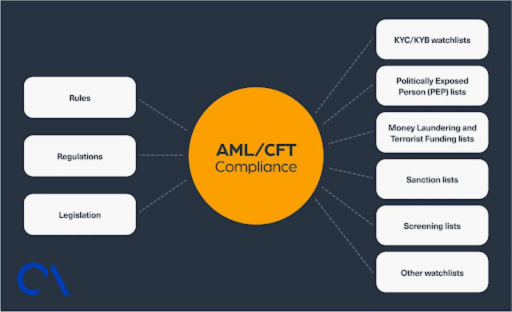
Like most businesses, outsourcing companies can be exposed to money-laundering and terrorism-financing risks. So adopt proactive measures and weigh the following. Partners with strong outsourced cybersecurity services add another layer of protection.
i. Security risk
Outsourcing partners should prioritize data security and confidentiality.
ii. Third-party risk
If partners use third-party providers, verify their money-laundering and terrorism-financing controls.
iii. Continuous employee training
All staff in these processes should get the right compliance training courses and certifications.
iv. Incident response plan
Create a clear plan that describes the impact of incidents, reports to authorities, and shows a commitment to fixing issues.
v. Contractual agreements
All written agreements should spell out the duties of both sides. For example, this includes the scope of services, reporting needs, and adherence to standards.
Conclusion
As your business expands across borders, learn and follow the rules in each country. So you can avoid problems and keep operations smooth. Of course, you should also do due diligence at home. If you plan to offshore, our guide to outsourcing to the Philippines is a useful start.
When you follow home-country laws, check for local laws that reach across borders. Extraterritorial laws uphold specific ethical standards. They apply even in places with different legal norms. Still, they can also raise jurisdictional issues. So verify any conflicts with international laws to stay safe.
Are you looking for a reliable outsourcing platform to sharpen your strategy? Let Outsource Accelerator assist you. We help you streamline operations, ensure compliance, and boost efficiency.
Global compliance in outsourcing FAQ
What does global compliance in outsourcing mean?
It means meeting the laws and standards of every country you and your partner operate in. This covers labor, data privacy, tax, and product rules. As a result, your work stays lawful and ethical.
Why is global compliance important in outsourcing?
It protects your staff, customers, and brand. It also cuts the risk of fines and legal disputes. In short, it keeps operations running smoothly across borders.
What are the main areas of global compliance?
The main areas are labor and employment, data protection, financial and tax rules, and product standards. Anti-money laundering controls also matter for many firms.
How do I check if an outsourcing partner is compliant?
First, review their labor policies and handbooks. Then request their certifications, such as ISO or Fair Labor Association. Finally, set joint policies and keep clear records.
What happens if I ignore global compliance?
You risk heavy fines and legal action. For example, Apple faced a huge back-tax dispute in Europe. Poor compliance can also harm your brand and partnerships.
Key takeaways
- Global compliance in outsourcing spans labor, data, tax, and product rules.
- Joint policies and clear records make compliance far easier to manage.
- Strong data privacy and security practices protect users and your brand.
- Watch trends in IT, dropshipping, and anti-money laundering controls.
- Do due diligence at home and abroad to avoid fines and disputes.






 Independent





