
10 game engine software that are shaping the gaming industry


What is the best game engine software?
The best game engine software depends on your project, but Unity, Unreal Engine, and Blender lead the field for most developers today.
- Unity and Unreal Engine power most professional and studio-grade titles.
- Open-source tools like Blender and GDevelop are free to use and easy to change.
- Cloud and no-code options help small teams build and ship games faster.
List of 10 best game engine software
- Unity
- Blender
- Unreal Engine
- UNIGINE
- Amazon O3DE (Lumberyard)
- Clickteam Fusion
- GDevelop
- ImpactJS
- CryEngine
- iCandy
Gaming is a fast-moving field. Within it, game engine software works as the core builder. In short, these tools shape the digital worlds that players love.
Each engine breathes life into pixels and polygons. As a result, systems can move players into rich, interactive worlds.
This article walks through the gaming industry, the main types of engines, and the top ten game engine software. Because studios face tight deadlines, many also turn to outsourced game development to build titles faster.
What is game engine software?
Game engine software is the base tech where a video game is built. In simple terms, it is the workshop for the whole project.
It offers a full set of tools and libraries. These are made to give life to game developers‘ creative ideas.
Game engine software also handles graphics, character expressions, and the rules of physics. As a result, every action and collision feels real. For extra coding support, some teams lean on outsourcing software development.

Type of game engines
Game engine software meets many needs across the gaming industry. So it helps to know the main groups first.
Here are the three primary types of game engines:
Proprietary game engines
Proprietary game engines show the private ownership of game development. In this case, one company puts real money into building and running an engine.
These engines are the property of their makers. As a rule, those makers grant licenses to other developers. In turn, this lets teams use the engine’s power for their own game projects.
What sets these engines apart is strong support and clear documentation. Because of this, developers can get help when they need it. Such help can include fixes, updates, and even training.
Open-source game engines
Open-source game engine software runs on community teamwork. In practice, many developers build it together.
These engines are made by a large, mixed community of developers. The main draw is access: they are free to use, change, and share.
As a result, this openness sparks new ideas. It also lets developers test bold concepts and push what is possible.
This game engine also supports the wider community. For example, it makes it easy to share code and skills.
The freedom to view and edit the source code drives a culture of exploration. So developers can:
- Tailor the engine to the game’s specific needs
- Add to the steady growth of the gaming industry
Engine-as-a-service platforms
These game engine software tools run on a subscription or pay-as-you-go model. In return, users get a full set of game development tools and services.
They are built to lower the cost of entry for new game developers. As a result, teams face less upfront spending than with old-school game development.
Top 10 game engine software
Here are the top ten game engine software leaving a mark on the gaming industry. Notably, each one fits a different kind of team.
1. Unity
Unity is one of the most popular game engine software tools. It is known for its range, so developers can build games for mobile, console, and PC.
Unity has a simple interface and a large asset store. As a result, indie and pro developers both like it.
Some notable features of Unity include:
- Versatility – Unity supports both 2D and 3D games, so it fits many projects.
- Cross-platform support – This game engine software exports games to PCs, consoles, mobile devices, and even AR and VR platforms.
- Asset store – Unity’s Asset Store offers many ready-made assets, scripts, and plugins. As a result, it cuts development time and cost.
- User-friendly interface – Its simple interface works for beginners and pros alike.
2. Blender
Blender first became known for 3D modeling. Since then, it has grown into a strong open-source game engine software. Artists and developers like it for its flexibility and low cost.
Blender supports 2D and 3D game development, so it is a flexible choice. Here are some notable features:
- Open source – Blender is fully open source. As a result, it is free to use and easy to change.
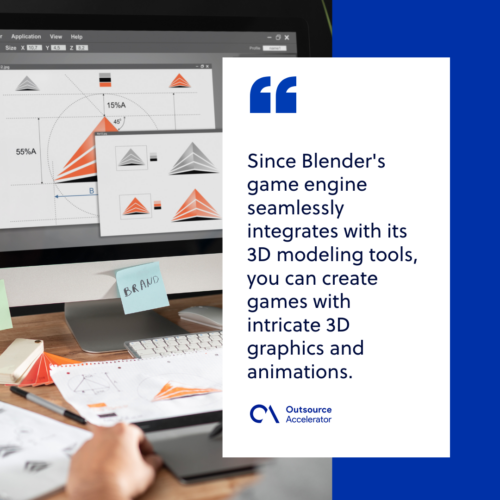
- 3D modeling integration – Because Blender’s game engine links with its 3D modeling tools, you can build games with rich graphics and animations.
- Physics simulation – Blender supports physics, so in-game interactions feel real.
- Python scripting – Developers can use Python for deeper control and game logic.
3. Unreal Engine
Unreal Engine, made by Epic Games, is known for stunning graphics. It powers many AAA games. In addition, it is prized for strong physics and rendering.
Unreal Engine also offers a fair revenue-sharing model. As a result, it works for developers of all sizes.
This game engine software’s notable features include:
- High-end graphics – Unreal Engine renders photorealistic graphics and special effects.
- Blueprint visual scripting – A visual system called Blueprint lets developers build game logic without code.
- Realistic physics – It shines at real-time simulations, which helps games with dynamic worlds.
- VR/AR support – Unreal Engine supports VR and AR well, so it is a go-to for immersive work.
4. UNIGINE
UNIGINE is a lesser-known but very capable game engine. It excels at rich virtual worlds. In particular, it is strong at physics, rendering, and terrain, so it suits simulation and training work.
Its notable features include:
- Simulation and virtual reality – UNIGINE is often used beyond gaming, such as in architecture, engineering, and education, because it builds real-world simulations.
- Advanced lighting – This game engine software offers global illumination and physically based rendering (PBR).
5. Amazon O3DE (Lumberyard)
O3DE, the open-source successor to Amazon Lumberyard, is a free engine for multiplayer games with cloud links. In addition, it offers strong networking tools and supports Windows and consoles.
Here are its unique features:
- Cloud integration – O3DE links well with cloud services, so it scales online multiplayer games and content delivery.
- Visual scripting – It has a visual scripting system, which simplifies game logic for non-coders.
- Realistic environments – O3DE provides tools for detailed, immersive worlds. As a result, it suits open-world and sandbox games.
- Multiplayer support – O3DE excels at building and running online multiplayer experiences.
6. Clickteam Fusion
Clickteam Fusion is a simple engine-as-a-service platform. It makes game engine software easy to use. So it is great for developers who want 2D games without deep coding.
Clickteam Fusion offers a visual programming interface for fast game creation. Notable features include:
- No coding required – Clickteam Fusion lets developers build games without a single line of code.
- Rapid prototyping – It is a great choice for quick tests and small 2D projects.
- Export options – You can export games to Windows, iOS, Android, and HTML5, so your game reaches more players.
- Community and marketplace – It has an active community and marketplace for extra assets and add-ons.
7. GDevelop
GDevelop is an open-source game engine software made for 2D game development. Because it is easy to learn, it works well for beginners and hobby developers.
Here is a closer look at what makes GDevelop stand out:
- Cross-platform compatibility – GDevelop supports Windows, macOS, Linux, and web games. It also pairs well with mobile app development workflows.
- Extensible with JavaScript – It focuses on no-code building, yet it still lets developers add custom JavaScript.
- Community and resources – GDevelop has a helpful community. As a result, users find plenty of guides, tutorials, and plugins.
8. ImpactJS
ImpactJS is a game engine software built for 2D web games. It uses the power of JavaScript, so it can run games across browsers.
Here are some key aspects of ImpactJS:
- JavaScript-powered – ImpactJS uses JavaScript, a common and flexible language. As a result, games run on many platforms and browsers without issues.
- Customization – It offers deep control, so developers can fine-tune graphics and physics.
- Plugin ecosystem – Its active community has built many plugins. These extend the engine and ease development.
- Responsive design – ImpactJS supports responsive design, so games adapt to different screens and devices.
9. CryEngine
CryEngine is famous for its graphics. As a result, it is a top pick for teams that want visually stunning games and simulations.
Here is a closer look at what sets CryEngine apart:
- High-fidelity graphics – CryEngine offers advanced lighting, physics, and rendering, so worlds feel lifelike.
- Royalty-free model – Its royalty-free model helps indie developers. In short, small teams can use it without ongoing royalties.
- Realistic physics – It has a strong physics engine, which powers real interactions and simulations.
- VR and next-gen compatibility – It supports VR and next-gen consoles. Before launch, every build still needs solid game testing.
10. iCandy
Lastly, iCandy is a cloud-based game engine software. Its features make it easy to build and share games:
- Cloud-based collaboration – Because iCandy runs in the cloud, developers can work together in real time from anywhere.
- Distribution and monetization – The platform offers ways to share and earn from games, such as in-app purchases and ads.
Frequently asked questions about game engine software
What is game engine software used for?
It is used to build video games. In practice, it handles graphics, physics, sound, and game logic in one place. As a result, developers work faster and ship better games.
Which game engine software is best for beginners?
Unity and GDevelop are great for beginners. Both have simple interfaces and large communities. So new developers can learn fast and find help easily.
Is game engine software free?
Many options are free. For example, Blender, GDevelop, and O3DE are open source. Others, like Unity and Unreal Engine, are free to start and charge only at higher revenue levels.
Can I make mobile games with game engine software?
Yes. Unity, Clickteam Fusion, and GDevelop all export to iOS and Android. As a result, you can reach mobile players with one project.
Do studios outsource game development?
Many do. Studios often bring in outside teams for art, coding, or testing. Because of this, they can ship larger titles on time and control costs.
Key takeaways
- Game engine software is the core toolkit for building video games.
- Unity and Unreal Engine lead for professional and studio-grade work.
- Open-source tools like Blender, GDevelop, and O3DE are free and flexible.
- No-code and cloud engines help small teams ship games faster.
- Many studios outsource art, coding, and testing to save time and money.






 Independent





