


Software Developer
HR Manager
Team Leader
Accountant
Copy Writer
Customer Service
Virtual Assistance
 Join the upcoming Outsource Insights live session. OA's Zoom room is open! Come chat with our outsourcing expert now.


Employees in the United States are planning to stay in their current jobs, but not necessarily for the right reasons. Economic uncertainty, rising living standards, and fears of job loss have forced workers to switch from a growth mindset to survival mode.
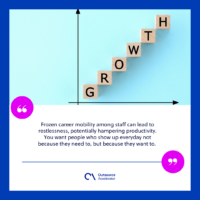
At face value, this seems like a good sign for employers. Since they can expect their staff to stay for at least another year, businesses can focus on growing their business and developing new revenue streams. However, frozen career mobility among staff can lead to restlessness, potentially hampering productivity. You want people who show up everyday not because they need to, but because they want to.
Some of them could turn in subpar work or accumulate more absences than usual. There could be a noticeable decrease in innovation, as staff are no longer invested in certain projects. In the end, having demotivated employees who are no longer interested in their jobs could have detrimental consequences for the firm’s finances and reputation.
A worker who overstays in a particular position could experience career stagnation. Not only will they miss out on career opportunities with higher salaries, but also on new skills. Remaining with one employer can make an employee less familiar with industry-standard tools and practices, creating a disadvantage when seeking new roles.
Moving to a different company requires workers to enter a learning curve, whether it’s a new software system, process, or responsibility. It’s this challenge that allows the employee to grow and be a better professional.
Employers must offer new paths to their employees. Why not start new projects and revenue streams that could challenge them? Moving them to a different department that still aligns with their skills and experience could change the tide.
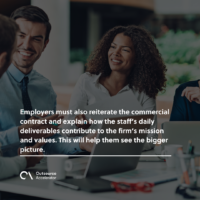
It’s also imperative to keep communication lines open to hear exactly what the staff is feeling. In these conversations, employers must also reiterate the commercial contract and explain how the staff’s daily deliverables contribute to the firm’s mission and values. This will help them see the bigger picture.
It also helps lighten the staff’s administrative burden by passing some of their workload to offshore staff. These tasks often take hours to accomplish, sometimes even more than the core responsibilities of the position. Alleviating staff from administrative work could help them rediscover the joy in their core work.
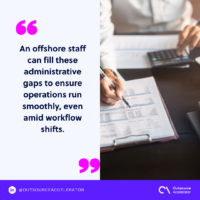
Outsourcing is instrumental, especially when transferring an employee to another department. An offshore staff can fill these administrative gaps to ensure operations run smoothly, even amid workflow shifts. This way, the newly transferred employees can easily navigate the learning curve of their new positions without significant difficulties.
Have you considered offshore staffing for your operations?
 IndependentSecureTransparent
Scale your business fast while reducing costs —
the average all-in employment costs
in the
Philippines are typically 70% less than its
Western counterparts
You can save 70% on staff costs, whilst driving quality & growth. Connect with an outsourcing expert to see how outsourcing can transform your business.







How many staff to outsource?



Outsource Accelerator is the trusted source of independent information, advisory and expert implementation of Business Process Outsourcing (BPO).
Outsource Accelerator offers the world’s leading aggregator marketplace for outsourcing. It specifically provides the conduit between world-leading outsourcing suppliers and the businesses – clients – across the globe.
The Outsource Accelerator website has over 5,000 articles, 450+ podcast episodes, and a comprehensive directory with 4,000+ BPO companies… all designed to make it easier for clients to learn about – and engage with – outsourcing.
Derek Gallimore has been in business for 20 years, outsourcing for over eight years, and has been living in Manila (the heart of global outsourcing) since 2014. Derek is the founder and CEO of Outsource Accelerator, and is regarded as a leading expert on all things outsourcing.
Outsource Accelerator in the media
See all media mentions