
Cybersecurity essentials for businesses: Protecting your digital assets

This article is a submission by SuccessLink Outsourcing. SuccessLink Outsourcing is a leading provider of customized outsourcing solutions, dedicated to refining business operations across diverse industries.
What are the cybersecurity essentials for businesses?
The core cybersecurity essentials for businesses are audits, secure networks, strong passwords, staff training, updates, backups, access limits, endpoint security, and an incident response plan.
In short, these steps protect your data, money, and reputation. So every business, large or small, should put them in place. Here is why they matter:
- Attacks are rising and can hit any company.
- Strong basics block most common threats.
- Good security also builds customer trust.
Businesses today face a changing set of cyberthreats. For example, there are ransomware attacks, phishing scams, and data breaches. The risks are wide and keep shifting.
As we rely more on technology, cybersecurity is no longer a luxury. Instead, it is a must for businesses of all sizes.
If you own or manage a business, the essentials really matter. Protecting your digital assets, customer data, and financial records supports long-term trust and growth.
So this guide breaks down the key cybersecurity measures every business should use to defend against cyber risks.
Why cybersecurity matters to businesses
The fallout from a cyberattack can be severe. Beyond lost money, a business can suffer reputational harm, legal trouble, and downtime.
According to IBM, the global average cost of a data breach was $4.44 million in 2025. Small and medium-sized firms are frequent targets, since they often lack the strong systems that big firms have.
Cybercriminals exploit weak networks, systems, and human habits. So without good protection, your digital assets are at risk. This includes proprietary data, customer records, and financial information.
Using strong cybersecurity practices will guard your business against these threats. For a wider playbook, review these cybersecurity best practices too.
Essential cybersecurity measures for businesses
1. Conduct a cybersecurity audit
The first step to protecting your assets is knowing your weak spots. So a cybersecurity audit helps you find them in your network, systems, and processes.
This includes:
- Assessing current security measures.
- Identifying risks to sensitive data.
- Reviewing access controls and user permissions.
By running regular audits, you stay ahead of threats. As a result, your defenses stay effective over time.
2. Secure your networks
Network security sits at the heart of any plan. A hacked network can let attackers reach sensitive data or plant malware.
Here is how to secure your business network:
- Use firewalls: Install and set up firewalls as your first line of defense.
- Enable encryption: Encrypt sensitive data so outsiders cannot read it.
- Secure wi-fi networks: Use strong passwords, hidden SSIDs, and WPA3 encryption.
- Monitor traffic: Use monitoring tools to spot odd activity.
3. Implement strong password policies
Weak passwords are one of the most common gaps that criminals exploit.
So enforce strong password rules across your organization:
- Mix letters, numbers, and symbols in every password.
- Use multi-factor authentication (MFA) for extra security.
- Ask employees to change passwords on a regular basis.
- Use password managers to store and create secure passwords.
4. Educate your employees
One main cause of breaches is human error. Staff who do not know the risks may click bad links or download infected files.
So regular training builds a culture of awareness. For example, cover these topics:
- Spotting phishing emails.
- Using company devices safely.
- Recognizing suspicious activity.
- Following good habits for data handling and passwords.
5. Update software and systems regularly
Attacks often target outdated software. Criminals exploit known gaps in older versions to break in.
So protect your business by:
- Turning on automatic updates for all systems and apps.
- Patching gaps as soon as updates arrive.
- Updating antivirus and anti-malware tools often.
6. Backup critical data
Data loss comes not just from attacks, but also from hardware faults, disasters, or human error.
So set up a solid backup plan to protect your critical data:
- Schedule regular automated backups.
- Store backups safely, both in the cloud and offline.
- Test backups now and then so data restores quickly.
With reliable backups, you can recover data and cut downtime after a breach or loss.
7. Limit access to sensitive information
Not every employee needs sensitive company data. So use the principle of least privilege (PoLP). This gives each person only the access their job needs.
- Use role-based access controls (RBAC) to manage permissions.
- Review access logs and user activity often.
- Remove access for staff who leave right away.
8. Deploy endpoint security
Endpoint devices, such as laptops, phones, and tablets, are common entry points for attacks.
So protect endpoints by:
- Installing endpoint security software, including antivirus and anti-malware.
- Enforcing device encryption for sensitive data.
- Using remote wipe to erase data on lost or stolen devices.
- Using device management tools to monitor and control endpoints.
These steps matter even more for home-based staff, so this guide to cybersecurity in remote work is worth a read.
9. Adopt a comprehensive incident response plan
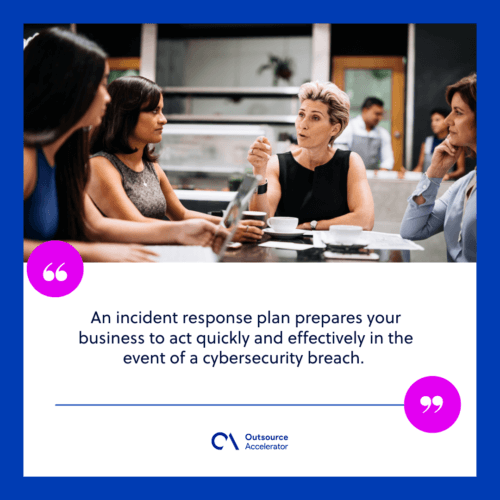
No system is fully safe from threats. So an incident response plan helps your business act fast after a breach.
Key parts include:
- Naming key response team members.
- Setting steps to detect, report, and contain incidents.
- Documenting steps for recovery and communication.
- Running post-incident reviews to improve next time.
Ransomware is a top threat here, so it helps to plan your ransomware protection in advance.
The role of cybersecurity in building customer trust
Beyond protecting your business, strong security builds trust with customers. Today, people are more careful about sharing data online.
So when your business shows a clear commitment to cybersecurity, it reassures customers that their data is safe.
Certifications like ISO 27001, or compliance with GDPR and HIPAA, can boost your credibility further. In short, protecting customer data is not just a legal duty. It is also a competitive edge.
Challenges businesses face in cybersecurity
Putting these measures in place is vital. Still, businesses often face real challenges, such as:
- Budget constraints: Many SMEs struggle to fund cybersecurity fully.
- Skill gaps: A shortage of IT talent makes it hard to build and maintain strong security.
- Evolving threats: Criminals keep inventing new tactics, so it is hard to stay ahead.
- Third-party risks: Vendors with weak security can create indirect threats.
So partnering with experienced cybersecurity pros can help you meet these challenges. For many firms, outsourced cybersecurity services fill the skill and budget gap.
Taking action: Start protecting your digital assets
Cybersecurity is not optional. Instead, it is an essential investment in the life and success of your business. By using the measures above, you can cut your risk and protect what matters most.
If you are unsure where to begin, consider partnering with professionals who can tailor solutions to your needs.
Final thoughts
The digital world offers huge opportunities for business. However, it also brings real risks.
So taking proactive steps is not just about dodging disasters. It is about building a secure base for growth, innovation, and trust. Start today, because prevention always beats cure.
Frequently asked questions about cybersecurity for businesses
What is the most important cybersecurity step for a small business?
Start with the basics: strong passwords, MFA, and regular updates. These block most common attacks at low cost. So they give small firms the biggest return for the least effort.
How much should a business spend on cybersecurity?
Spending depends on size, industry, and risk level. However, even small budgets go far when aimed at training, backups, and updates. So focus first on the steps that cut the most risk.
Can small businesses outsource cybersecurity?
Yes, many do. Outsourcing gives you expert skills without a full in-house team. As a result, it often closes both the budget and skill gap at once.
How often should employees get cybersecurity training?
Run training at least twice a year, plus quick refreshers after new threats appear. For example, a phishing test can keep staff alert. So regular practice keeps awareness high.
What should a business do right after a data breach?
Follow your incident response plan at once. First, contain the breach and secure your systems. Then notify affected parties and review what went wrong to prevent a repeat.






 Independent






