
6 pillars of a customer experience management framework


What is a customer experience management framework?
A customer experience management framework is a structured system that helps businesses deliver consistent, customer-first interactions across every channel and touchpoint.
- A customer experience management framework helps businesses deliver consistent, scalable, and customer-centric interactions across all touchpoints.
- Strong CX management drives customer loyalty, reduces churn, improves operational efficiency, and strengthens overall brand reputation.
- The six key pillars: customer understanding, journey mapping, omnichannel consistency, employee experience, process optimization, and measurement, work together to support continuous improvement.
- Partnering with experienced providers like Hugo enables organizations to scale efficiently, maintain quality, and adapt to evolving customer expectations.
Improving customer experience has become harder as businesses grow across channels, markets, and segments. As a result, small gaps can quickly turn into lost loyalty.
Fragmented systems and uneven service often stop teams from acting on feedback in real time. Meanwhile, expectations keep rising, so even a minor slip can cost you a customer.
Forbes has gone as far as stating that as high as 96% of customers will walk away from a brand they love for better service.
PWC’s report highlights the same reality. In the U.S., 59% of consumers will leave a brand they love after several bad experiences. Still, 17% will leave after just one.
So customer relationships can be fragile without a clear plan. To stay ahead, you need a scalable way to manage every stage of the journey.
This is where a well-defined customer experience management framework becomes essential. In this article, we will explore the six pillars that support it.
Why effective customer experience management matters
Customer expectations keep changing across digital and in-person touchpoints. So businesses that fail to adapt often see lower satisfaction and weaker retention.
A structured approach helps you deliver consistency and act on feedback. As a result, you build long-term relationships that drive growth.
Builds stronger customer loyalty
Consistent, positive interactions encourage customers to come back. For example, quick replies and personal touches make people feel valued.
Over time, these moments turn into trust and repeat purchases. In addition, loyal customers refer your brand to others, so you grow without heavy ad spend. For more on this, see how to build customer loyalty over time.
Reduces customer churn
Bad experiences remain one of the top reasons customers leave. In fact, many will walk away after poor service, even if they once loved the brand.
Good CX management spots friction points early. As a result, teams can fix issues before they lead to customer churn.
Improves operational efficiency
A clear approach to customer experience streamlines work across support, sales, and success teams. For instance, shared workflows and central feedback cut duplicate effort.
So teams spend less time reacting to problems. Instead, they focus on proactive help and steady improvement.
Strengthens brand reputation
Customer experience shapes how the market sees your brand. For example, good interactions lead to strong reviews and social proof.
Over time, that reputation becomes a real edge. As a result, it sets you apart from rivals with similar products.
Supports scalable growth
As you expand into new markets or channels, consistency gets harder. Still, a solid framework gives you the base to scale without losing quality.
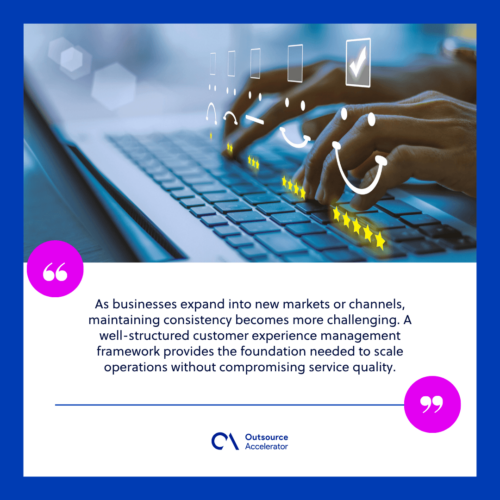
Leading external providers help you keep high standards as demand grows. Because of this, many firms pair a framework with a trusted partner.
6 pillars of a customer experience management framework
Lasting CX excellence takes more than one-off projects. So the best teams treat experience as one system across people, process, and technology.
| Pillar | Focus Area | Outcome |
|---|---|---|
| Customer understanding | Data and insights | Clear view of customer needs and behavior |
| Journey mapping | End-to-end experience | Identification of friction points |
| Omnichannel consistency | Channel integration | Unified interactions across touchpoints |
| Employee experience | Internal engagement | Better service delivery |
| Process optimization | Workflow efficiency | Faster resolution and fewer errors |
| Measurement and feedback | Performance tracking | Continuous improvement and accountability |
A structured framework brings clarity to your priorities. As a result, teams align their work around shared goals.
1. Customer understanding
First, you collect and study customer data to learn their needs and habits. This pillar leans on feedback loops, analytics, and segmentation. So you can tailor each interaction and plan ahead.
2. Journey mapping
Customer journey mapping lays out each stage, from awareness to post-purchase support. Teams use it to spot gaps, delays, and weak points. As a result, you can target fixes where they matter most.
3. Omnichannel consistency
Customers reach you through email, chat, phone, and social media. So this pillar focuses on a smooth experience across every channel. Consistent tone and fast replies build trust, which is why strong omnichannel support matters so much.
4. Employee experience
Employees shape customer interactions every day. For this reason, training, engagement, and the right tools help them serve better. In turn, firms that invest in staff often see higher morale and happier customers.
5. Process optimization
Efficient internal processes cut delays and raise quality. For example, clear steps, automation, and escalation paths speed up each request. So this pillar removes the bottlenecks that hurt the customer experience.
6. Measurement and feedback
Finally, you track metrics like satisfaction, net promoter score, and response times. These numbers show what works and what does not. As a result, teams refine their plans and adapt as expectations change.
Take your customer experience a step forward with Hugo
Teams that want to lift every stage of the journey can lean on dedicated support. For example, the right partner blends strategy, execution, and steady improvement.
Hugo delivers fully managed customer experience teams that handle every channel. So accountability stays clear from first contact through long-term engagement.
Its end-to-end approach helps you design, run, and refine customer journeys. As a result, each one aligns with your goals and your customers’ needs.
In short, you gain trained teams, clear processes, and performance-driven operations. Because of this, your service stays consistent and responsive as you grow. Pairing a partner with sound customer retention strategies keeps more of the customers you win.
Frequently Asked Questions (FAQs)
This section answers common questions about structured customer experience management.
What is the difference between customer service and customer experience management?
Customer service fixes single issues. Customer experience management, on the other hand, covers the whole journey. So it aligns people, processes, and tools to shape every interaction, from first contact to post-purchase support.
How does outsourcing support a customer experience management framework?
Outsourcing gives you trained teams, proven processes, and scalable resources. For example, partners like Hugo Inc manage end-to-end interactions. As a result, you keep consistency, improve response times, and adapt fast to new demands.
How can businesses measure the success of their customer experience strategy?
Track key metrics such as customer satisfaction (CSAT), net promoter score (NPS), retention rates, and resolution times. In turn, these insights guide steady improvements and smarter decisions.
Key takeaways
A structured customer experience management framework helps businesses align teams, streamline processes, and deliver consistent interactions across every touchpoint.
The six pillars: customer understanding, journey mapping, omnichannel consistency, employee experience, process optimization, and measurement, work together to improve satisfaction and long-term loyalty.
Organizations that invest in scalable solutions and experienced partners can adapt more effectively to evolving customer expectations while maintaining operational efficiency and brand reputation.






 Independent






