
Content moderation practices to protect users in the digital age


What are the best content moderation practices?
The best content moderation practices combine clear rules, trained moderators, consistent enforcement, transparency, and smart technology to keep online spaces safe.
In short, strong content moderation practices protect users and guard your brand. Here is what they deliver:
- They set clear limits on what people can post.
- They remove harmful content quickly and fairly.
- They build trust with your online community.
User-generated content never stops flowing. Information moves fast, so a safe and welcoming space matters more than ever. The internet still offers huge opportunity and free expression. Yet it also brings harmful content and misinformation.
As digital spaces grow, so do the risks and challenges tied to unfiltered posts. Because of this, content moderation acts as a critical shield. So this article walks through the content moderation practices you need to protect users and keep a healthy digital space for your brand.
5 best practices for content moderators
Good content moderation practices help you manage online interactions. As a result, you build a positive digital space. Here are five practices you can use right away.
1. Clear community guidelines and policies
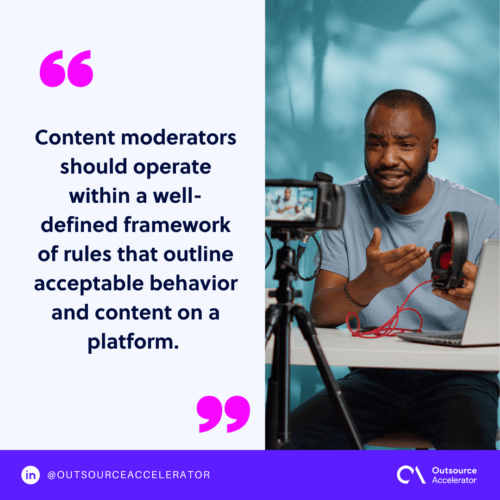
Content moderators need a clear set of rules. These rules spell out what content and behavior a platform allows. As a result, moderation stays consistent and users know the limits.
Your guidelines should cover many topics. For example, include hate speech, harassment, graphic content, and misinformation. In addition, keep the language plain so everyone understands it.
2. Regular training and updates
The digital world keeps shifting. Trends, slang, and culture change fast. So regular training keeps your outsourced moderators up to date with the latest changes.
Offer ongoing sessions, workshops, and resources. For example, cover new moderation tools, platform policies, and cultural sensitivity. Because of this, moderators apply the rules with more care.
3. Consistent rule enforcement
Good content moderation practices apply the same rules to every user. Consistency keeps things fair. In addition, it protects the platform’s integrity.
So build standard steps for each type of content. Then train all moderators to follow them the same way. Also review and adjust your rules often to keep them consistent. For high-volume sites, it helps to plan how to scale content moderation as your community grows.
4. Transparency and accountability
Transparency builds trust with your users. So moderators should log their decisions and explain them when asked. As a result, people see the process as fair.
Set a clear way to record actions and handle appeals. For example, tell users why a post was removed or flagged. Because of this, fewer disputes arise.
5. Use of advanced technology
Leveraging automation tools can speed up the work. This helps most on large platforms. Still, human oversight stays vital, so people can catch what machines miss.
Train moderators to treat these tools as support. Meanwhile, let them focus on the tricky, nuanced cases. This is one of the smartest content moderation practices for busy teams.
Benefits of effective content moderation
Content moderation brings clear benefits. It supports safety, integrity, and quality on your platform. Here are the main advantages.
User safety and protection
Content moderation shields users from harmful, abusive, or unsuitable posts. Moderators can spot and remove content that is offensive or distressing. As a result, the community feels safer for everyone.
Brand reputation and credibility
A platform known for respectful, quality content earns a strong name. So it attracts more users, advertisers, and partners. In turn, this helps the platform grow. Fast, kind social media customer service supports that reputation too.
Legal compliance
Platforms that fail to moderate may face legal trouble. They risk hosting illegal or harmful material. So moderation helps you follow rules on child protection, hate speech, and data privacy.
Enhanced user experience
Clean, quality content lifts the user experience. As a result, interactions stay positive and useful. In addition, the platform feels more enjoyable to use.
Prevention of misinformation
Content moderation keeps information accurate and credible. Misinformation, especially on social media, can cause panic and harm. So by removing fake news and misleading posts, moderators support reliable discussion.

Risk mitigation
Unmoderated content invites cyberbullying, scams, and phishing. It can also expose vulnerable users to unsafe material. So moderation works as a shield that lowers these risks. This matters most for e-commerce content moderation, where fake listings and reviews spread fast.
How OP360’s outsourced content moderation can help
As a leading provider of outsourced content moderation services, OP360 helps online platforms deliver a positive user experience. Its moderators train in industry best practices. As a result, they uphold high quality standards.
OP360 knows how to balance free expression with user safety. In addition, its team understands cultural and regional nuances. So by partnering with OP360, you can grow your business while it handles the details of content moderation. Many teams start by managing user-generated content with trained moderators before scaling up.
Choose OP360 for your content moderation needs. Then enjoy the peace of mind that comes with expert, reliable service.
Frequently asked questions about content moderation practices
What is the difference between content moderation and content curation?
Moderation removes or flags content that breaks the rules. Curation, by contrast, selects and promotes the best content for users. So moderation guards safety, while curation shapes what people see first.
Should content moderation be done by humans or AI?
Both work best together. AI can scan huge volumes fast and flag clear issues. However, humans judge context, tone, and cultural nuance. So a blended model gives you speed plus fairness.
How do you measure if content moderation is working?
Track a few simple metrics. For example, watch response time, appeal rates, and repeat offenders. In addition, gather user feedback on safety. Together, these numbers show whether your rules land well.
Why do platforms outsource content moderation?
Outsourcing gives you trained moderators and round-the-clock coverage. As a result, you scale fast without hiring a large in-house team. It also spreads the emotional load across skilled staff.
How often should moderation guidelines be updated?
Review them at least a few times a year. Trends, slang, and laws keep changing. So frequent updates keep your content moderation practices current and fair.






 Independent





