
Is a captive service right for your business expansion?


Is a captive service right for your business?
A captive service is your own offshore team that you fully own and control, instead of hiring a third-party provider.
It tends to suit firms that want:
- Full control over staff and processes.
- Strong brand consistency across teams.
- Lower long-term costs at scale.
Businesses always look for smart ways to run leaner and cut waste. Whether they outsource support or tidy up internal steps, the goal stays the same. In short, they want more efficiency without losing quality.
For example, a growing tech firm might set up its own offshore support center. That way, it avoids leaning on outside vendors. This model, known as a captive service, offers more control, brand alignment, and long-term savings.
However, it also brings challenges. So this article breaks down what a captive service is, how it differs from outsourcing, and whether it fits your growth plans.
What is captive service?
A captive service is a model where a company runs its own offshore or nearshore site. This site handles set tasks, such as support, IT, or back-office tasks.
Unlike outsourcing to a third party, the company owns and runs the center. Here is how it works:
- The company sets up a fully owned entity in a low-cost location.
- It hires local talent directly under its own brand.
- Operations follow the company’s own systems and standards.
- Management keeps full oversight of staffing, training, and results.
Captive centers appeal to firms that want long-term growth and tight control. As a result, they suit sensitive and critical functions well. To compare paths, review these offshore outsourcing models.
Captive service vs. Outsourcing
Firms that plan to expand often face a big choice. Should they build a captive center or outsource to a third-party provider? Both models bring perks. In truth, the best pick depends on your goals, budget, and need for control.
For firms that want captive control without the heavy setup, Sourcefit offers specialized captive services. In short, businesses lease dedicated staff and infrastructure while keeping the direct oversight of a true captive center.
The table below shows the key differences between the two models:
| Aspect | Captive Service | Outsourcing |
| Ownership | Fully owned and operated by the parent company | Managed by an external service provider |
| Control | Full control over staff, processes, and infrastructure | Limited control over daily operations |
| Cost Structure | Higher upfront investment, lower long-term cost potential | Lower upfront cost, but fees may increase over time |
| Scalability | Slower to scale due to setup and staffing | Fast to scale with provider’s existing resources |
| Customization | High level of customization aligned with company goals | Often limited to provider’s standard service offerings |
| Risk Management | Direct responsibility for legal, compliance, and HR | Shared or transferred risk depending on the contract |
Knowing these gaps helps you pick the right model. As a result, you set your team up for long-term success. Many firms also weigh a build-operate-transfer approach as a middle path.
7 Benefits of opting for a captive service
As firms grow, so do their daily challenges. Managing support, IT, or back-office work with thin resources can slow you down. It can also hurt service quality.
Many firms think about outsourcing. Yet not all feel easy handing control to a third party. For those who want to grow while keeping oversight, a captive service is a smart, scalable choice. Here is why.
1. Greater operational control
With a captive center, the parent company runs staffing and results directly. So you keep tighter control over daily work, compliance standards, and quality. Moreover, you set your own systems without leaning on a vendor.
2. Improved data security
Captive centers offer stronger security control. This matters most in fields like healthcare, finance, and legal work, where data is sensitive. As a result, you keep full say over access, storage, and policy.
3. Stronger brand alignment
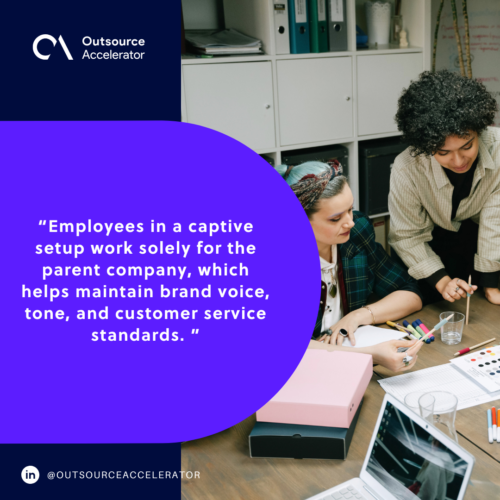
In a captive setup, staff work only for the parent company. So your brand voice and service standards stay consistent. In addition, training and internal chat reflect your culture. This leads to a better customer experience.
4. Cost-efficiency over time
A captive center needs a bigger upfront spend. Still, the long-term cost often drops below outsourcing. For example, you avoid third-party markups and can run leaner. In low-cost regions, those savings grow year after year.
5. Talent development and retention
Captive centers let firms invest in their workforce, build loyalty, and cut turnover. With direct hiring, you can shape clear career paths. As a result, performance and retention both climb. These offshore team best practices can help you get there.
6. Customizable operations
Outsourcing limits you to the provider’s set services. A captive model, by contrast, allows full customization. So you can adapt fast, scale specific tasks, and deploy new tools as needs change.
7. Strategic global presence
A captive center abroad can boost your global footprint. In turn, it supports growth and opens new markets. Meanwhile, you keep full control over your processes. To weigh locations, see these offshore staffing options in the Philippines.
In short, captive service models give growing firms a real edge. They reward control, consistency, and scale.
Captive service drives innovation for your business
A captive service gives you room to innovate on your own terms. With full control over teams, steps, and tools, you can:
- Test new ideas
- Implement custom workflows
- Respond quickly to market changes
Direct oversight keeps your ideas tied to real goals. Meanwhile, steady team chat drives faster, smarter choices. As you grow, the captive model supports agility and long-term value. These traits keep any business ready to lead.
Frequently asked questions about captive service
What is a captive service?
A captive service is an offshore center a company fully owns and runs. In short, it handles set tasks in-house rather than through a vendor.
How is a captive service different from outsourcing?
You own and control a captive center. With outsourcing, a third party runs the work for you.
Is a captive service more expensive?
It costs more to set up. However, the long-term cost is often lower, since you skip third-party markups.
Who should use a captive service?
Firms that value control, brand consistency, and scale benefit most. It also suits work with sensitive data.
Can you start with a hybrid model?
Yes. Many firms lease staff and space first, then move toward a full captive center over time.
Key takeaways
- A captive service is an offshore team you fully own and control.
- It offers strong brand alignment, security, and long-term savings.
- Outsourcing scales faster and costs less upfront, but gives you less control.
- Captive models suit sensitive work and long-term growth plans.
- A hybrid or leased setup can ease you into the captive approach.






 Independent





