
2021: A rebound year for the Philippines’ BPO and shared services industry


Is the Philippine BPO industry still growing?
Yes. The Philippine BPO industry keeps growing, and it stays one of the world’s top outsourcing hubs.
- Revenue and jobs rise almost every year.
- Firms now offer flexible, tech-driven services.
- Growth is spreading beyond Manila to many regions.
The Philippine BPO industry has shown that it can adapt to almost any shock. Global business once reeled from a sudden health crisis. Still, local firms adjusted fast. As a result, they added new health steps and safety gear so teams could keep working. Much of this strength comes from the resilience of the Filipino workforce. Because of this, the sector came back stronger and more flexible than before.
2021 as a rebound year for the BPO sector
The sector today looks stable and hopeful. When COVID-19 first hit, it caught the whole world off guard. However, BPO and shared services firms learned fast. Now they are better set up to adapt to a new way of working:
- Better healthcare protocols in the workplace
- Equipping employees with the knowledge and protective equipment
- Flexible working schedules
- On-site and off-site delegation of teams
- A re-calibrated growth projection built on hard-won lessons
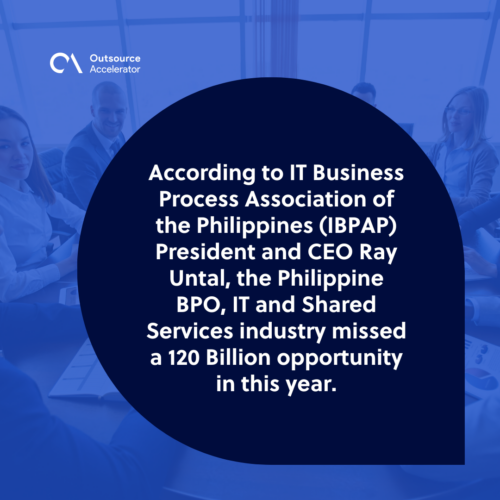
The IT Business Process Association of the Philippines (IBPAP) calls the sector a key growth engine for the country. Recent data shows why. The IT-BPM industry earned about $40 billion in export revenue in 2025. It also employed roughly 1.9 million workers. In addition, IBPAP expects revenue to reach $42.3 billion in 2026. Because of this, the Philippines stays a top outsourcing destination for global firms.
Outlook Points for the Philippine BPO & IT Services
Humanization
The Philippine BPO industry has learned to put people first. The pandemic taught firms to rethink how they work and lead. This mirrors the World Economic Forum’s idea of a “great reset.” In short, it means new thinking on business, social duty, and how solutions can scale.
In the Philippines, BPO and IT firms have done more for their teams. For example, many now focus on:
- Workplace healthcare as the top priority
- Flexible work that fits health protocols
- More corporate social responsibility and community outreach
- Greater focus on mental health
- Stronger workforce inclusion and diversity
- Employee welfare, with HMO and insurance offered over the years
Firms also invest more in training and career growth. As a result, employees see a clear path forward. Culture and social duty now shape talent decisions. Millennials and Gen Z want more than pay. As a result, fair BPO industry wages and a caring workplace both help firms keep good people.
Virtualization
The world keeps going digital, and this opens more outsourcing work. Firms now expand service lines through apps, portals, and device access. Meanwhile, teams in customer service and tech support face faster response demands. For example, many of the roles companies outsource to the Philippines now run fully online.
For Philippine IT & BPO companies, small niche markets in API and network services can now grow. Interim programs and microservices are moving into the wider market. In this case, the young, skilled Filipino workforce fits the need well. So firms can offer both long-term virtual jobs and service contracts.
Some worried that Blockchain, AI, and Robotic Process Automation (RPA) could shake the Philippines ’ status as a BPO and IT Shared Services destination. However, that has not happened. Instead, groups like IBPAP treat these tools as a chance to grow. New BPO models now blend automation with skilled human work. As a result, the local workforce has moved from back-office tasks to higher-value roles.
Decentralization
The Philippine government has pushed to spread growth across the country. It backs new business hubs, tech hubs, and economic zones outside the capital. Because of this, more regions are now ready for investment.
Metro Manila is no longer the only choice. Cities such as Bacolod, Cebu, Cagayan de Oro, Davao, Angeles in Pampanga, and Iloilo are rising fast. They now draw commercial, business, and tech investment. This is good news for anyone investing in the Philippines. These regional hubs also ease crowding in Manila. In addition, they give local graduates jobs close to home. In turn, this creates jobs, lifts local income, and builds new skills.
Frequently asked questions about the Philippine BPO industry
What is the Philippine BPO industry?
The Philippine BPO industry covers firms that handle business tasks for other companies. These tasks include customer support, IT, finance, and back-office work. The country is one of the largest outsourcing markets in the world.
How big is the Philippine BPO industry today?
The sector earned about $40 billion in export revenue in 2025. It employed roughly 1.9 million workers. IBPAP expects revenue to grow to $42.3 billion in 2026.
Why do companies outsource to the Philippines?
Firms choose the Philippines for skilled, English-speaking talent and fair costs. The workforce is young and quick to learn new tech. In addition, strong government support keeps the sector stable.
Will automation replace BPO jobs in the Philippines?
Automation changes the work, but it does not erase it. Tools like RPA handle simple tasks. Meanwhile, workers move into roles that need judgment and people skills.
Key takeaways
- The Philippine BPO industry keeps growing and stays a top outsourcing hub.
- Revenue reached about $40 billion in 2025, with 1.9 million workers.
- Firms now lead with people-first culture and flexible work.
- Automation adds value instead of replacing skilled Filipino talent.
- Growth is spreading to Cebu, Davao, Iloilo, and other regions.






 Independent





