
Average salary in the US: How outsourcing benefits the US economy


What is the average salary in the US?
The average salary in the US is about US$63,795 a year, and outsourcing helps American companies manage these high labor costs while staying competitive.
- Pay in the US changes with location, job type, education, gender, and age.
- US wages rank among the highest in the world, so hiring locally can be costly.
- As a result, many firms send some work offshore to save money and keep growing.
Most people think firms that outsource only want to cut costs and boost profit. However, the story is bigger than simple profit.
Offshoring is a smart way to keep operations running and to fund growth. Small and medium businesses cannot hire local staff the way large firms do. So they need a better way to fill roles without spending too much.
To make good calls, owners should know the basics of running a business. This includes local operating costs and the average salary. Because of this, understanding US pay matters before you compare hiring options.
This article covers what business owners need to know about the average salary in the US.
The national average salary in the US
According to Forbes and the US Bureau of Labor Statistics, the average annual wage in the US is roughly US$63,795. For example, median weekly earnings reached US$1,204 in the fourth quarter and recent years, based on BLS data.
Still, that figure can feel like a good salary or a tight one. It all depends on the factors that shape it.
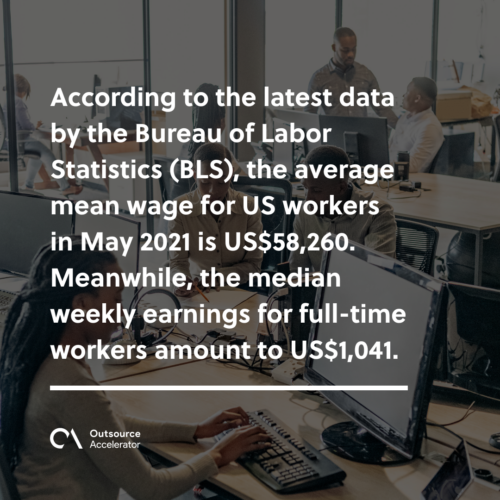
Pay variations for US workers
In the US, workers are paid either by the hour or on a fixed salary. Their pay mainly depends on job type, education, and company practice.
Meanwhile, more than half of US employees are hourly workers, according to the Bureau of Labor Statistics. That share adds up to tens of millions of workers across the country.
Factors that affect the average salary in the US
Here are the main factors that shape the average salary in the US.
Geographical location
The cost of living in each state helps set how much a person can earn. For example, states like Massachusetts, New York, and California tend to post the highest average salaries. Meanwhile, several southern states sit near the lower end.
Because pay tracks local costs, it helps to study the minimum wage in US states before you set budgets. In addition, salary benchmarking can help you match offers to each market.
Gender and race
Demographics such as race and gender also play a role in pay. For instance, a gender pay gap still exists. Men earn a median of about US$1,326 a week, while women earn about US$1,089, based on BLS data. So women earn roughly 82% of what men make.
Occupation
Occupation has a big effect on how much a worker earns. According to statistics by Investopedia, the healthcare field holds many of the highest-paying jobs. For example, roles such as cardiologist and anesthesiologist sit near the top of the pay scale.
Educational attainment
More education tends to pay off in the US, according to BLS data. As a result, college graduates usually earn more each month than workers with less schooling. In addition, an advanced degree often lifts pay even higher.
Age
Salary can vary by age too. Still, it can also be shaped by the pay gap between men and women.
The average salary in the US compared to offshore countries
Numbeo ranks the US among the highest average salaries in the world, next to Switzerland, Singapore, and Australia.
Because of the high cost of living and a skill shortage, hiring local teams is not always ideal. This is true for small businesses in particular. As an alternative, they can move some work offshore to boost savings and lift revenue. In short, offshore staffing gives smaller firms access to skilled talent at lower cost.
Below is a rough comparison of average monthly salaries in the US and other offshoring countries.
| Average salaries | |
| USA | US$4,952.33 |
| India | US$438 |
| The Philippines | US$308 |
| Eastern Europe | |
| US$1,286.13 | |
| US$391.94 |
India
The average salary in India is around US$438 a month, far below US pay.
India is a top offshoring choice for US firms in IT, development, and tech support. As a result, many companies that outsource to India enjoy strong cost savings and better returns. For instance, firms can save a lot when hiring software developers there instead of local staff.
The Philippines
Unlike the average salary in the US, pay in the Philippines is much lower, at about US$308 a month. As the leading hub for customer support and voice services, the country offers strong English skills and a good cultural fit. Many US firms therefore turn to outsourcing to the Philippines for these roles.
Eastern Europe
Finally, Eastern Europe competes in outsourced technology and development work. Two hubs, Poland and Ukraine, are among the most sought-after in the region.
The average salary in Poland is about US$1,286 a month. So it offers fewer savings than the Philippines or India. However, clients can still cut costs by up to 30%, get quality work, and keep strong data protection.
In Ukraine, meanwhile, workers earn an average of about US$392 a month. The country keeps building its outsourcing sector and takes pride in its growing base of skilled talent.
How outsourcing benefits the US economy
Some US firms still hesitate about outsourcing. They worry about cheap labor and jobs moving away from local workers.
However, BPOs do neither of those things. Instead, moving some work offshore frees companies to add value. As a result, they can improve their products, their teams, and even the wider US economy. For a fuller view, see the broader benefits of outsourcing.
For starters, outsourcing creates the following benefits for the US.
Keeps companies competitive
Cost savings are not just a way to earn more. The savings from outsourcing keep firms running. As a result, they stay more competitive in their local markets.

Generates more valuable jobs
At the same time, businesses only pass off low-value, repetitive tasks. This frees their teams from busywork. So they can create more high-value roles for local workers who need them.
Encourages business continuity
Finally, a shutdown is one of the biggest threats to any business during a crisis. It can hurt jobs and the wider economy in turn.
Outsourcing keeps operations going through these shocks. As a result, firms can protect jobs, support the economy, and help it recover over time.
Frequently asked questions about the average salary in the US
What is the average salary in the US right now?
The average salary in the US is about US$63,795 a year, based on BLS data. Median weekly pay sits near US$1,204, which points to a slightly lower typical wage.
Why does the average salary in the US vary so much?
Pay changes with location, job type, education, gender, and age. For example, high-cost states and healthcare roles tend to pay far more than the national average.
How does the average salary in the US compare to offshore countries?
US pay is much higher than pay in India, the Philippines, and most of Eastern Europe. As a result, many US firms move some tasks offshore to cut costs.
Does outsourcing hurt US jobs?
No. Firms usually send only low-value, repetitive work offshore. So local teams can focus on higher-value roles that add more to the business.
Is a US$63,795 salary considered good?
It depends on where you live. In high-cost states, that figure can feel tight. In lower-cost areas, the same pay stretches much further.
Key takeaways
- The average salary in the US is about US$63,795 a year, among the highest in the world.
- Location, job type, education, gender, and age all shape US pay.
- Offshore pay in India, the Philippines, and Eastern Europe is far lower.
- Because of this, outsourcing helps US firms save money and stay competitive.
- Outsourcing also supports local jobs and keeps operations running through crises.






 Independent





