
CSR 101: Why is corporate social responsibility important?


Why is corporate social responsibility important?
Corporate social responsibility is important because it builds trust, lifts a company’s brand, draws investors and talent, and helps society benefit from a growing business.
- CSR lets a business give back while it keeps making a profit.
- It boosts brand image, staff morale, and investor interest.
- It works best when it is built into daily operations, not bolted on.
Corporate social responsibility helps society benefit from a growing business. It supports communities, builds a strong employer-employee bond, and lifts morale across the organization.
CSR takes many forms. In fact, it depends on the industry a company belongs to. The article below explains how CSR works, how it can shape a brand, and the different ways to show a company’s corporate social responsibility.
What is corporate social responsibility?
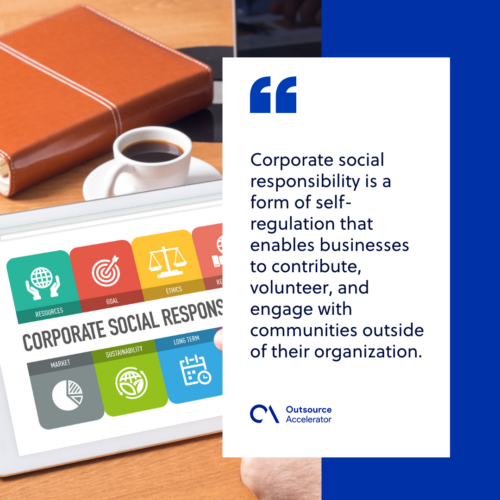
Corporate social responsibility is a form of self-regulation. It lets businesses give, volunteer, and engage with communities outside their own walls. As a result, it keeps employees charitable and accountable to the people tied to their work.
A CSR plan makes employers aware of their impact on society. That impact can be economic, social, or environmental. Because of this, companies can operate in a way that helps both the business and the wider community. Many firms also fold this into ESG compliance to keep their reporting clear.
Large corporations usually lead on CSR in the workplace. After all, the more recognizable the brand is, the bigger its duty to set an example. So they often set the pace for peers in the industry.
Is corporate social responsibility similar to charity work?
Corporate social responsibility helps businesses operate ethically while they help society. CSR can look like charity work. However, the two are not the same.
Here are some key differences between companies with CSR and charity organizations.
- Period of solutions. Charities create long-term solutions to problems people face. CSR often offers short-term answers to current issues.
- Goal. A charity’s main goal is to give profits back to society. CSR helps people while the business still earns from paying stakeholders.
- Coverage. CSR aims to help society at large. Charities pick a smaller group to support.
- Beneficiaries. CSR gives time and profit to a community close to the business model. Charity work can go to anyone at any time.
Why should a company implement a CSR initiative?
There are many reasons to build a corporate social responsibility plan. Here are some of the main ones.
Improves the brand image
CSR plays a big role in drawing new customers. Their consumer behaviors are shaped by a company’s values, reputation, and activism.
Stakeholders often weigh CSR when they pick a brand. Most also hold companies to account for social change through their beliefs, practices, and profits. So to stand out, your company must prove it is a force for good. Advocating for important causes is a great way to raise brand value. In addition, it builds wider audience awareness.
Increases appeal to investors
Investors act much like customers here. They look at a company’s social record before they commit. A well-planned CSR campaign is likely to catch their eye. As a result, they grow more interested in what the business can do.
Attracts and retains employees
The modern workforce looks beyond pay when job hunting. They also check how a company treats its people and community. Most workers today are purpose-driven, and they want that at work too.
Top talent is drawn to firms that give back. Because of this, CSR is a strong factor in hiring and retention. Pairing it with real employee engagement makes the effect even stronger. It also helps solve common employee retention problems.
Boosts employee creativity
How a company treats its community says a lot about how it treats staff. People who connect with company causes feel supported and productive at their workplaces.
CSR lets employees spend work hours on something meaningful. It also builds a sense of community inside the team. Plus, it links staff to the outside world. These chances give people pride and motivation in their roles.
Explore these different types of corporate social responsibility
Corporate social responsibility can differ by industry. To feel genuine, CSR should sit inside the company’s culture and operations. Here are the main types a company can adopt.
Environment
Every business adds to its carbon footprint, no matter its size. So any step to cut that footprint counts as a good move for the community. For example, some firms choose sustainable outsourcing partners to lower their impact. Others explore green outsourcing to keep operations cleaner.
Philanthropy
Businesses can practice CSR by donating money, products, or services. Large firms have the resources to give big to charities and community centers. Small firms, meanwhile, can make smaller gifts to a cause they care about.
Ethical responsibility
Treating people fairly is also a strong CSR move. This means any organization that follows labor laws in every country where it works.
Volunteering
Beyond giving money, companies can also give time. For instance, workers can spend part of their hours on events or causes in the community. As a result, the whole team feels more connected to the people around them.
Frequently asked questions
What are the four main types of corporate social responsibility?
The four common types are environmental, philanthropic, ethical, and volunteering. Each one gives back in a different way. So companies often mix a few types at once.
Does CSR only apply to large companies?
No, small firms can practice CSR too. They can donate, volunteer, or treat staff fairly. Because of this, CSR fits a business of any size.
How does CSR benefit a business financially?
CSR can lift sales, loyalty, and staff retention. It also draws investors who value social records. As a result, a strong CSR plan can support long-term profit.
Is CSR the same as ESG?
No, but the two are closely linked. CSR is the broad practice of giving back. ESG is the way firms measure and report that impact.
How do companies measure CSR success?
Firms track volunteer hours, donations, and emissions cut. They also watch brand trust and staff engagement. First, set clear goals, then review results each year.






 Independent






