
Secure your business with offshore payment processing

What is offshore payment processing?
Offshore payment processing lets businesses accept debit and credit card payments from customers worldwide, in many currencies, through a provider based in another country.
- First, it helps e-commerce firms take secure card payments online.
- Next, it supports many currencies, which reduces cart abandonment.
- Finally, it suits both high-risk and low-risk merchants.
Online shopping is now the norm. Customers want speed and ease when they pay. Thanks to the internet, a brand’s reach is no longer limited to local buyers.
For e-commerce businesses, offering many payment modes is now a top need. This includes debit and credit cards. Still, some firms struggle to accept and process these card transactions.
Payment processing is your company’s lifeline. So without a payment system, your firm cannot run well. It is a good thing that offshore payment processing services can solve this problem.
Defining offshore payment processing services
Offshore payment processing is also called offshore merchant services. So this service helps e-commerce firms, big or small, accept card payments with ease.
Some industry-leading card companies include Mastercard, American Express, and Visa.
Through these services, firms can process online payments from customers worldwide. In addition, this covers fees in all types of currencies. So providers offer offshore banking solutions for firms in every sector. Many pair this with broader e-commerce outsourcing to run the whole back office.
2 types of offshore merchant services
Offshore merchant services are payment gateways. So they let you take card payments online.
There are two main types:
- Credit card processing. You can accept credit cards on your website or on-site. For example, through a card reader or mobile app.
- Online payments. This type helps firms accept online payments from customers who lack cash or checks.
Which types of businesses offshore payment processing?
Offshore merchant services mainly suit high-risk merchants. Still, other types of firms can also open an offshore merchant account.
High-risk merchant accounts
High-risk merchant accounts belong to firms prone to risky transactions. So payment processors label them as high-risk.
As a result, they may face many chargebacks, fraud, and refunds.
Not all high-risk merchants are illegal. Still, some have poor card processing scores or weak security. In addition, some see very high sales volumes. So banks often charge them extra fees. In some cases, banks block future transactions.
For example, weapon retailers, blockchain, health, finance, and travel firms fall into the high-risk group.
Low-risk merchant accounts
Low-risk merchants work in beauty, retail, or restaurant sectors. They are lower risk, yet they can still choose offshore payment processing. So long as they keep a low chargeback ratio, it works well.
E-commerce
E-commerce firms often sell to customers all over the world. So processing international payments can be hard.
The e-commerce industry can gain a lot from offshore payment processing. As a result, it reaches a wider audience and lifts income. To compare storefront tools, see our list of top e-commerce platforms.
How offshore payment processing services work
Providers offer reliable online payment tools and fraud management. So offshore processors give payment gateways to their clients.
This helps ensure that payments from many locations go through. Here is how offshore payment processing usually works:
- First, customers log in on the merchant’s website or portal.
- Next, they fill in the details for their chosen payment method. For example, a debit card, credit card, or online banking.
- Then all data goes to the merchant’s bank.
- After that, the transaction moves to the customer’s issuing bank, where it is approved or declined.
- Either way, the result goes back to the merchant’s bank.
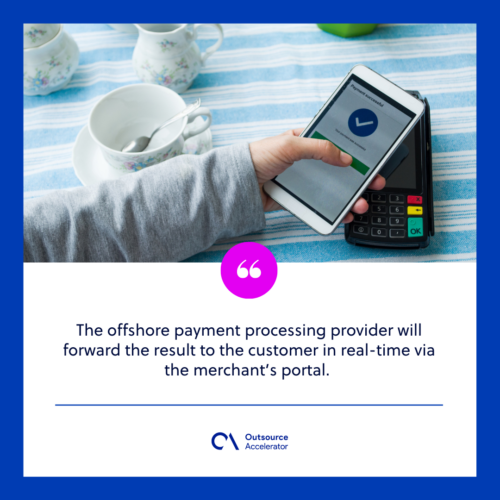
- Meanwhile, the provider sends the result to the customer in real time through the portal.
- Finally, once approved, the issuing bank transfers funds to the merchant’s account. Receipts also go to both sides.
So both merchants and customers get a secure process. In fact, it takes just seconds or a few minutes.
4 significant perks of offshore payment processing
Businesses can gain a lot from offshore payment processing. So here are its main benefits.
Security
Providers are known for strict security standards. For example, they use screening systems, address verification, and fraud management.
They also offer 24/7 customer support, which helps firms spot fraud and chargebacks. Strong security also lowers the risk of common e-commerce security issues.
Easy payments in various currencies
Through these services, firms can accept payments in many currencies. As a result, this cuts cart abandonment. So customers pay in the currency they prefer.
Increased profitability
As noted, customers prefer online shopping because it is convenient. So offshore payment processing makes online transactions simple. In turn, firms are more likely to earn repeat purchases and retain their customer base.
Cost-efficiency
There are many perks to these services. Still, one of the biggest is lower transaction costs.
Offshore payment processing lets firms sell worldwide at a lower cost. In addition, it cuts foreign exchange fees and can lower tax expenses. So overall, it trims a big chunk of operating costs. To manage the books behind these sales, some firms add offshore accounting support.
How to get started with offshore payment processing
Looking to start with offshore payment processing? So here are the steps you should take.
Choose an offshore merchant account provider
First, do thorough research before you partner with a processor. This is key if your business is high-risk.
Next, pick a provider that offers strong service at a fair price. So your customers can pay for goods in real time.
These firms have deep experience with many currencies and rules. In addition, a trusted partner meets all laws tied to currency exchange. So make sure the provider knows international payments well.
Set up offshore merchant accounts
To manage offshore payment processing, work with a foreign bank that accepts your business. So you can use this account for all financial transactions, such as deposits and withdrawals.
Also make sure the bank is licensed and regulated at home. As a result, this protects you from fraud and other illegal activity.
Integrate your payment system
An integrated system lets your business accept payments from anywhere. So you avoid manual entry on your website.
In addition, it keeps payments secure. So you can manage and organize the whole transaction process. Automating invoice processing services can round out this setup.
Frequently asked questions about offshore payment processing
Is offshore payment processing legal?
Yes, it is legal when done through licensed, regulated providers. So always check that your partner meets local and international rules.
Who needs offshore payment processing?
High-risk merchants gain the most. Still, low-risk and e-commerce firms use it too. For example, sellers who serve global customers in many currencies.
Is offshore payment processing secure?
Yes. Providers use strict security, such as fraud screening and address checks. In addition, many offer 24/7 support to catch issues fast.
How much does offshore payment processing cost?
Fees vary by provider and risk level. Still, offshore processing often lowers transaction and foreign exchange costs. So compare rates before you commit.
How do I start with offshore payment processing?
First, research and pick a trusted provider. Next, set up an offshore merchant account with a licensed bank. Then integrate the system with your website.
Key takeaways
- Offshore payment processing lets firms take card payments worldwide.
- It supports many currencies, which reduces cart abandonment.
- It suits high-risk, low-risk, and e-commerce merchants alike.
- Key perks include security, global reach, and lower costs.
- Choose a licensed provider, then set up and integrate your system.






 Independent





