
Get to know how intelligent document processing works


What is intelligent document processing?
Intelligent document processing (IDP) is technology that reads, extracts, and processes data from documents automatically, using AI tools like machine learning, OCR, and natural language processing.
- It handles structured, unstructured, and semi-structured documents in one workflow.
- It cuts manual data entry, so teams spend less time on repetitive tasks.
- It fits firms that deal with high volumes of invoices, forms, and contracts.
Our digital age helps companies run smoother daily operations. This matters most for firms that handle large volumes of data. Today’s tools play a big role in making document processing faster and more accurate.
Document processing is a normal part of many firms’ daily work. However, it used to be slow and manual. Through new tech, organizations can now optimize that laborious task. As a result, intelligent document processing has become a key part of every firm’s digital transformation.
Intelligent document processing (IDP)
Intelligent document processing (IDP) is one type of intelligent process automation (IPA).
In IDP, other tools also take part in the work. These include machine learning (ML), natural language processing (NLP), and intelligent character recognition (ICR). Together, they remove the dull, repetitive tasks that normally need human effort.
So what can it do? Intelligent document processing can extract, recognize, capture, and process data from many document formats. This suits firms that work with large volumes of unstructured or semi-structured documents. For example, think of sales orders, invoices, and customer correspondence.
Still, it helps to know the main automation tools and how they differ. That way, you can use each one to its full potential.
IDP system vs OCR software
An intelligent document processing system grew out of optical character recognition (OCR) software. OCR software pulls data out of structured electronic documents. Then it converts that information into an editable text or PDF file.
IDP systems go further. They can identify and extract information from unstructured documents, such as emails, articles, or contracts. Both IDP systems and OCR software remove the need for staff to do manual data entry. However, OCR offers more customization than IDP. In contrast, the data an IDP system extracts flows straight into a business workflow. Firms that still rely on manual keying often turn to data entry outsourcing while they adopt IDP.
IDP system vs RPA software
Robotic process automation (RPA) uses artificial intelligence (AI) to handle simple daily tasks. Intelligent document processing, as noted, improves workflows by making sense of unstructured data.
There is a clear split in what each one handles. An RPA tool usually works with structured data, and in some cases semi-structured data such as invoices. Meanwhile, an IDP system can handle any form of data, whether structured, unstructured, or semi-structured. To see how automation bots fit the bigger picture, read this guide to robotic process automation.
Where can you use an intelligent document processing system?
IDP is a vital part of intelligent automation. With standard RPA, firms still pay extra to add features like data extraction and automation. So many organizations now plug IDP systems into their RPA platforms. As a result, they automate their processes from end to end.
To make this clearer, here are the main ways firms use IDP systems.
Extract specific information
Intelligent document processing helps firms pull any information they need from a document. So it draws out the right data for storage, for other apps, or for further processing.
Manage certain data and documents
IDP can also store, manage, and organize large volumes of information. This is handy for retrieving documents, automating records retention, and archiving files.
Digitize physical documents
IDP systems usually include document-scanning features. They turn physical documents into formats such as PDF, Word, or other Microsoft files. In addition, they add search features for better performance.
Streamline supply chain
This fits businesses with accounts payable work. Intelligent document processing systems can also read barcodes, invoices, and manifests. So they speed up supply chain steps.
Automate documents and create reports
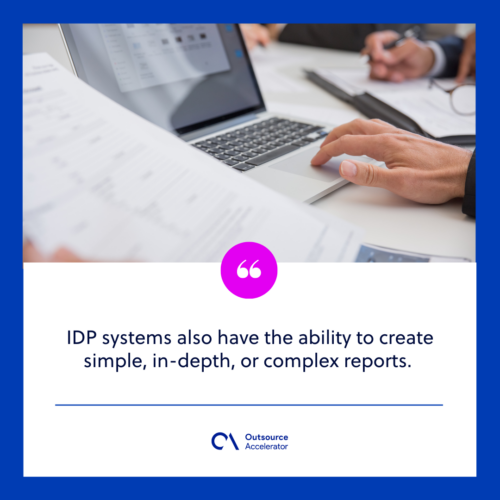
IDP systems can create simple, in-depth, or complex reports. Through automated document creation, they pull data from many sources. They also use document templates to build reports. On top of that, IDP can process other hard-to-read text. For example, it handles mortgage documents, medical forms, and oil and gas files. Many firms pair this with outsourcing document processing to clear large backlogs.
Wrapping up on intelligent document processing
Intelligent document processing combines several data science tools. These include machine learning, OCR, computer vision, and natural language processing. Each tool plays a part at every stage of document processing. In short, IDP boosts human understanding of structured, unstructured, and semi-structured data.
So what can an intelligent document processing system do? It covers the following:
- Classify and recognize different forms of information
- Process structured, unstructured, and semi-structured data
- Run automated data extraction
- Incorporate AI and machine learning tools
- Integrate with data management software
IDP systems fit the workflows of organizations across many industries. Often, enterprise-level firms use them first, since they already know automated workflows well. These gains sit within a wider shift toward the benefits of automation across the back office.
Another way to use IDP is to outsource document processing to a reliable provider like SixEleven. This works well alongside broader back office outsourcing. Ultimately, intelligent document processing systems suit firms that handle large, complex documents with no strict formatting rules.
Frequently asked questions about intelligent document processing
What is the difference between IDP and OCR?
OCR reads structured documents and turns them into editable text. IDP goes further. It uses AI, machine learning, and NLP to read unstructured documents too, such as emails and contracts. So IDP extracts data and feeds it straight into a workflow.
What types of documents can IDP handle?
IDP handles structured, unstructured, and semi-structured documents. For example, it processes invoices, sales orders, contracts, medical forms, and mortgage files. It also works with barcodes and manifests for supply chain tasks.
Which industries benefit most from intelligent document processing?
Firms that process high volumes of documents gain the most. These include finance, insurance, healthcare, and logistics. Enterprise-level firms often adopt IDP first, since they already run automated workflows.
Can you outsource document processing instead of building IDP in-house?
Yes. Many firms outsource document processing to a specialist provider. This gives you trained staff and proven tools without the upfront build. It also helps you scale up fast when document volumes spike.






 Independent






