
Why these 10 US cities are turning to offshore outsourcing the most


Why are US cities turning to offshore outsourcing?
US cities are turning to offshore outsourcing to cut labor costs, tap skilled global talent, and let core teams focus on growth.
- Offshore teams can lower labor costs by a large margin.
- They give fast access to skilled, work-from-home staff.
- They free local teams to focus on high-value work.
A recent study found that the US leads the world in offshore outsourcing. As costs rise and talent grows scarce, more US cities turn to offshore outsourcing to stay competitive.
Outsourcing helps businesses thrive even in a tough economy. For small and medium firms, it is a smart way to keep operations strong. The Philippines remains a top outsourcing destination for many of these cities.
Advantages of offshore outsourcing
The outsourcing industry has stayed stable for years. What is interesting is its counter-cyclical nature. It often gets stronger when the economy is weak. Because of this, the sector keeps growing through good times and bad.
More firms want to protect margins and scale fast. So they turn to outsourcing. Here is how the industry helps businesses of all sizes. It also explains the advantages of business process outsourcing in plain terms.
1. Companies can hire dedicated, skilled staff while reducing employment costs up to 70%
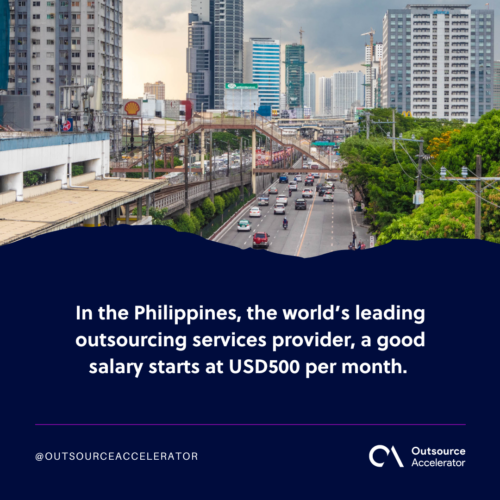
Businesses love the chance to save money and keep a skilled team. With outsourcing, employers can reduce labor costs by up to 70%. In the Philippines, a good salary starts low, and English is the main language. The country also produces hundreds of thousands of graduates each year. So it is a win-win for both sides. Many firms compare offshore vs onshore options before they decide.
2. Companies get access to a work-from-home (WFH) enabled workforce
Today, flexibility matters more than ever. With WFH-ready teams, businesses can keep running with light supervision. Many outsourced firms in the Philippines still work in centralized offices. Meanwhile, many now offer strong remote setups too.
A WFH-enabled workforce proves a simple point. Remote, outsourced, and offshore teams can deliver great work. So they are solid alternatives to in-office staff.
3. Core teams can focus on main responsibilities
A skilled offshore team can handle the tedious, repetitive tasks. As a result, your core staff can focus on the work that drives growth. Different offshore outsourcing models let you match the setup to your goals.
Misconceptions about outsourcing
“My company can save up to 70% on labor costs and still keep a skilled staff? No way. It must be a scam!”
Outsourcing can sound too good to be true. It looks like a win-win at every turn. Of course, it has downsides like any industry. Still, here are some outsourcing myths and misconceptions we can debunk for you.
1. Outsourcing weakens the country’s economy
In fact, outsourcing strengthens the company and the home economy. For example, as firms grow, they hire more local staff. As a result, they give back more to the community.
2. Outsourcing is unethical
This is a sad myth. Outsourced staff are not overworked or underpaid. In fact, they often earn 100% to 200% more than peers in similar non-outsourcing roles. The Philippine government is also very pro-labor in its policies.
3. Outsourcing delivers low-quality work
Outsourcing in the Philippines would not thrive if clients felt unhappy. Recruiting firms run a thorough interview and testing process. So staff arrive with the right skills and background for each role.
Top ten cities turning to offshore outsourcing
To adapt and grow, more US cities are turning to offshore outsourcing. A study found that these cities have been outsourcing to the Philippines in record numbers. They also rank among the cities with the highest average salaries earned. Many rely on offshore staffing solutions to fill roles fast.
1. San Jose, California

For example, San Jose is home to big firms like Samsung, IBM, eBay, and Hewlett-Packard. They all rely on outsourcing for IT and bookkeeping needs. So the city hires many IT providers and bookkeepers in the Philippines.
2. San Francisco, California

Meanwhile, San Francisco leads the tech sector. It is home to Apple, Google, Facebook, and others. As a result, the city outsources more support agents and virtual assistants in the Philippines.
3. Washington, D.C.

For example, Washington hosts law firms, contractors, nonprofits, associations, and many Fortune 500 firms. So they outsource virtual receptionists and assistants to the Philippines.
4. Boston, Massachusetts

Meanwhile, Boston is one of the most economically powerful cities in the world. So to keep pace, high-tech firms here outsource virtual assistants and call centers in the Philippines.
5. Seattle, Washington

Also, Seattle is a hub for global health. It hosts groups like the Bill & Melinda Gates Foundation and the Infectious Disease Research Institute. So the city outsources many telehealth providers in the Philippines.
6. New York City, New York

Also, New York City is the most populous US city. It hosts many multinational firms. In addition, it is a center for banking, finance, retail, trade, and tourism. So the city outsources customer service, bookkeeping, and virtual receptionist work. Meanwhile, the Philippine industry meets much of that demand.
7. Hartford, Connecticut

Next, Hartford is a center for research and medical care. It hosts Hartford Hospital and The Institute of Living. So the city outsources telehealth and customer service work to the Philippines to meet demand.
8. Anchorage, Alaska

Anchorage relies on outsourced accountants and IT support for its government and corporate offices. So it ranks eighth on this list. Tourism is also big here. As a result, the city outsources more virtual assistants and support staff.
9. Denver, Colorado

Meanwhile, Denver is a key trade point thanks to its location and transport links. So the city hires many outsourced IT staff and bookkeepers to keep its economy strong.
10. San Diego, California

Finally, San Diego is a top city to launch a startup. So investors and owners build companies here. Then they outsource virtual assistants and bookkeepers to handle non-core tasks.
Frequently asked questions
Why do US cities use offshore outsourcing?
First, cities use it to cut labor costs and access skilled global talent. It also frees local teams to focus on core work. As a result, firms stay competitive and scale faster.
How much can companies save with offshore outsourcing?
Many firms cut labor costs by up to 70%. However, savings depend on the role and the country. So the Philippines remains a top choice for value.
What roles do US cities outsource most?
Common roles include IT support, bookkeeping, and customer service. In addition, cities outsource virtual assistants, receptionists, and telehealth staff.
Is offshore outsourcing good for the local economy?
Yes, in most cases. As firms save and grow, they often hire more local staff. So the wider community can benefit over time.
Key takeaways
- US cities use offshore outsourcing to cut costs and reach skilled global talent.
- Outsourcing can lower labor costs by up to 70%.
- The Philippines stays a top destination for IT, support, and back-office work.
- Tech, finance, and health hubs lead the shift to offshore teams.
- Done well, outsourcing frees core teams to focus on growth.






 Independent





