
SMEs expected to provide bright future for Philippine outsourcing


At a glance
- Small and medium enterprises in the West are the next big source of demand for Philippine outsourcing.
- Cheap telecoms, cloud tools, and remote work have made outsourcing affordable for firms that were once too small to offshore.
- The Philippines stays a top choice thanks to its outsourcing pedigree, English skills, and young, educated workforce.
Why are SMEs the next growth engine for Philippine outsourcing?
SMEs in Western markets are the next wave of demand, because technology has finally made outsourcing cheap and simple enough for small firms to use. For years, outsourcing served mainly large corporations. Now that barrier is gone.
- Advanced tech and cloud tools have made outsourcing affordable and flexible for smaller firms.
- The Philippines remains a top choice for its skills, culture fit, and command of English.
- Better online representation is the main thing still holding the sector back.
The Philippine outsourcing industry can look to small and medium enterprises (SMEs) from the West to stay relevant. This matters despite market saturation, skills shortages, and the rise of AI and automation. According to Derek Gallimore, Outsource Accelerator founder, the “next wave” of outsourcing could create millions of high-paying skilled jobs for Filipinos. In his view, it also offers higher salaries and strong resilience to automation and AI.
Outsourcing is now within reach for SMEs thanks to advanced tech, cheap telecoms, and cloud-based infrastructure, said Gallimore. “The growing pace of digitization and globalization also allows companies to pick low-cost destinations to provide staffing needs,” he noted. “The Philippines is expected to be the destination of choice for SMEs due to its outsourcing pedigree, cultural alignment, young educated workforce, and a good grasp of the English language.” Still, Gallimore added that the sector needs better online representation to promote its services and connect with employers. For context, OA’s guide explains why the Philippines is a top outsourcing destination.
Where the Philippine outsourcing industry stands now
The sector has grown fast over the past three decades. By 2024, industry group IBPAP reported revenue of about US$38 billion. In addition, it employed roughly 1.82 million people. That growth reversed much of the old brain drain. It also helped justify the rise of business hubs like BGC, Eastwood, Ortigas, and Makati. In short, the industry remains a jewel of the Philippine economy. OA tracks this story in its overview of BPO and the Philippine economy.
See the full article below:
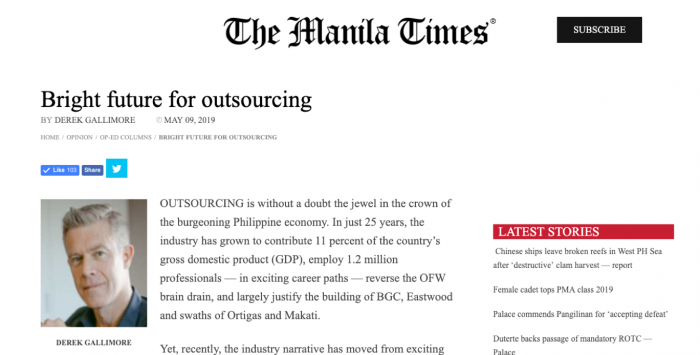
Bright Future for Outsourcing
This article was first published in Manila Times on May 09, 2019 – read here.
Outsourcing is, without doubt, a jewel in the crown of the Philippine economy. In just a few decades, the industry grew to employ well over a million professionals in strong career paths. As a result, it helped reverse the OFW brain drain. It also helped justify the building of BGC, Eastwood, and swaths of Ortigas and Makati.
For a time, the industry story shifted. People started to talk of a sunset sector, skill shortages, and decline. They blamed market saturation, automation, and AI. In contrast, the evidence points not to a decline, but to a far brighter future for Philippine outsourcing.
Gallimore argued that the next wave could add tens of millions of high-paying skilled jobs. Moreover, he projected the industry could grow many times over from its then-current base. This “next wave” is not only far bigger than the old model. It also offers a wider range of higher-skilled jobs, higher salaries, and strong resilience to automation and AI.
Philippines means outsourcing
So where will these jobs come from? The answer is the small and medium enterprise (SME) sector of the “West.”
In the early days, high infrastructure costs limited outsourcing to the world’s big conglomerates. SMEs were shut out, because they lacked the scale. However, with advanced tech, cheap telecoms, and cloud-based infrastructure, outsourcing has become affordable, accessible, and flexible. In other words, it is now perfect for SMEs.
Despite the name, the SME sector is anything but small. For example, research shows “the West” (mainly English-speaking countries) is home to about 35 million SMEs. These firms make up roughly 95 percent of all businesses. In addition, they employ around 100 million people, close to 60 percent of the workforce. Together they produce trillions of dollars in revenue. Ironically, the biggest barrier to SME outsourcing is simply awareness, education, and comfort with the idea. Once those hesitations fade, broad adoption should follow.

For years, only a small pool of large corporate clients supported most of the outsourcing industry. Most of them had been outsourcing for 20 years or more. For perspective, most large corporations outsource, yet only a tiny share of SMEs do. So there are still tens of millions of SMEs out there, yet to outsource. Many of the roles outsourced to the Philippines now suit exactly these smaller firms.
Technology keeps advancing hand in hand with globalization. As a result, the younger generation of Filipinos is now fully connected to the Western world. They grow up on YouTube, Netflix, NBA basketball, Hollywood movies, and Silicon Valley start-ups. Moreover, they use the same apps as their Western peers and join the same forums and online coding academies.
Globalisation and outsourcing
Historically, labor markets were tied to geography. However, with digitization and globalization, the world’s employment is moving toward “one” marketplace. The same goes for education and professional life. People now work from behind computer screens. In addition, they communicate through a shared suite of workplace software. Because of this, the worker’s physical location is becoming almost irrelevant.
This gives Filipinos an incredible chance to shine on the world stage. Now, more than ever, it does not matter where you were born or schooled. Instead, it matters who can produce great work, and at what cost. In short, employment has never been more meritocratic. For a fuller view, see OA’s guide to the benefits of globalization.
This shift means Western employers will naturally look to the Philippines and other low-cost destinations for staffing. They no longer limit hiring to their own hometown. So the Philippines is increasingly the destination of choice for SMEs. It wins on outsourcing pedigree, cultural alignment, a young educated workforce, and strong English.
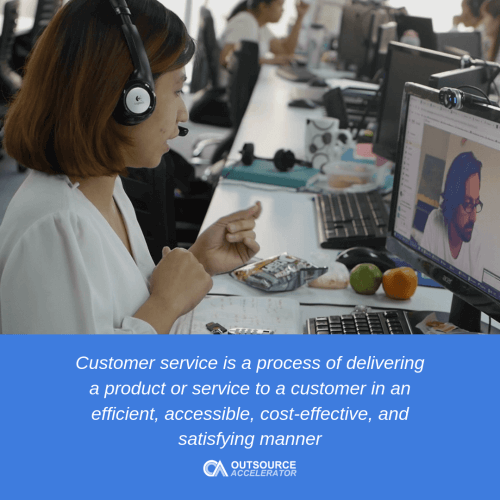
Large corporations have already proven outsourcing and offshore employment. Adoption by SMEs has been slower. Still, globalization and technology keep speeding it along. Reliable offshore staffing solutions in the Philippines make that handoff easier each year.
The main constraint for the Philippines is simple. It needs better promotion of its services and better ways to connect employers with workers. The world keeps getting more “digital.” So the Philippine outsourcing sector must be better represented online. For a long time, there was no central outsourcing marketplace, and the country’s suppliers stayed disaggregated. As a result, they need a coordinated, modern approach to marketing. These factors are now coming together to create a win-win for everyone. In short, this is an exciting time for the Philippines.
Outsourcing Payments
Emerging global payment solutions have widened the ways clients and businesses can trade across the world. For example, they have broken the barrier of different currencies. In addition, they make managing finances easier through online platforms. This alone has helped enable international trade, because it cuts the friction and limits of doing business.
With these tools, businesses can send and receive payments in many currencies. Best of all, they avoid the hassle of wire transfer fees. So this suits SMEs and startups that do business outside their own country.
This article was first published in Manila Times on May 09, 2019 – read here.
Frequently asked questions about SMEs and Philippine outsourcing
Here are the questions business owners ask most about this shift.
Why can SMEs now afford to outsource?
Cheap telecoms, cloud tools, and remote work have removed the old setup costs. In the past, only large firms could justify an offshore team. Today, a small business can hire one or two offshore staff with little upfront spend. As a result, outsourcing is no longer just for big corporations.
Why do SMEs pick the Philippines?
The Philippines offers a rare mix of strengths. First, it has decades of outsourcing pedigree. Next, it has strong English and close cultural alignment with Western clients. In addition, it has a young, educated, and tech-fluent workforce. So it remains a natural first stop for many SMEs.
Will AI and automation shrink Philippine outsourcing?
Not in the way the headlines suggest. Routine tasks will be automated. However, demand is shifting toward higher-skilled roles that machines cannot easily replace. Because of this, the next wave points to more skilled jobs, not fewer.
How can SMEs pay offshore teams across borders?
Global payment platforms handle this well. For example, they let firms send and receive money in many currencies. Moreover, they avoid heavy wire transfer fees. So small firms can run an offshore team without a complex finance setup.
What is the biggest barrier to SME outsourcing?
The main barrier is awareness, not cost. Many owners simply do not know how easy outsourcing has become. Once they learn the basics and gain comfort, adoption tends to follow quickly.






 Independent






