
COO playbook: Restructuring your accounting firm’s overhead model with a Philippines offshore team


This article is a submission by Kinetic Innovative Staffing, a leading offshoring solution provider based in Australia. Kinetic Innovative Staffing offers access to a diverse, international talent pool, serving roles across operations, customer support, marketing, IT, and back-office functions.
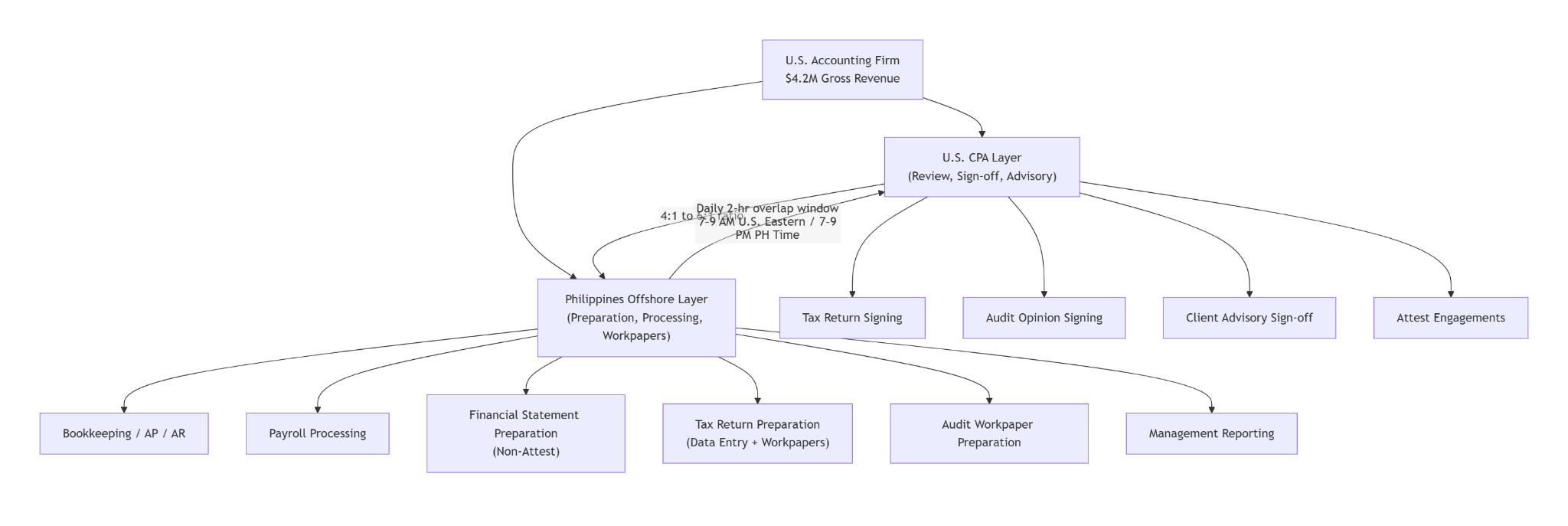
A Philippines offshore accounting team restructuring is the deliberate reallocation of your firm’s labor stack—moving preparation, processing, and workpaper functions to Philippine-based CPAs and bookkeepers at 13–17% of U.S. fully-loaded cost, while retaining U.S.-licensed CPAs exclusively for attest, sign-off, and advisory functions.
Done correctly, this model compresses direct labor overhead from the industry average of 38.4% of gross revenue down to the 12–15% range. Done incorrectly, it creates compliance exposure, a productivity crater in Month 3, and hidden costs that quietly erode 22–31% of projected savings.
Why the Philippines offshore accounting model exists—and why 2026 is the forcing function
The U.S. accounting profession is not experiencing a temporary talent shortage. It is experiencing a structural, multi-year contraction in its labor supply pipeline.
Analysis by Hudson Labs, reported by Bloomberg News, found the profession had roughly 340,000 fewer accountants in the field by 2022 than in 2019 — driven by a wave of Baby Boomer retirements alongside a sustained, multi-year decline in accounting degree completions (though recent AICPA Trends data shows early signs the decline may be easing, with accounting program enrollment up 12% year-over-year in 2024–25).
That contraction has pushed up compensation: the 2026 Robert Half Finance & Accounting Salary Guide projects public accounting roles in tax, audit, and assurance will see 3.7% year-over-year salary growth in 2026 — nearly double the 2.1% average projected across all finance and accounting roles — as firms compete harder for a shrinking pool of licensed talent.
Meanwhile, the 2026 PCPS CPA Firm Top Issues Survey confirms staffing and technology/AI change management now rank among the top concerns for CPA firms of every size — a sign that the labor and cost pressure described above isn’t a temporary blip but a structural feature firms are actively building strategy around.
The labor arbitrage foundation
Philippines offshore accounting model — labor stack restructuring for U.S. CPA firms
The cost differential between U.S. and Philippine accounting talent is structural, not cyclical—rooted in purchasing power parity, a government-supported BPO sector, and a CPA licensure pipeline that produced approximately 4,723 new CPAs in a single examination cycle (November 2025 board exam, per the Professional Regulation Commission Philippines).
Below is the Q2 2026 fully-loaded cost comparison, with Philippine statutory obligations calculated at the mandated 12–15% above base salary (SSS employer share at 9.5%, PhilHealth at 2.5%, Pag-IBIG at 2%):
| Role | PH Base Salary (Annual USD) | PH Fully-Loaded (+12–15%) | U.S. Fully-Loaded | Arbitrage Savings |
|---|---|---|---|---|
| Staff Accountant (2–4 yrs) | $7,200–$9,600 | $8,064–$11,040 | $62,000–$72,000 | 82–87% |
| Senior Accountant (5–8 yrs) | $10,800–$14,400 | $12,096–$16,560 | $85,000–$98,000 | 83–86% |
| Audit Associate | $8,400–$11,200 | $9,408–$12,880 | $68,000–$80,000 | 83–86% |
| Tax Specialist (BIR-trained) | $9,600–$13,200 | $10,752–$15,180 | $75,000–$92,000 | 83–87% |
| Bookkeeper / AP-AR Clerk | $5,400–$7,200 | $6,048–$8,280 | $48,000–$58,000 | 85–87% |
Those numbers represent the ceiling of your savings, not the floor—before accounting for phantom overhead.
The structural ceiling you cannot ignore
Philippine CPAs are licensed under the Philippine Accountancy Act of 2004 (RA 9298). They are not automatically eligible to sign U.S. audit opinions, tax returns (Form 1040/1120), or attest documents.
Attest authority in the U.S. is governed by Section 14 of the Uniform Accountancy Act — the joint AICPA/NASBA model law adopted (with variations) by U.S. state boards — which restricts audits, reviews, and compilations to licensed CPAs or those holding practice privileges in the relevant jurisdiction.
This is not a problem. It is a design constraint that, when respected, produces a more efficient firm structure.
Roles fully transferable offshore (no U.S. licensure required):
- Bookkeeping, AP/AR processing, bank reconciliation
- Payroll processing and payroll tax calculations
- Financial statement preparation (non-attest)
- Tax return preparation—data entry and workpaper assembly under U.S. CPA review
- Audit workpaper preparation
- Management reporting and variance analysis
Roles requiring U.S.-side CPA retention:
- Tax return signing
- Audit opinion signing
- All attest engagements
- Client advisory sign-off
The optimal COO structure is a “preparation engine” offshore paired with a “review and sign-off layer” onshore, targeting a 4:1 to 6:1 offshore-to-onshore ratio. At 6:1, you are pushing the quality control limits of your U.S. review layer—firms that attempt it frequently spend the savings on error remediation.
How the Philippines offshore accounting model works: Operational architecture
The model operates in four sequential phases: workflow decomposition, role architecture, compliance infrastructure, and overlap window design.
Skipping or compressing any phase is the primary cause of the Month 3 quality crisis that derails 73% of poorly planned deployments.
Step 1: Workflow decomposition before hiring
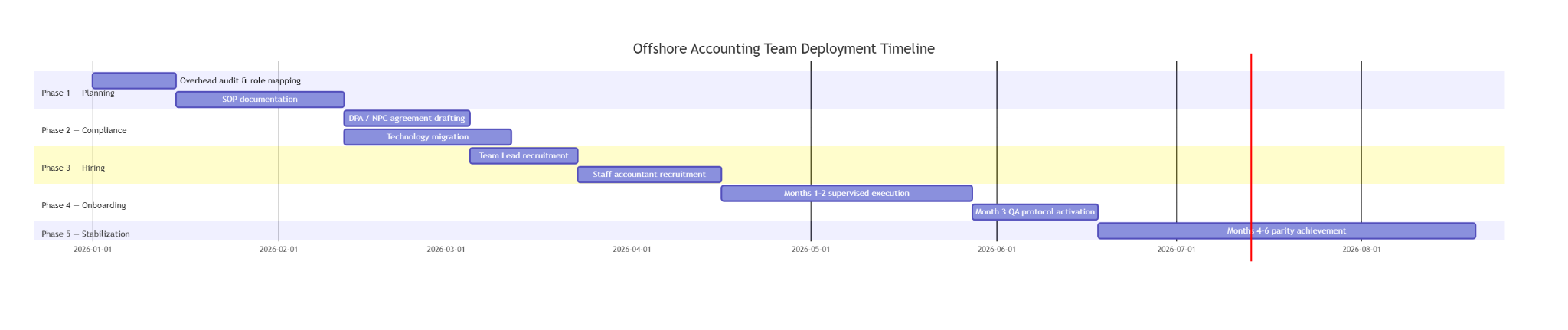
Map every engagement type to a written SOP before a single offshore hire is made. Every engagement type needs a Standard Operating Procedure specifying inputs, outputs, software touchpoints, review checkpoints, and escalation paths.
This takes several weeks. It feels slow. It is often the difference between a functional offshore team and a costly transition with little to show for it.
Step 2: Role architecture and hiring timeline
Hiring timelines for offshore accounting roles vary by seniority — staff-to-senior level roles typically move faster than controller-equivalent positions, which require deeper vetting. If you need staff operational by a specific quarter, plan your hiring process to start well in advance — several months is a reasonable buffer for senior roles.
Build a Philippine-side Team Lead role into your org chart from day one. Consider a modest salary premium above the standard band for this person, since retention and structured career pathing for this role directly affects the stability of the whole offshore team.
Poorly managed offshore leadership turnover is a real cost driver in this model — both in direct rehiring expense and in the disruption to the team it leads — even without a precise industry-wide benchmark to cite.
Philippines offshore accounting team — 6-month deployment timeline for U.S. CPA firms
Step 3: Compliance infrastructure before data transfer
Execute proper data-sharing or data-processing agreements before the first file transfer — not after onboarding. Anecdotally, this is one of the most commonly skipped steps in offshore engagements, since firms tend to treat it as paperwork to catch up on later rather than a prerequisite.
Under the Data Privacy Act of 2012 (RA 10173), U.S.-based accounting firms acting as Personal Information Controllers should maintain properly executed data-sharing or data-processing agreements with Philippine-based Personal Information Processors for all client financial data processed offshore.
The National Privacy Commission can impose administrative fines of up to PHP 5,000,000 (roughly USD $85,000–$90,000) for serious violations under NPC Circular 2022-01 — a real and material exposure that firms often underestimate until it becomes a problem.
Step 4: The overlap window architecture
Async handoffs between U.S. and Philippine teams generate an average of $11,000–$19,000 annually in billable write-offs from rework and error correction. The fix is a mandatory 2-hour daily overlap window: 7–9 AM U.S. Eastern, corresponding to 7–9 PM Philippine Time.
During this window: daily standup, review handoffs, escalation resolution, and client-facing questions requiring U.S. CPA judgment. Everything else runs async.
The Month 3 cliff: Transition risk data
73% of firms report a temporary quality dip in weeks 10–14 as offshore staff transition from supervised task execution to semi-autonomous workflow ownership. Error rates in workpaper preparation spike an average of 18–23% above baseline during this window.
| Transition Phase | Productivity vs. U.S. Equivalent | Primary Risk |
|---|---|---|
| Months 1–2 | 45–60% | Normal ramp; do not over-hire to compensate |
| Month 3 (Weeks 10–14) | Temporary quality dip | Error rates 18–23% above baseline |
| Months 4–5 | 85–92% | Recovery contingent on QA protocol activation |
| Month 6+ | At or above parity | Routine tasks stabilized; advisory layer optimized |
The correct response to Month 3 is a structured QA protocol designed before Month 3 arrives—not improvised during it. Weekly error log reviews, root cause categorization, and targeted retraining on specific failure modes are non-negotiable.
The real P&L math: Before and after restructuring
A 15-person U.S. accounting firm at $4.2M gross revenue can reduce direct labor overhead from 23.3% to 12.1% of revenue through a 4:1 offshore restructuring.
Before restructuring (all U.S. staff)
| Role | Count | Fully-Loaded Cost | Total |
|---|---|---|---|
| Staff Accountants | 8 | $78,000 avg. | $624,000 |
| Senior Accountants | 2 | $105,000 avg. | $210,000 |
| Controller | 1 | $145,000 | $145,000 |
| Total Direct Labor | $979,000 |
Overhead as % of revenue: 23.3%
After restructuring (4:1 offshore ratio)
| Role | Count | Fully-Loaded Cost | Total |
|---|---|---|---|
| U.S. Senior CPAs (review/sign-off) | 2 | $105,000 each | $210,000 |
| U.S. Controller (retained) | 1 | $145,000 | $145,000 |
| PH Staff Accountants | 8 | $10,500 avg. | $84,000 |
| PH Senior Accountants | 2 | $15,200 avg. | $30,400 |
| Offshore management overhead | — | — | $38,000 |
| Total Direct Labor | $507,400 |
Overhead as % of revenue: 12.1% Annual overhead reduction: $471,600 (48.2%) Transition cost estimate: $85,000–$120,000 Payback period: 2.2–3.1 months
5 key benefits of the Philippines offshore accounting model
The Philippines offshore model delivers five compounding structural advantages: overhead compression, credentialed talent access, scalable capacity, U.S. CPA focus, and sector infrastructure maturity.
Benefit 1: Overhead compression that compounds
Meaningfully reducing direct labor overhead doesn’t just improve this year’s margin — it changes your firm’s capacity to price competitively, invest in technology, and absorb client growth without proportional headcount scaling.
Staffing and cost pressure consistently rank among CPA firms’ top operational concerns in the 2026 PCPS CPA Firm Top Issues Survey, underscoring why firms restructuring around an offshore model can meaningfully outpace peers still absorbing rising domestic labor costs.
Benefit 2: Access to a deep, credentialed talent pool
The Philippine IT-BPM sector employed roughly 1.9–2 million people as of 2026, with IBPAP’s Roadmap 2028 targeting 2.5 million total FTEs by 2028. This is not a thin market, and Finance & Accounting is one of its established growth verticals.
Talent density in Metro Manila and Cebu for accounting roles is genuinely exceptional, supported by a demanding CPA licensure exam — recent national pass rates have run in the 30–34% range, making it one of the more selective professional credentials in the country.
Benefit 3: Scalability without proportional overhead growth
Adding a Philippine staff accountant at a fully-loaded cost of roughly $10,000–$15,000 annually, versus a U.S. equivalent commonly in the $65,000–$80,000+ range, changes your capacity expansion math entirely.
You can absorb significantly more client volume for a fraction of the incremental cost — a structural advantage that compounds with each growth cycle.
Benefit 4: U.S. CPA retention and focus
When U.S. CPAs are not doing data entry, bank reconciliations, and workpaper assembly, they are doing client advisory work and complex technical review. That is where their licensure and billing rate justify their cost. Offshore restructuring is, in effect, a U.S. CPA job enrichment program.
Benefit 5: Sector growth momentum and infrastructure maturity
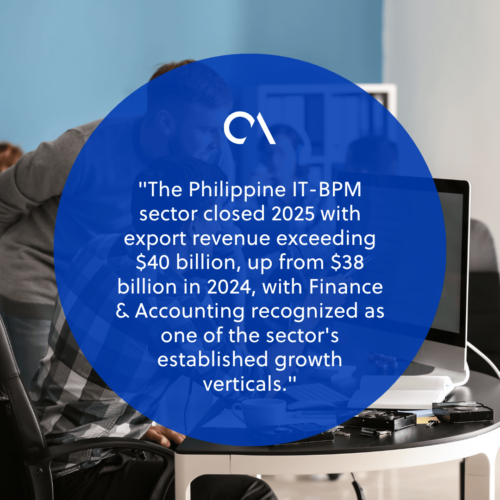
The Philippine IT-BPM sector closed 2025 with export revenue exceeding $40 billion, up from $38 billion in 2024, with Finance & Accounting recognized as one of the sector’s established growth verticals.
The infrastructure, regulatory environment, and talent pipeline supporting this sector are mature and government-backed — this is not an emerging experiment.
Phantom overhead: The four hidden cost categories
Unmanaged hidden costs erode offshore ROI by an average of 22–31%. These four categories account for the majority of that erosion:
| Hidden Cost Category | Annual Impact (10-person team) | Mitigation |
|---|---|---|
| Redundant software licensing (dual-seat U.S. + PH) | $18,000–$34,000 | Consolidate to cloud-native, concurrent-user licensing |
| Offshore manager burnout/turnover (18-month avg. tenure) | $42,000–$67,000 in rehiring/retraining | PH-side Team Lead with 15–20% salary premium |
| Time-zone misalignment rework (async handoff errors) | $11,000–$19,000 in billable write-offs | Mandatory 2-hour daily overlap window |
| Compliance gap penalties (DPA non-execution) | $5,000–$50,000+ in regulatory exposure | Execute DPAs before first data transfer |
The software licensing issue catches almost every firm in the first 90 days. Migrating to cloud-native platforms with concurrent-user or unlimited-user licensing before you hire offshore is a prerequisite, not an afterthought.
Costs & pricing: What U.S. accounting firms actually pay for Philippines offshore teams
A 10-person Philippine offshore accounting team typically costs in the range of $120,000–$165,000 annually fully-loaded — versus roughly $680,000–$780,000 for equivalent U.S. headcount.
Transition costs (recruiting, training, SOP development, and the productivity dip during ramp-up) vary significantly by firm size and complexity, but the cost savings are typically substantial enough that most firms recoup their transition investment within the first year of a structured deployment.
For a full breakdown of engagement structures and service fee models, see our offshore team pricing and engagement models.
Direct labor costs: Philippine statutory obligations
Philippine employer statutory contributions are fixed by law and non-negotiable:
| Statutory Contribution | Employer Rate |
|---|---|
| SSS (Social Security System) employer share | 9.5% |
| PhilHealth employer share | 2.5% |
| Pag-IBIG employer share | 2.0% |
| Total statutory load above base salary | 12–15% |
Role-level monthly cost benchmarks (USD/month, fully-loaded)
| Role | PH Monthly Cost (USD) | U.S. Monthly Equivalent | Monthly Savings |
|---|---|---|---|
| Staff Accountant (2–4 yrs) | $672–$920 | $5,167–$6,000 | $4,247–$5,080 |
| Senior Accountant (5–8 yrs) | $1,008–$1,380 | $7,083–$8,167 | $5,703–$6,787 |
| Audit Associate | $784–$1,073 | $5,667–$6,667 | $4,594–$5,594 |
| Tax Specialist (BIR-trained) | $896–$1,265 | $6,250–$7,667 | $4,985–$6,402 |
| Bookkeeper / AP-AR Clerk | $504–$690 | $4,000–$4,833 | $3,310–$4,143 |
Transition and setup costs
| Cost Category | Typical Range |
|---|---|
| SOP documentation and workflow mapping | $8,000–$18,000 (internal time or consultant) |
| Recruiting and hiring (10-person team) | $12,000–$22,000 |
| Technology migration and licensing restructure | $15,000–$28,000 |
| DPA / compliance infrastructure | $4,000–$9,000 |
| Onboarding and training (Months 1–3 productivity loss) | $18,000–$35,000 |
| QA protocol development | $5,000–$8,000 |
| Total transition cost estimate | $62,000–$120,000 |
Ongoing management overhead (annual)
Budget $38,000–$52,000 annually for ongoing offshore management overhead. This covers Team Lead salary premium, compliance maintenance, technology costs, and overlap window coordination.
Firms that eliminate this line item are the ones managing a quality crisis by Month 4.
| Ongoing Cost Item | Annual Range |
|---|---|
| Team Lead salary premium (15–20% above band) | $1,620–$2,880 |
| Compliance maintenance (DPA renewals, NPC updates) | $2,000–$4,000 |
| Cloud platform licensing (concurrent-user model) | $8,000–$14,000 |
| Overlap window coordination overhead | $4,000–$7,000 |
| QA protocol administration | $3,000–$6,000 |
| EOR / MSP service fees (if applicable, 15–25% above salary) | $18,000–$28,000 |
| Total ongoing management overhead | $38,000–$52,000 |
EOR vs. MSP vs. captive: Cost structure comparison
| Engagement Model | Best For | Service Fee Above Salary | Compliance Handled By |
|---|---|---|---|
| Employer of Record (EOR) | Teams of 1–15 | 15–25% | EOR provider |
| Managed Service Provider (MSP) | Teams of 5–30 | 20–35% | MSP provider |
| Captive entity (own PH subsidiary) | Teams of 30+ | 0% (direct cost) | Your PH legal/HR team |
Global case studies: How offshore accounting models perform across markets
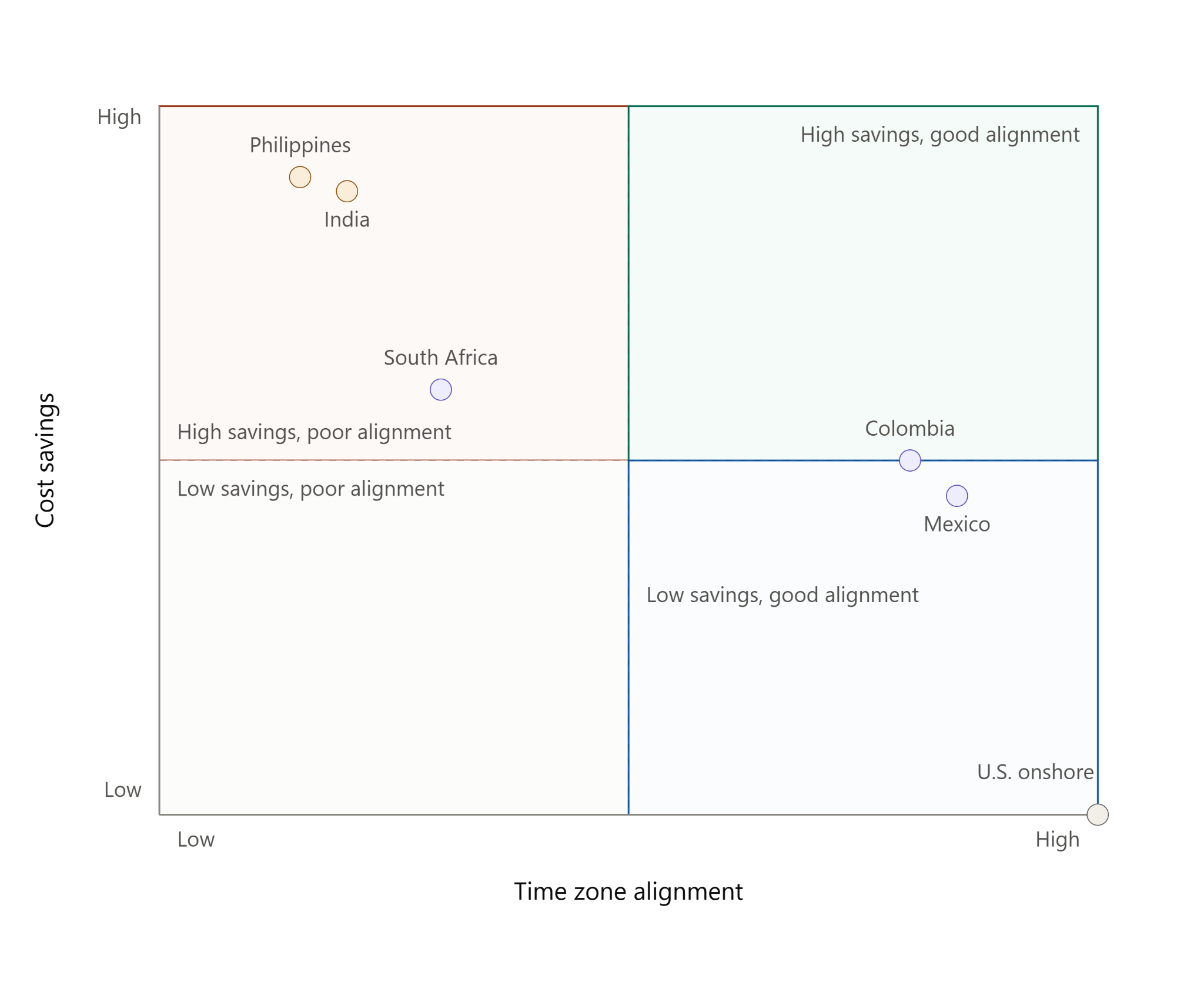
The Philippines is the dominant offshore destination for English-language accounting work, but India, Colombia, and South Africa each serve distinct firm profiles based on cost depth, time zone, and talent density.
Market-by-market structural analysis
Offshore Accounting Destinations — Cost Savings vs. Time Zone Alignment
Philippines: The default choice for U.S. mid-market firms
The Philippines wins on the combination of English proficiency, CPA talent density, established F&A BPO infrastructure, and cost arbitrage depth. The Philippine IT-BPM sector generated $38.9 billion in revenue in 2025, with F&A BPO representing ~$7.1B, per the IBPAP Annual Report 2025.
For a U.S. mid-market accounting firm, it is the default choice for a reason.
Fully-loaded cost vs. U.S. equivalent: 13–18% Primary friction: 12–13-hour time zone gap (manageable with evening shift overlap) Optimal firm size: 5–200+ FTE offshore
India: The large-scale F&A BPO alternative
India offers comparable cost arbitrage and a large Chartered Accountant talent pool (ICAI-licensed), making it the stronger choice for engagements above 50 FTEs. Primary friction points include accent calibration for client-facing roles, a 10.5-hour time zone gap from U.S. Eastern, and a more fragmented BPO market structure.
Fully-loaded cost vs. U.S. equivalent: 14–20% Primary advantage: Depth of CA talent for complex technical work Optimal firm size: 50+ FTE offshore
Colombia and Mexico: The nearshore alternative
Colombia and Mexico offer significant time zone advantages (1–3 hours from U.S. Eastern) with fully-loaded costs running 40–55% below U.S. equivalents. Meaningful savings, but substantially less than the 82–87% arbitrage available in the Philippines.
For firms where real-time collaboration is critical, and cost savings are secondary, nearshore Latin America is worth evaluating.
Fully-loaded cost vs. U.S. equivalent: 45–60% Primary advantage: Near-real-time collaboration with U.S. teams Optimal firm size: Firms prioritizing collaboration over maximum cost reduction
South Africa: The U.K.-facing niche
South Africa is gaining traction for U.K.-facing accounting firms due to time zone alignment with European markets and strong English-language proficiency. Less relevant for U.S.-focused practices, but worth noting for firms with international client bases.
Fully-loaded cost vs. U.S. equivalent: 35–50% Primary advantage: European time zone alignment Optimal firm size: U.K./EU-facing practices
Composite scenario: $4.2M U.S. firm, 10-person offshore team
| Destination | Annual Offshore Labor Cost | Annual U.S. Equivalent | Annual Savings | Time Zone Friction |
|---|---|---|---|---|
| Philippines | $120,000–$165,000 | $680,000–$780,000 | $515,000–$660,000 | Manageable (evening shift) |
| India | $130,000–$180,000 | $680,000–$780,000 | $500,000–$650,000 | Challenging |
| Colombia | $306,000–$429,000 | $680,000–$780,000 | $251,000–$474,000 | Minimal |
| U.S. Onshore | $680,000–$780,000 | $680,000–$780,000 | $0 | None |
Philippines relevance & local examples: Metro Manila, Cebu, PEZA, and the PRC pipeline
The Philippines offers two primary deployment markets for U.S. accounting firms—Metro Manila for talent depth and Cebu for retention efficiency—supported by a government-backed BPO infrastructure and a rigorous CPA licensure pipeline.
Metro Manila vs. Cebu: the location decision
Metro Manila (BGC, Makati, Ortigas) offers the deepest talent pool and most established BPO infrastructure, while Cebu delivers lower attrition rates and 10–15% lower salary costs for teams of 5–15 people.
| Factor | Metro Manila | Cebu City |
|---|---|---|
| Talent pool depth | Very High | High |
| Salary premium vs. provincial rates | Baseline | 10–15% below Manila |
| Attrition rate | Higher (BPO job-hopping common) | Lower (more stable workforce) |
| Top CPA universities | UP Diliman, DLSU, Ateneo | UP Cebu, USC, CIT-U |
| Optimal team size | 20+ FTEs | 5–15 FTEs |
| PEZA-registered BPO availability | Extensive | Growing |
For a first offshore deployment of 8–12 people, Cebu often produces better retention outcomes at lower cost. For teams above 20 people where talent depth matters more than attrition, Manila is the stronger choice.
PEZA registration and its implications
Philippine Economic Zone Authority (PEZA)-registered BPO providers operate under a preferential tax regime that reduces their operating costs—savings that are partially passed through to client pricing.
When evaluating MSP or EOR providers, confirm their PEZA registration status. PEZA-registered providers benefit from income tax holidays and VAT zero-rating on services rendered to foreign clients, under the PEZA Act of 1995 (RA 7916), as later refined by the CREATE Act (RA 11534) and CREATE MORE Act (RA 12066).
This is not a minor detail. A PEZA-registered provider’s cost structure is materially different from a non-registered one, and that difference should be reflected in your service fee negotiation.
The BIR-trained tax specialist advantage
BIR (Bureau of Internal Revenue)-trained tax specialists bring exceptional documentation discipline and deadline management habits that transfer directly to U.S. tax workpaper assembly.
These professionals have hands-on experience with Philippine tax compliance processes that, while not directly transferable to U.S. tax law, produce accountants who are exceptionally detail-oriented on workpaper standards.
For U.S. firms doing high-volume 1040 or 1120 preparation work, a BIR-trained tax specialist trained on U.S. tax software (UltraTax, Lacerte, ProConnect) is a high-value hire at $896–$1,265/month fully-loaded.
The PRC licensure pipeline: Why the talent supply is reliable
The PRC Board of Accountancy administers the Philippine CPA board exam twice annually, in May and October, producing a consistent, government-supported pipeline of credentialed accounting talent.
The October 2025 cycle produced 3,460 new CPAs from 10,171 examinees — a 34.02% pass rate, consistent with recent cycles running in the 30–34% range — reflecting genuine rigor, not rubber-stamp credentialing.
Philippine CPAs who pass the board exam have demonstrated competency in financial accounting, auditing, taxation, and management services. IBPAP’s Roadmap 2028 projects continued growth in the broader IT-BPM workforce, targeting 2.5 million total FTEs by 2028, with Finance & Accounting recognized as one of the sector’s established growth verticals expected to continue absorbing new accounting graduates.
USD/month benchmarks by location
| Role | Metro Manila (USD/Month) | Cebu City (USD/Month) | Savings vs. U.S. Equivalent |
|---|---|---|---|
| Staff Accountant | $672–$920 | $580–$800 | 82–87% |
| Senior Accountant | $1,008–$1,380 | $870–$1,200 | 83–86% |
| Audit Associate | $784–$1,073 | $680–$940 | 83–86% |
| Tax Specialist (BIR-trained) | $896–$1,265 | $780–$1,100 | 83–87% |
| Bookkeeper / AP-AR Clerk | $504–$690 | $440–$600 | 85–87% |
| Team Lead (Senior, +15–20% premium) | $1,210–$1,656 | $1,044–$1,440 | 80–84% |
Data privacy compliance: The NPC framework
The Philippine Data Privacy Act (Republic Act 10173) establishes strict regulations for data transfers. Under NPC Advisory Opinion No. 2024-031, U.S. firms must sign a binding PIP-PIC Data Processing Agreement before moving any client data to a Philippine-based team.
Failing to set up these agreements leaves firms exposed to regulatory audits and substantial compliance penalties, making data privacy a top priority before launching operations.

Conclusion: Restructuring for long-term firm solvency
Transitioning to a blended onshore-offshore labor stack has shifted from an optional cost-cutting tactic to an operational necessity for mid-market firms. With the domestic accounting talent pipeline shrinking and U.S. operating overhead lingering near 38.4%, global labor arbitrage offers a clear path to financial stability and scalable growth.
However, a successful deployment depends entirely on operational discipline. COOs who treat offshoring as a simple headcount replacement run the risk of hitting a costly quality cliff in Month 3, where initial savings are lost to errors and rework.
Long-term success requires respecting clear design constraints: keeping your domestic team focused on high-value advisory work, investing the necessary time to map detailed SOPs, and strictly enforcing cross-border compliance protocols from day one.
Done right, this strategy goes beyond reducing overhead—it builds a predictable, efficient preparation engine that expands your firm’s capacity and drives long-term profitability.
Frequently Asked Questions
Do Philippines-based CPAs understand U.S. GAAP and tax laws?
Yes. Major accounting universities in the Philippines teach financial accounting frameworks heavily modeled on international standards and U.S. GAAP.
Furthermore, top-tier Philippine offshore accountants have spent years working inside major global business processing outsourcing organizations (BPOs), processing corporate structures, tax workpapers, and reconciliations for Western businesses.
However, because they do not carry domestic U.S. licensure, they should operate exclusively as a “preparation engine,” while your onshore U.S. CPAs retain final review and sign-off authority.
Does hiring an offshore team in the Philippines require client disclosure?
Yes. Under AICPA Code of Professional Conduct Section 1.700.040, U.S. CPA firms must notify clients in writing before sharing their confidential information with a third-party service provider.
Most firms successfully handle this by updating their standard engagement letters to include explicit language regarding the use of global delivery centers and secure cloud infrastructure for preparation work.
What is the average turnover rate for offshore accounting teams in the Philippines?
The broader Philippine BPO sector sees an average annual attrition rate of 25–30%, largely driven by entry-level customer service roles. However, in specialized Finance & Accounting (F&A) teams, turnover drops significantly if managed properly.
You can suppress attrition to single digits by hiring a dedicated Philippine-side Team Lead from day one, paying a 15–20% premium over the baseline salary bands, and offering a clear, structured career path inside your firm’s ecosystem.
Can a Philippine offshore team access our local servers directly?
They can, but standard remote desktops are a major security risk. The safest operational method is to use cloud-native platforms with multi-factor authentication (MFA) or structured virtual desktop infrastructures (VDIs) paired with rigid enterprise endpoint protection.
Under the Philippine Data Privacy Act (RA 10173), you must establish an explicit Data Processing Agreement (DPA) with your provider before any remote data sharing occurs.






 Independent





