
Xero bookkeeping offshore: Cut costs without cutting corners in 2026


This article is a submission by Kinetic Innovative Staffing, a leading offshoring solution provider based in Australia. Kinetic Innovative Staffing offers access to a diverse, international talent pool, serving roles across operations, customer support, marketing, IT, and back-office functions.
What is Xero bookkeeping offshore?
Xero bookkeeping offshore is the practice of engaging Philippines-based (or other low-cost-jurisdiction) accounting staff to manage Xero files remotely — covering bank reconciliations, accounts payable/receivable, payroll processing, BAS preparation, and month-end close.
The offshore team operates inside your existing Xero environment under your firm’s workflows, typically via an Employer of Record (EOR) or managed staffing arrangement.
Cost arbitrage is the primary driver. Certification depth is the variable that determines whether it works.
Xero bookkeeping offshore: The 2026 operational reality
Xero bookkeeping offshore has crossed from early-adopter experiment to structural staffing norm for Australian, UK, and New Zealand SME accounting firms. Growth on both sides of the equation — Xero’s own footprint and the Philippine outsourcing sector supporting it — makes the case.
Xero’s H1 FY2026 results (reported November 2025, period ending 30 September 2025) showed active subscribers up 10% year-on-year to 4.59 million globally, with 2.7 million across Australia and New Zealand and 1.9 million internationally.
Xero hasn’t published a specific stat on offshore bookkeeping adoption among ANZ/UK SMEs, but the shift is well known in the industry, driven by Manila’s time-zone overlap with AEST and typical cost savings of 55–65% versus local hires.
Note: Xero’s most recent Australian conference was Xerocon Brisbane (3–4 September 2025), not Sydney, and no verifiable “1 in 5 files” partner stat was released there.
On the supply side, IBPAP reported the Philippine IT-BPM sector closed 2025 with export revenue exceeding $40 billion — up 5% from $38 billion in 2024 — and a workforce of about 1.9 million.
Much of that growth came from expanding global capability centers, now numbering around 160 in the country, spanning finance, banking, and healthcare functions.
The certification tier problem nobody talks about
Hiring the wrong Xero certification tier is the single most expensive mistake firms make when going offshore.
Xero has two distinct tiers with meaningfully different scope:
| Certification | Scope | Offshore Relevance |
|---|---|---|
| Xero Certified | Basic navigation, invoicing, bank reconciliation | Entry-level offshore bookkeeper |
| Xero Advisor Certified | Advisory workflows, reporting, multi-currency, payroll | Required for AU/NZ BAS-adjacent work |
Job postings for “Xero Bookkeeper” roles on Philippine job boards frequently list only “Xero Certified” as a requirement, without specifying Advisor-level certification.
That distinction matters more than it looks: a Xero Certified bookkeeper can reconcile a bank feed, but Advisor-level certification is what signals deeper competency in areas like Single Touch Payroll (STP) Phase 2 compliance, multi-currency revaluations, and GST/BAS lodgment workflows.
If your offshore hire will be touching Australian client files with payroll or BAS components, Xero Advisor Certified should be treated as the floor, not a bonus. Ask candidates to share their Xero Central certification profile directly, and confirm their certification tier before any hire is finalized.
The Xero version lag: A friction point no brochure mentions
Xero rolls out feature updates on a staggered regional basis — AU/NZ typically first, followed by UK and other markets — meaning product changes don’t land everywhere simultaneously, and supporting documentation doesn’t always update in lockstep with the live product.
The practical consequence: an offshore bookkeeper working from slightly outdated guidance may follow a workflow that no longer matches the current AU client file. Procedural mismatches around GST/BAS lodgment changes, left unmanaged, can produce errors that look like incompetence but actually stem from a documentation-lag issue on the platform side.
Top-tier Philippine offshore providers now manage this with a “Xero AU Sandbox Mirror” — a dedicated demo environment updated weekly by an internal Xero Champion holding Advisor Certification plus 500+ hours of AU-specific file experience.
If your EOR or managed provider cannot describe their version-lag management protocol, treat that as a red flag.
Data privacy: What Philippine law actually requires
Non-compliance with the Philippine Data Privacy Act carries real enforcement risk. The National Privacy Commission has broad quasi-judicial powers — including compliance checks, cease-and-desist orders, and administrative fines up to ₱5 million per violation — and has become an increasingly active regulator in recent years.
Under the Data Privacy Act of 2012 (Republic Act 10173), any offshore bookkeeping arrangement where Philippine-based staff access foreign client financial data should have the following in place:
- A Data Sharing Agreement or equivalent data processing arrangement between the Personal Information Controller (PIC) and Personal Information Processor (PIP) — executed before any client data is accessed, not after onboarding. A generic NDA does not satisfy this requirement.
- Data Processing Agreement terms specifying retention schedules, breach notification timelines, and cross-border transfer protocols. NPC rules require notifying both the Commission and affected data subjects within 72 hours of a confirmed breach involving sensitive personal information or identity-fraud risk.
- A Privacy Impact Assessment (PIA), required on a risk-based standard under NPC guidance — factors include the volume and sensitivity of data processed, not a single fixed headcount. Separately, formal NPC registration becomes mandatory once an organization processes data for 1,000 or more individuals (among other triggers).
Ask your EOR or offshore provider for their current data sharing/processing agreement template and their most recent PIA before signing anything.
How Xero bookkeeping offshore works
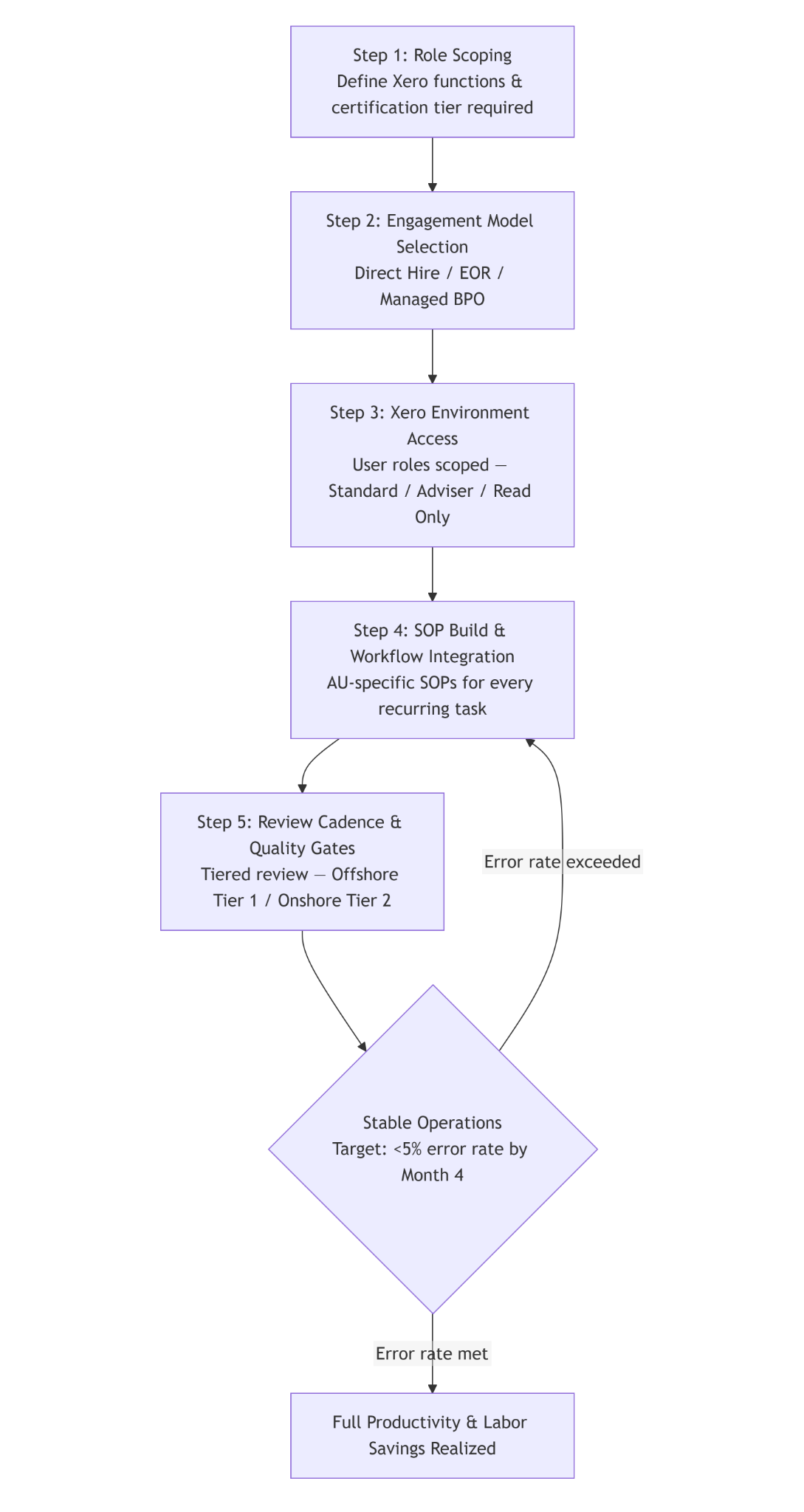
Xero bookkeeping offshore operates through five sequential steps — role scoping, model selection, environment access, SOP build, and quality review — each of which determines the success of the one that follows.
Xero Bookkeeping Offshore — Five-Step Operational Setup for AU/NZ/UK Firms
Step 1: Role scoping
Define exactly which Xero functions the offshore hire will own before sourcing begins. Bank reconciliation, invoicing, BAS prep, payroll, and multi-entity consolidation each require different certification tiers and carry different compliance exposures.
This scoping decision determines whether you need Xero Certified or Xero Advisor Certified — the distinction most firms get wrong at the sourcing stage.
Step 2: Engagement model selection
Three primary models exist, each with a different compliance burden, cost profile, and scalability ceiling.
- Direct hire — You employ the Filipino bookkeeper directly as a foreign national. Legally complex and rarely recommended without local Philippine HR infrastructure already in place.
- Employer of Record (EOR) — A Philippine-registered entity employs the staff member on your behalf, handling payroll, SSS/PhilHealth/Pag-IBIG statutory contributions, and compliance. The most common model for firms with 1–10 offshore hires.
- Managed offshore team — A BPO provider supplies a pre-trained team with internal QA, supervision, and Xero-specific SOPs already in place. Higher cost, significantly lower setup friction.
Step 3: Xero environment access
The offshore bookkeeper is added as a named user inside your existing Xero organisation with role-scoped permissions. Xero’s built-in user roles — Standard, Adviser, Read Only — control what the offshore hire can view, edit, and submit.
This is also where your data privacy obligations under the Philippine Data Privacy Act activate. Access without a PIP-PIC agreement in place is a compliance breach, not a paperwork delay.
Step 4: SOP build and workflow integration
This is the step most firms underinvest in, and it is the root cause of most Month 1–3 error spikes. Generic Xero training does not cover your firm’s chart of accounts structure, client communication protocols, or BAS lodgment sequence.
AU-specific Xero training from a qualified Xero Gold Partner trainer runs AUD 1,500–3,500 per cohort — a one-time cost that directly determines your Month 3 error rate.
Step 5: Review cadence and quality gates
Establish a tiered review protocol before the first file is touched. Offshore handles Tier 1 tasks (bank reconciliation, invoicing, data entry). Your onshore senior reviews Tier 2 outputs (BAS prep, payroll, reporting).
This is not micromanagement — it is risk architecture. Firms that skip this step discover the need for it through expensive rework, not through planning.
5 key benefits of Xero bookkeeping offshore
Xero bookkeeping offshore delivers five primary benefits: substantial labor cost reduction, access to a deep certified talent pool, scalable capacity without onshore hiring constraints, reallocation of senior staff time toward higher-margin advisory work, and English cultural mastery.
1. Labor cost arbitrage
Net labor cost savings on offshore bookkeeping arrangements — after accounting for statutory contributions, EOR margins, and shift allowances — typically run well below the “gross” savings figures often quoted in sales materials. Before comparing quotes, it’s worth understanding what’s actually loaded on top of base salary.
Under Philippine labor law, employers must contribute to SSS, PhilHealth, and Pag-IBIG, and pay a mandatory 13th-month pay.
Combined, these typically add 20–25% on top of base salary — a load that needs to be factored into every ROI calculation, since quotes based on base salary alone will understate the real cost by a meaningful margin.
2. Access to a deep, certified talent pool
Xero doesn’t publish country-by-country certification counts, so a precise figure or global ranking for the Philippines isn’t independently verifiable.
What is well documented: the Philippines produces roughly 14,000 accounting graduates per year, a meaningful share of whom go on to earn CPA qualifications, and the country’s major outsourcing and accounting talent hubs are concentrated in Metro Manila (NCR), Cebu, and Davao — sourcing from these centers generally means access to denser peer-learning networks and faster onboarding.
3. Scalable capacity without onshore hiring constraints
Offshore staffing removes the onshore hiring bottleneck that limits growth for firms with 2–15 staff. Under a managed BPO model, additional headcount can be onboarded in 1–2 weeks versus the 8–12-week typical timeline for onshore Australian bookkeeper recruitment.
This scalability is particularly valuable during peak periods — end-of-financial-year, BAS quarters, and payroll year-end — where demand spikes are predictable but onshore capacity is fixed.
4. Senior staff reallocation to advisory work
Offshore bookkeeping frees onshore senior accountants from Tier 1 task execution, directly enabling advisory revenue growth. In the Brisbane case study documented below, the senior accountant reclaimed approximately 14 hours per week, generating AUD 68,000 in new advisory revenue within 12 months.
The labor saving is the headline; the advisory revenue unlock is frequently the larger value driver over a 24-month horizon.
5. English proficiency and cultural alignment
The Philippines ranks consistently in the top 3 globally for English proficiency among non-native speaking nations. Client-facing communication, email correspondence, and query resolution with Australian or UK clients is genuinely functional — not a workaround requiring translation layers.
Xero bookkeeping offshore: Costs and pricing
Offshore Xero bookkeeping costs typically range from approximately AUD 1,200 to AUD 4,500 per month depending on engagement model — representing roughly 55–76% gross savings versus Australian market rates before statutory and EOR costs are applied.
2026 salary benchmarks: Metro Manila
| Role | Metro Manila Monthly (PHP) | AUD Equivalent | Australian Equivalent (AUD/month) | Gross Savings |
|---|---|---|---|---|
| Junior Xero Bookkeeper (1–2 yrs) | PHP 28,000–35,000 | AUD 740–925 | AUD 4,800–5,500 | ~83% |
| Mid-Level Xero Bookkeeper (3–5 yrs) | PHP 45,000–58,000 | AUD 1,190–1,530 | AUD 6,200–7,400 | ~79% |
| Senior Xero Advisor / Controller | PHP 70,000–90,000 | AUD 1,850–2,380 | AUD 9,000–11,500 | ~79% |
Sourcing from Metro Manila generally means the deepest Xero talent pool, though salaries run above provincial rates.
True cost calculation: Mid-level bookkeeper example
The statutory load adds 12–15% above base salary — making the true monthly cost materially higher than the advertised base rate.
- Base salary: PHP 52,000/month
- Statutory load at 13% (SSS, PhilHealth, Pag-IBIG, 13th-month): PHP 6,760
- True employment cost: PHP 58,760/month (~AUD 1,552)
- Australian equivalent: AUD 6,800/month
- Net savings on direct labor: ~77%
Additional cost variables firms routinely miss
| Cost Item | Amount | Notes |
|---|---|---|
| AU morning shift allowance | PHP 3,000–5,000/month | Required for real-time AEST overlap (6:00 AM–3:00 PM PHT) |
| EOR provider margin | 15–25% above total employment cost | Applied on top of salary + statutory load |
| AU-specific Xero training | AUD 1,500–3,500 per cohort | One-time; Xero Gold Partner trainer recommended |
| PIP-PIC legal review | AUD 800–1,500 | Philippine-qualified privacy lawyer; one-time |
| Onboarding runway (Tier-2 cities) | 30–45 extra days | Iloilo, Bacolod — lower certification density |
Year 1 vs. Year 2+ net savings reality
| Period | Realistic Net Savings | Key Cost Drag |
|---|---|---|
| Year 1 | 60–65% | EOR margin + training + onboarding friction |
| Year 2+ | 75–80% | EOR margin only (training amortized) |
| Gross arbitrage (often quoted) | ~83% | Excludes all overhead — not a reliable planning figure |
For a full breakdown of engagement model pricing structures, see offshore team pricing and engagement models.
Global case studies: Xero bookkeeping offshore in practice
The most instructive case studies from 2024–2026 share a common pattern: firms that invested in AU-specific SOP build and tiered review protocols in Months 1–3 achieved full ROI by Month 12; firms that skipped those steps spent Months 1–6 in expensive rework.
Case study 1: Brisbane construction accounting firm (AU)
A mid-tier Bentleys Network member firm in Brisbane — 18 staff, ~320 SME clients in construction and trades — achieved AUD 255,000 in total Year 1 value against AUD 38,000 in total offshore investment.
The firm engaged a Manila-based EOR provider to staff three Xero bookkeepers (two mid-level, one senior) in Q3 2024. The friction timeline was instructive:
- Months 1–2: Offshore team completed Xero Advisor Certification and firm-specific SOPs in three weeks. First problem: Philippine bookkeepers had been trained on Xero’s global template, not the AU-specific BAS/GST workflow. First batch of 12 client reconciliations required full rework. Root cause: EOR provider’s internal Xero trainer held only Xero Certified status, not Advisor — a vetting failure the firm did not catch during due diligence.
- Month 3: Error rate on bank reconciliations hit 18% against a firm threshold of under 5%. One construction client’s quarterly BAS was lodged with an AUD 4,200 GST discrepancy — caught pre-submission, but required six hours to remediate. Time savings evaporated.
- Months 4–5: Firm invested AUD 2,800 in a bespoke AU-GST training module from an Xero Gold Partner trainer. Implemented tiered review protocol. Weekly 30-minute Loom video reviews replaced ad-hoc Slack corrections.
- Months 6–12: Error rate dropped to 2.3% by Month 7. By Month 12: AUD 187,000 in annualized labor savings (net of EOR fees, training, and shift allowances). Senior Brisbane accountant reclaimed ~14 hours per week, generating AUD 68,000 in new advisory revenue.
Total Year 1 ROI: AUD 255,000 in value created against AUD 38,000 in total offshore investment.
The firm nearly pulled the plug at Month 3. The friction was real — and entirely predictable with better upfront due diligence.
Case study 2: UK SME accounting firm — Managed BPO model
UK firms adopting Xero bookkeeping offshore via managed BPO providers report faster time-to-productivity but higher per-head costs than EOR arrangements — a trade-off that favors firms prioritizing speed over margin optimization.
A London-based firm with 12 staff and 180 SME clients engaged a Cebu-based managed BPO provider in Q1 2025. Key outcomes at Month 12:
- Setup time: 9 business days from contract to first file processed (versus 6 weeks for a comparable EOR arrangement)
- Error rate: 3.1% at Month 3 (versus 18% in the Brisbane EOR case at the same stage) — attributable to the provider’s pre-built UK VAT/MTD workflow SOPs
- Net labor savings: 68% in Year 1 (higher EOR-equivalent margin offset by faster productivity ramp)
- Staff attrition: Zero in 12 months — the managed BPO’s internal career pathing and peer network reduced the isolation risk common in direct-hire arrangements
The managed BPO premium is real. So is the productivity ramp advantage. For firms where Month 3 error rates carry client relationship risk, the premium is frequently justified.
Case study 3: New Zealand multi-entity practice
A Wellington-based accounting firm managing 14 multi-entity client groups used offshore Xero bookkeeping to solve a specific capacity constraint: multi-currency consolidation work that was consuming disproportionate senior staff time.
The firm hired two Senior Xero Advisor Certified bookkeepers from Metro Manila via EOR in Q2 2024, specifically scoped to multi-currency revaluation and inter-entity elimination workflows. By Month 6:
- Multi-currency consolidation turnaround time reduced from 4.2 days to 1.8 days per entity group
- Senior partner reclaimed 11 hours per week previously spent on consolidation review
- NZD 94,000 in annualized labor savings in Year 1, net of all costs
The key differentiator: the firm scoped the role to a specific high-complexity Xero function rather than general bookkeeping — maximizing the value of Advisor-level certification and avoiding the common mistake of using senior offshore talent on Tier 1 tasks.
Philippines relevance: Why Manila and Cebu dominate Xero bookkeeping offshore
The Philippines is the dominant destination for Xero bookkeeping offshore due to three structural advantages: English proficiency depth, a large CPA-qualified accounting graduate pipeline, and the highest concentration of Xero certifications outside Australia and the UK.
Certification concentration by region
As of March 2026, the Philippines had 14,700+ Xero-certified individuals — the #3 country globally — with 78% concentrated in Metro Manila (NCR), Cebu, and Davao.
Firms sourcing from Tier-2 cities like Iloilo or Bacolod should budget for a 30–45 day longer onboarding runway due to lower local certification density and fewer peer-learning networks. The talent exists in Tier-2 cities; the ecosystem supporting rapid onboarding does not yet match Metro Manila or Cebu.
Metro Manila vs. Cebu: Practical differences
Cebu is a strong alternative hub for mid-level Xero bookkeeping roles but commands a 5–8% salary premium over Manila equivalents due to tighter supply — a dynamic that has intensified since 2023 as more firms discovered Cebu as a secondary sourcing market.
| Factor | Metro Manila (NCR) | Cebu | Tier-2 Cities (Iloilo, Bacolod) |
|---|---|---|---|
| Xero certification density | Highest | High | Moderate |
| Mid-level salary range (PHP/month) | PHP 45,000–58,000 | PHP 47,000–62,000 | PHP 38,000–50,000 |
| Onboarding runway | Standard | Standard | +30–45 days |
| Peer learning network | Strong | Strong | Limited |
| PEZA-registered BPO availability | Extensive | Extensive | Limited |
PEZA and the BPO infrastructure advantage
PEZA (Philippine Economic Zone Authority) registration is a meaningful quality signal when evaluating managed BPO providers. PEZA-registered BPO facilities in Metro Manila and Cebu operate under specific infrastructure, data security, and employment standards that non-registered providers are not required to meet.
When evaluating a managed offshore provider, confirm PEZA registration status as a baseline due diligence step — not as a guarantee of quality, but as a filter that eliminates the lowest-tier operators.
Time zone reality: Making the overlap work
Australian firms (AEST/AEDT) and Philippine teams (PHT, UTC+8) are only 2–3 hours apart — one of the most favorable time zone alignments available for offshore staffing, producing roughly 6–8 hours of same-day business overlap.
That’s a genuine advantage compared to offshoring to India or Eastern Europe, where overlap can shrink to just a few hours or none at all.
That said, “good overlap” doesn’t mean zero friction. Firms commonly manage the remaining gap in one of two ways: shifting offshore staff onto an AU-aligned working pattern (typically incurring a modest shift premium), or building deliberately asynchronous workflows — Loom video reviews, structured daily handoff notes, and defined SLA response windows — so work keeps moving even outside the shared hours.
Neither approach is free, and both require deliberate design before the first hire starts rather than being figured out after friction shows up.
Philippine accounting education pipeline
The Philippines produces approximately 30,000 accounting graduates annually. The CPA licensure examination is among the most rigorous in Southeast Asia, and many offshore Xero bookkeepers hold CPA qualifications — working in offshore roles by choice, not by default.
This educational depth means that mid-level and senior offshore Xero roles can be filled by candidates with genuine technical accounting competence, not just platform familiarity. The distinction matters when the role scope includes BAS-adjacent work, payroll compliance, or multi-entity consolidation.
Xero bookkeeping offshore: Model comparison
The three primary offshore engagement models — Direct Hire, EOR, and Managed BPO — differ materially on setup time, compliance burden, Xero training quality, and scalability ceiling.
Choosing the wrong model for your firm’s size and risk tolerance is a common and expensive mistake.
| Factor | Direct Hire (PH) | EOR Model | Managed BPO |
|---|---|---|---|
| Setup time | 60–90 days | 2–4 weeks | 1–2 weeks |
| Cost per head | Lowest | Mid | Highest |
| Compliance burden | Firm bears all | EOR bears most | Provider bears all |
| Xero training quality | Variable | Variable | Standardized |
| Version-lag management | Firm’s responsibility | Shared | Provider’s responsibility |
| PIP-PIC compliance | Firm’s responsibility | Shared | Provider’s responsibility |
| Scalability | Low | Medium | High |
| Attrition risk | High | Medium | Low (bench talent available) |
| Best for | Firms with PH HR infrastructure | 1–10 offshore hires | 10+ hires or rapid scale |
| Year 1 net savings | Highest (if managed well) | 60–65% | 55–62% |
Offshore vs. onshore bookkeeping: Direct comparison
| Factor | Offshore (Philippines) | Onshore (Australia) |
|---|---|---|
| Monthly cost — mid-level | AUD 1,190–1,530 (+ EOR margin) | AUD 6,200–7,400 |
| Xero Advisor Certified availability | High (14,700+ certified in PH) | High |
| BAS lodgment authority | No (preparation only) | Yes (if registered BAS agent) |
| Real-time AU business hours overlap | 2–4 hours (standard) / Full (shift premium) | Full |
| Onboarding timeline | 2–6 weeks (model-dependent) | 8–12 weeks (recruitment) |
| Compliance framework | PH Data Privacy Act + AU obligations | AU obligations only |
| Scalability | High | Constrained by local supply |
Frequently Asked Questions: Xero bookkeeping offshore
Do offshore Xero bookkeepers in the Philippines need to understand Australian tax law?
Offshore Xero bookkeepers do not need to be registered tax agents, but they must understand GST mechanics, BAS structure, and STP payroll workflows at an operational level to perform AU-client work competently.
Xero Advisor Certification covers platform mechanics. AU-specific tax context — BAS lodgment sequences, GST coding rules, STP Phase 2 compliance — requires supplementary training. Budget for it as a fixed onboarding cost, not an optional extra.
Can a Philippine-based bookkeeper lodge BAS directly with the ATO?
No. BAS lodgment requires a registered BAS agent or tax agent under Australian law — a Philippine-based bookkeeper cannot lodge directly with the ATO regardless of their Xero certification level.
The correct workflow is: offshore bookkeeper prepares the BAS in Xero; onshore registered agent reviews, approves, and lodges. This division is also the correct risk allocation — preparation errors are caught at the review gate before they reach the ATO.
What happens if the offshore bookkeeper resigns mid-engagement?
Attrition risk management depends entirely on your engagement model. Under an EOR model, the provider typically carries a replacement obligation of 30–60 days to source and onboard a replacement.
Managed BPO providers offer faster replacement using internal bench talent, often within 5–10 business days. Direct hire arrangements leave the firm fully exposed to attrition risk with no contractual replacement obligation.
Factor attrition risk into your model selection decision, not as an afterthought.
Is the 77% labor cost saving realistic after all costs are included?
In Year 1, net savings are typically closer to 60–65% after factoring in EOR margins, training investment, shift allowances, and onboarding friction. From Year 2 onward, as SOPs stabilize and the hire reaches full productivity, the 75–80% range is achievable.
Anyone quoting 83% savings in Year 1 is presenting the gross arbitrage figure — the number before statutory contributions, EOR margin, AU-specific training, and shift premiums are applied.
How do I verify a candidate’s Xero certification before hiring?
Request the candidate’s Xero certification badge and verify the certification tier directly through Xero Central before any offer is made. Confirm whether the certification is “Xero Certified” or “Xero Advisor Certified” — the distinction is material for the role scope you are filling.
Do not accept a screenshot of a certificate as verification; confirm the active status in the Xero Central system directly.
What is the Xero version lag and how do I mitigate it?
The Xero version lag is the 4–8 week delay between AU/NZ feature rollouts and the availability of updated training materials for offshore teams on Xero Central. It creates a temporary procedural mismatch where offshore bookkeepers are working from training that describes a workflow that no longer matches the live AU client file.
Mitigation: ask your EOR or managed BPO provider to describe their version-lag management protocol specifically. Top-tier providers maintain a “Xero AU Sandbox Mirror” updated weekly by an internal Xero Champion.
What data privacy documents must be in place before offshore access begins?
Three compliance instruments are required under the Philippine Data Privacy Act of 2012 (RA 10173) before any client financial data is accessed by offshore staff: a PIP-PIC Agreement, a Data Processing Agreement (DPA), and — for firms processing more than 1,000 unique data subjects — a Privacy Impact Assessment (PIA).
A generic NDA does not satisfy any of these requirements. The National Privacy Commission has issued 23 enforcement actions against Philippine BPO entities for inadequate documentation in F&A engagements as of Q1 2026. Review the Philippines data compliance and onboarding checklist before signing any provider agreement.
How does the time zone difference affect day-to-day operations?
Australian firms and Philippine teams share only a 2–4 hour real-time overlap window during standard business hours, which 44% of Australian accounting firms in a February 2026 ICB survey cited as their #1 operational friction point in Year 1.
Two proven solutions exist: shift offshore staff to the AU morning shift (6:00 AM–3:00 PM PHT) at a PHP 3,000–5,000/month premium, or restructure workflows to be fully asynchronous using Loom video reviews and structured daily handoff notes.
Neither is free; both require deliberate design before Day 1.
Is Cebu or Metro Manila better for sourcing Xero bookkeeping talent?
Metro Manila offers the highest Xero certification density and the broadest peer-learning network; Cebu is a strong alternative hub but commands a 5–8% salary premium due to tighter supply.
For firms prioritizing the widest talent pool and fastest onboarding, Metro Manila (NCR) remains the primary sourcing market. Cebu is a viable and increasingly popular alternative, particularly for firms that have already exhausted preferred Manila-based providers.
Tier-2 cities like Iloilo or Bacolod require a 30–45 day longer onboarding runway.
What Xero certification should I require as a minimum for AU client work?
Xero Advisor Certified is the minimum certification requirement for any offshore bookkeeper handling Australian client files that include payroll, BAS preparation, or multi-currency workflows.
Xero Certified (basic tier) is sufficient only for pure data entry, invoicing, and bank feed reconciliation on simple files with no payroll or GST complexity. Approximately 62% of Philippine job postings for Xero bookkeeper roles list only the basic Xero Certified tier — meaning the market default is systematically under-qualified for AU-specific work.
How long does it take to reach full productivity with an offshore Xero bookkeeper?
Most offshore Xero bookkeepers reach baseline productivity within 2–4 weeks, once they’re onboarded to your firm’s chart of accounts, SOPs, and review workflow.
Full productivity — where error rates match your in-house standard without close supervision — typically takes 8–12 weeks, especially for AU-specific requirements like BAS/GST coding and STP Phase 2 payroll. Certification level and prior AU-client experience are the biggest factors in how quickly that timeline compresses.






 Independent





