
5 Proven remote employee engagement strategies

Table of contents
- The importance of remote employee engagement
- Actively engaged vs disengaged employees
- 5 Remote employee engagement strategies that surely work
- How Remote Employee supports remote employee engagement
- FAQs
How to improve remote employee engagement
How do you improve remote employee engagement?
You improve remote employee engagement by setting clear goals, recognizing good work, gathering feedback often, building community, and backing career growth.
- Engaged staff share ideas and work together. Disengaged staff pull back and work alone.
- Managing remote staff is hard. Motivation, teamwork, and output all need real care.
- Providers like Remote Employee can help you run these strategies at scale.
The importance of remote employee engagement
Keeping remote teams engaged is one of the biggest challenges for growing businesses. Without visibility and steady communication, even strong performers can drift over time.
Remote teams offer flexibility and efficiency. However, they also need intentional leadership to stay connected and productive. Firms that invest in remote employee engagement often see higher performance, stronger employee retention, and better teamwork. Low engagement, by contrast, is one of the most common employee retention problems leaders face.
Remote Employee CEO and Co-founder Ruffy Galang puts it simply: “Connection isn’t optional; it’s the backbone of engagement in dispersed teams. It’s not just theory; it’s the industry pulse.”
According to Gallup’s State of the Global Workplace report, only 21% of employees worldwide are engaged at work. So disengaged employees can cut productivity and weaken workplace culture.
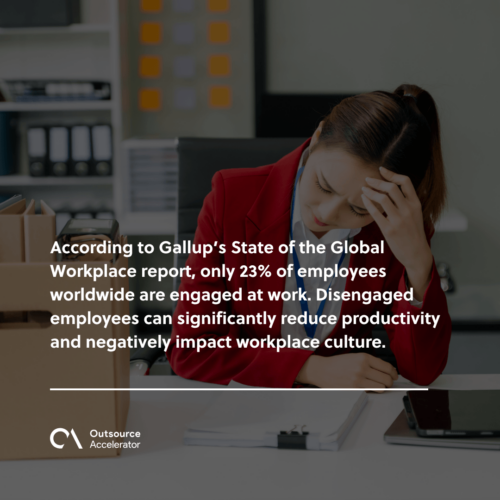
In addition, Gallup reported that low employee engagement cost the global economy $438 billion in 2024.
Key takeaway: Remote employee engagement is a key driver of long-term business success.
Actively engaged vs disengaged employees
Knowing the difference between engaged and disengaged employees helps managers spot problems early. So they can build stronger remote teams. Below is a simple comparison.
| Actively engaged employees | Disengaged employees |
| Feel motivated and enthusiastic about their work | Often feel disconnected from their responsibilities |
| Contribute ideas and join team discussions | Do the bare minimum required |
| Take ownership of projects and outcomes | Avoid extra responsibilities |
| Feel connected to company goals and values | Feel detached from the company’s direction |
| Support collaboration and teamwork | Work in isolation and lack team involvement |
Pro tip: Companies must proactively build remote employee engagement strategies that keep connection, communication, and motivation strong.
5 Remote employee engagement strategies
Strong engagement in remote teams needs intentional leadership and steady communication. Here are five proven strategies that help organizations improve.
1. Set clear expectations and goals
Clarity is critical when managing remote teams. Remote employees do their best when they know their duties, targets, and key deliverables.
So managers should set clear KPIs, deadlines, and communication channels. Regular check-ins, employee engagement tools, and open goal tracking keep people focused and accountable. When expectations are clear, staff feel more confident and engaged.
2. Celebrate wins
Recognition plays a major role in remote employee engagement. For example, celebrating wins, big or small, helps staff feel valued. This recognition can take many forms, such as:
- Public shout-outs during team meetings
- Recognition in company chat channels
- Performance bonuses or incentives
- Employee appreciation programs
For more, see these remote employee recognition ideas. In short, praise motivates people to keep performing. It also reinforces a positive workplace culture.
3. Collect feedback regularly
Virtual team engagement is a two-way process. So companies must give staff a chance to share thoughts, concerns, and ideas. Regular feedback can come through:
- Employee engagement surveys
- One-on-one meetings
- Anonymous feedback tools
- Team retrospectives
In addition, listening helps leaders learn what works and what needs fixing. It also shows staff that their voices matter, which strengthens engagement.
4. Foster a sense of community
One of the biggest challenges of remote work is the lack of social contact. Without chances to connect, staff may feel isolated. So companies can build stronger bonds with spaces for remote collaboration, such as:
- Virtual coffee chats
- Online team-building activities
- Slack or Teams channels for casual talk
- Joint projects across departments
As a result, these steps build relationships and a shared sense of purpose within remote teams.
5. Support professional development
In fact, employees are more engaged when they see room to grow. So companies can lift engagement by investing in development through:
- Training programs and workshops
- Mentorship opportunities
- Online courses or certifications
- Clear career progression paths
When staff feel their company backs their growth, they stay motivated and committed. Over time, this also feeds a healthier remote work culture.
How Remote Employee supports remote employee engagement
Building and managing a remote workforce needs the right setup, support, and management. To help with this, BPO firms like Remote Employee give businesses access to skilled remote professionals across many roles.
Some of the ways Remote Employee supports remote teams include:
- Providing vetted remote professionals
- Supporting communication and collaboration frameworks
- Encouraging structured performance management
- Helping companies keep a strong remote team culture
By partnering with a trusted provider, businesses can focus on growth. Meanwhile, their remote workforce stays engaged and productive. To learn more about Remote Employee’s outsourcing solutions, get in touch with them here.
FAQs
What is remote employee engagement?
Remote employee engagement is the level of motivation, commitment, and connection remote workers feel toward their work and company. In addition, engaged employees are more productive and more invested in company success.
What are common challenges in remote employee engagement?
Common challenges include isolation, weak communication, unclear expectations, and few chances to collaborate. So companies must tackle these issues head-on to keep engagement high.
How do you measure remote employee engagement?
Track it with regular surveys, one-on-one check-ins, and clear KPIs. In addition, watch retention, output, and participation in team activities. Together, these signals show whether engagement is rising or falling.
Can outsourcing help improve remote employee engagement?
Yes. Providers like Remote Employee offer structured management systems and support services. So businesses can build well-supported, engaged remote teams with less effort.






 Independent






