
All you need to know about performance management systems (with examples)


What are performance management systems?
Performance management systems are structures that set goals, measure work, and review how well employees perform.
They help firms stay efficient and keep growing. Here is the quick view:
- They set clear targets for each employee.
- They measure work against those targets.
- They point out where people can improve.
Efficiency is what keeps a business from tanking. Efficient firms thrive, and thriving firms prosper.
So how do firms gain and keep that efficiency? They use strong performance management systems, of course.
If you work in human resources, you may know this term well. Still, for owners who are new to it, this guide can help. So read on to start learning.
What is a performance management system?
As the name implies, these systems set expectations, measure work, and review employee performance. In short, they keep everyone aligned on results.
Many types of systems exist across different firms. Still, most mix informal check-ins with formal reviews on a set schedule.
No matter the type, all systems share three common goals:
1. Set an ideal and expected level of work for staff.
2. Measure how well staff perform against those metrics.
3. Find areas to improve based on the results.
4 Types of performance management systems
Every firm has its own needs, steps, and priorities. So they each measure workplace efficiency in their own way.
Here are the performance management systems that firms use most.
Balanced Scorecard
The Balanced Scorecard suits firms that measure work across many areas. Think of it as a report card for staff.
Instead of one mark, it shows how a worker did across the whole job. For example, take an employee at a call center.
Common metrics used to measure performance here include average handle time and agent utilization rate. Rather than judge an agent on one metric, this system averages scores across weighted categories. As a result, it gives a fuller, more balanced view.
360-degree Feedback System
The 360-degree Feedback System works in a different way. It uses anonymous input from many people as the basis for review.
The inputs come from people who work with the employee. So the result gives a rounded view of skills and behavior.
This method leans more qualitative than quantitative. As such, it helps measure soft skills, such as:
- Character
- Collaboration
- Leadership
- Overall workplace behavior
HR staff often use surveys or feedback forms for this review. In this way, it links closely to employee engagement.
Objectives and Key Results (OKR)
The OKR framework is one of the most used systems today. It gives firms a simple way to track and measure work.
OKR has two parts: objectives and key results. Objectives are the goals set for staff within a set time.
Key results are the clear, measurable outcomes that show if staff met those goals. Firms often run OKR reviews each quarter, but some do it more often. Simple OKR measurement keeps this on track.
OKR sounds like KPI, but the two shouldn’t be conflated. Both track metrics. Still, KPI tracks performance, while OKR sets and reaches goals.
Management by Objectives (MBO)
Like OKR, Management by Objectives sets goals that staff must reach. So the two share a clear focus on targets.
What sets MBO apart is that it has no clear key results. Instead, MBO looks at the big picture, which is the set goal.
So firms that track employee performance with MBO care most about whether a goal is met. For example, a firm could set “Improve Customer Experience” as an objective.
With OKR, that goal would break into clear metrics, such as:
- Increased Net Promoter Score from 0 to 85
- Achieve post-service CX survey scores of 90% or higher
- Reduce customer service response time to under 1 hour
Core components of performance management systems
Firms can pick from many systems. Still, most share a few basic parts.
Planning and goal setting
Clear goals are key to any performance management system. When you set the goalposts early, staff know what to aim for. As a result, they can gauge how well they are doing.
Objectives should always be SMART, or:
- Specific: Staff must know the goal (e.g., reduce AHT)
- Measurable: You must be able to quantify it (e.g., reduce AHT by a set percent)
- Achievable: It must be within reach (e.g., reduce AHT by 20%)
- Realistic: It must fit the role (e.g., reduce AHT by 20% for inbound agents)
- Time-bound: It needs a set period (e.g., reduce AHT by 20% within 3 months)
Constant communication
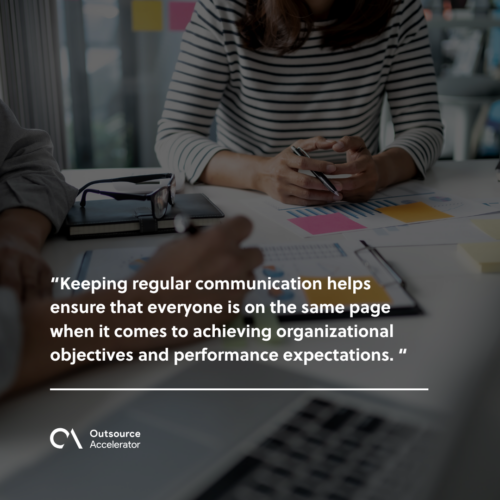
Regular talks keep everyone on the same page. So goals and expectations stay clear.
Open talk between staff and managers also lifts morale. As a result, it builds a culture of trust.
Performance appraisal
Reviews are the whole point of these systems. They help managers spot gaps and plan fixes. So they are a good time to set new goals and priorities. Many firms pair them with employee performance monitoring.
Rewards and recognition
For staff who go above and beyond, these systems help them get noticed. As a result, managers can reward strong work ethics and efficiency. Often, raises and bonuses rest on these results.
Feedback and suggestions
Reviews give a steady source of feedback. So both staff and managers gain a clear view of the work.
This feedback works in two ways. First, it praises the effort of top performers. Second, it shows where each person can grow.
Role of HR in performance management
HR staff play a broad role in performance management. They keep the tools fair and consistent for all staff.
HR also coaches managers on best practices. On top of that, clear HR responsibilities keep the whole process on track. Most of all, HR keeps staff motivated and their goals aligned with the firm.
Performance management systems: Examples of case use
Still unsure how firms use these systems? Here are a few examples that show them in action:
- MBO: A manager gives a sales agent a goal to lift Q2 revenue. It does not matter how the rep does it. What matters is whether they hit the goal.
- OKR: A senior developer gets the goal to improve the app’s user experience. It has three key results: cut the crash rate by 30%, launch new navigation by Q2, and raise the app store rating from 4.2 to 4.5.
- 360-Degree Feedback: A top performer up for promotion gets a 360-degree review. It checks if their skills match what HR expects from managers.
Which performance management system is the best?
Each system has its strengths and weaknesses. So when you choose one, think about how your organization thinks about strategy.
For example, if your firm runs on separate departments with their own goals, MBO can be a solid pick. However, if your firm relies on cross-functional teams, OKR is likely better. As a result, it promotes shared goals across departments.
Do you want to lift your firm’s efficiency through performance management? Then hiring a performance manager can be a smart move.
Frequently asked questions about performance management systems
What is the goal of a performance management system?
The goal is to set clear targets and measure work against them. It also helps staff improve over time. In short, it keeps people and firm goals aligned.
What are the main types of performance management systems?
The main types are the Balanced Scorecard, 360-degree Feedback, OKR, and MBO. Each fits a different firm and need. So the best choice depends on your goals.
How often should performance reviews happen?
Many firms run formal reviews each quarter. Others check in more often with informal talks. Regular feedback works better than one yearly review.
What is the difference between OKR and KPI?
KPI tracks ongoing performance against set metrics. OKR sets goals and the results that prove you met them. So one measures, and the other drives change.
Key takeaways
- Performance management systems set goals, measure work, and guide reviews.
- Common types include the Balanced Scorecard, 360-degree Feedback, OKR, and MBO.
- Every system shares core parts like goal setting, feedback, and rewards.
- HR keeps the process fair and keeps staff motivated.
- The best system depends on how your firm thinks about strategy.






 Independent





