
What does an appointment setter do? A B2B guide for real estate, finance, and insurance industries

This article is a submission by Remote Latinos. Remote Latinos connects businesses with top talent from Latin America. Their platform facilitates the hiring of professionals from over 40 countries in Latin America.
There is a moment in every B2B sales conversation that determines whether revenue follows or evaporates. That moment is not the proposal. It is not the negotiation. It is the point where a qualified decision maker agrees to sit down, listen, and engage.
Getting to that moment is exactly what an appointment setter does, and in industries where trust is built before the product is ever discussed, few roles carry more weight.
This guide explains what an appointment setter does across the full arc of the workday, why the function matters in B2B industries with long relationship cycles, and what separates setters who fill a closer’s calendar with real opportunities from those who generate meetings that go nowhere.
Understanding the core function
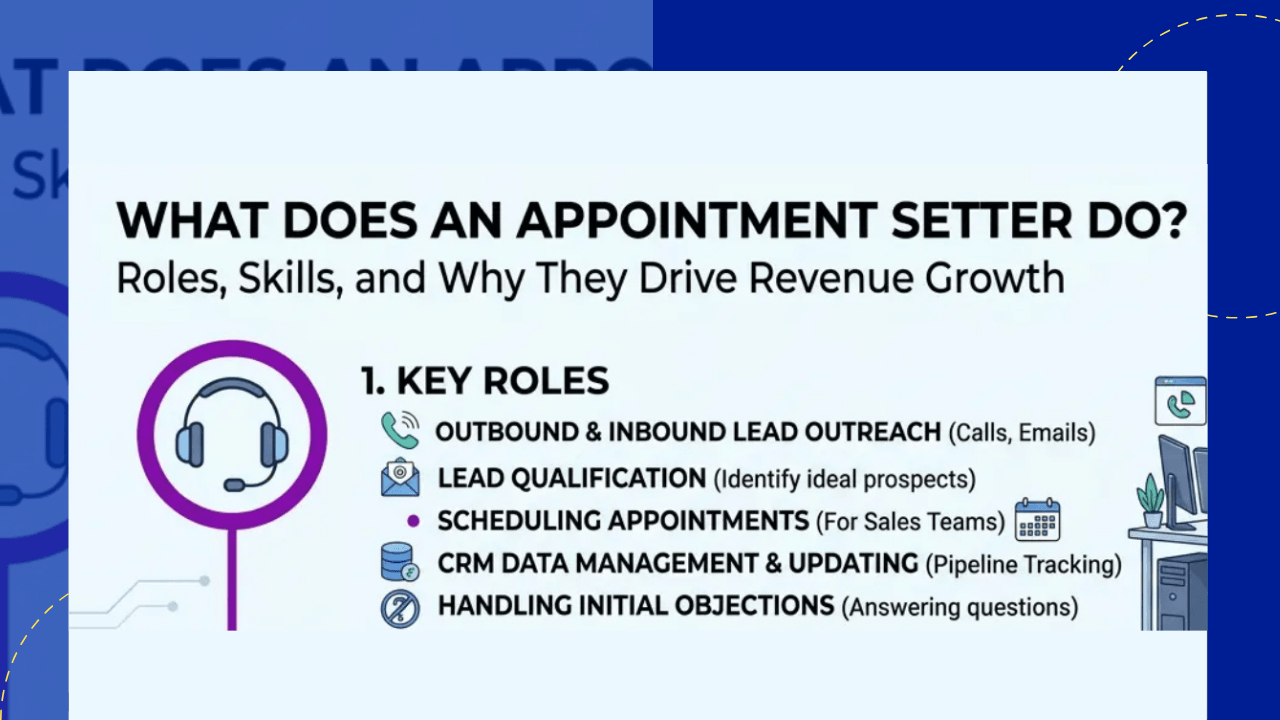
An appointment setter is a sales professional responsible for the top of the pipeline: identifying prospects, making contact, qualifying interest and fit, and booking scheduled meetings between those prospects and the appropriate person on your sales team.
They are not responsible for closing deals. That is a deliberate and important distinction.
Their entire focus is on one question: is this prospect worth your closer’s time, and are they ready to have a conversation?
In B2B environments, this specialization matters enormously. Jonathan Whistman writes in The Sales Boss that every sales team operates within a series of connected stages, and the fall-out between each stage determines the health of the entire pipeline.
The appointment setter owns the earliest and most volume-dependent stage: initial contact through to booked and confirmed meeting (Whistman, 2016).
When that stage is staffed with the right person and managed with clear expectations, everything downstream becomes more predictable.
A day in the life of a B2B appointment setter
Understanding what an appointment setter does requires moving through the actual activities that fill their day.
The work begins with a prospect list. This may come from the marketing team, a CRM system, a purchased database, or a research process the setter builds themselves.
The quality of this list shapes everything that follows. A setter working from a poorly segmented, outdated list will struggle regardless of how skilled they are on the phone.
From that list, the setter initiates outreach. Phone calls remain the most direct channel in B2B contexts.
Prospects in real estate, banking, insurance, and home improvement services are busy people who receive a high volume of email. A well-timed, professionally delivered phone call cuts through in a way that a cold email sequence rarely matches.
The setter’s opening matters: a flat, scripted introduction signals that this is a routine interruption. A concise, conversational open that references something specific to the prospect signals that this call was prepared, not automated.
Kerry Johnson, in How to Recruit, Hire and Retain Great People, makes a point that applies equally to outreach: great communication requires listening skills as much as speaking skills (Johnson, 2022).
The same principle holds for appointment setting. A setter who speaks over objections or pushes through discomfort without acknowledging what the prospect has said will book fewer meetings than one who genuinely hears the concern, responds to it, and then moves the conversation forward.
Qualification happens during the live conversation.
The setter is asking, either directly or through conversational questions, whether the prospect meets the defined criteria: the right company size, the right industry segment, a decision-making role with actual authority, and a situation that the closer’s product or service genuinely addresses.
A meeting booked with a prospect who does not meet these criteria wastes your closer’s time and, over time, erodes their trust in the setter’s judgment.
Once the prospect qualifies and agrees to a meeting, the setter books the appointment in the CRM, sends a calendar invitation, and prepares a brief handoff note that summarizes what was discussed, what the prospect expressed as a concern or interest, and any relevant context the closer should know before the conversation starts.
The setter then moves to the next prospect on the list and repeats the process.
The industries where this role changes everything
Real Estate
Commercial real estate firms, investment brokerages, and residential real estate operations with a B2B component all depend on consistent conversation flow to generate deals.
In commercial real estate, the relationship between a broker and a property owner or institutional investor develops over months or years. An appointment setter gets the first meeting on the calendar, which is the point where that relationship begins.
Eric Herrenkohl observes in How to Hire A-Players that companies with a talent gap in their prospecting and outreach function often find that their top performers are doing work they should not be doing at their level (Herrenkohl, 2010).
In real estate, this translates directly: a senior broker spending two hours a day on cold outreach is a senior broker spending two fewer hours on negotiations, site visits, and relationship development with warm clients. An appointment setter changes that equation.
Banking and Finance
In banking, the conversation starts long before a product is presented. A business banking officer or relationship manager is trying to connect with a CFO, business owner, or treasury professional who already has a banking relationship and is not necessarily dissatisfied with it.
The setter’s job is to create enough interest and enough trust in the initial call to make a meeting feel worthwhile.
This environment requires a setter who understands that compliance shapes every statement. What can be said, how it must be framed, and what must be avoided in an initial outreach call in the financial services space is not optional knowledge.
A setter who does not have this context will create liability before the closer ever speaks to the prospect.
Fintech
Fintech companies operate in an environment where the product is often unfamiliar, the brand is often newer than the prospect’s existing vendor, and the prospect has been approached by many competitors with similar claims.
The appointment setter in a fintech company must be able to speak with enough credibility about the platform’s core function to create interest without overpromising. They must also navigate through multiple contacts within a target account before reaching the right decision maker.
Speed matters in fintech. A well-run appointment setting function allows a growing fintech company to generate pipeline at a pace that a small, fully senior sales team cannot sustain on its own.
The setter removes the prospecting burden from account executives and lets those executives focus on converting the pipeline that already exists.
Insurance
Few B2B sales environments are as dependent on consistent appointment volume as commercial insurance.
Brokers and carriers operate in a world where the vast majority of initial outreach is unwelcome, where prospects have existing coverage and existing broker relationships, and where a meeting is only possible when the setter has made a genuinely compelling case for why the conversation is worth having now.
A high-performing appointment setter in insurance is not trying to sell the policy on the phone. They are selling the value of a conversation about risk exposure, coverage gaps, or competitive pricing.

The setter who understands this distinction books meetings consistently. The setter who tries to close too early destroys the opportunity before it reaches the closer.
Kerry Johnson’s research on trust-based communication is especially relevant here.
His point that candidates and clients both respond to being genuinely heard applies to insurance outreach: a prospect who feels that the setter understands their situation will agree to a meeting. One who feels they are being moved through a script will not (Johnson, 2022).
Home improvement services
B2B home improvement companies, whether they serve commercial property managers, real estate investors, or corporate facility managers, operate in a crowded calling environment.
Many competitors are reaching the same prospect list at the same time. An appointment setter who can differentiate the company’s capabilities in 60 seconds, handle price objections with confidence, and identify the right contact within a property management organization is genuinely driving revenue, not just making calls.
Whistman (2016) makes the point that consistent prospecting, maintained even when the team is busy with active accounts, is what prevents the feast-and-famine cycle that affects so many sales teams.
The appointment setter is the structural answer to that problem. They keep prospecting going every day, regardless of what the closers are focused on.
Marketing agencies
Marketing agencies pursuing B2B clients face a specific irony: their prospects are often marketing professionals who can immediately identify a generic, low-effort outreach approach.
An appointment setter representing a marketing agency must demonstrate in the initial call the same quality of thinking and communication that the agency claims to deliver for its clients.
This means personalization, research, and specificity.
A setter who calls a marketing director at a regional bank and says something relevant about a challenge that is specific to that sector, that size of organization, or that type of marketing initiative, will get a meeting. One who delivers a generic capability pitch will not.
David Lahey makes the case in From Hire to Inspire that aligning people with the right roles, based on a clear understanding of what the role actually requires on a daily basis, is what produces performance rather than just activity (Lahey, n.d.).
For marketing agencies hiring appointment setters, this means being honest about the level of sophistication and research the role requires, and hiring accordingly.
What separates a high performer from an average one
The appointment setter function is often underestimated and underdefined. Companies post a job, hire someone who sounds energetic in the interview, and then wonder why the calendar is not filling up.
The problem is almost always one of three things: the wrong person in the role, insufficient structure around the role, or inadequate management of the person once hired.
Chaka Booker writes in Mastering the Hire that one of the most reliable ways to improve hiring outcomes is to stop trusting interview performance as a predictor of job performance (Booker, 2020).
The person who sounds confident and articulate in an interview is not always the person who handles fifty calls of rejection per day and maintains composure and creativity through all of it.
The evidence that predicts setter performance comes from their documented history of outreach activity, their ability to describe in specific terms how they qualified prospects, handled a difficult objection, or recovered from a stretch of low contact rates.
Herrenkohl (2010) describes the A-Player Profile as the foundation of every successful hire: a clearly defined picture of what the right person looks like based on what the top performers in that role have in common.
For appointment setters, that profile typically includes genuine resilience under rejection, active listening skills, a detail-oriented approach to CRM documentation, and the ability to pivot conversationally when a prospect’s response takes the call in an unexpected direction.
Personality also matters in a specific way. Herrenkohl (2010) provides an example of an inside sales company that discovered its top performers shared a profile of being assertive and people-oriented rather than purely aggressive or purely service-focused.
The best setters are genuinely interested in the person they are speaking with, not just in getting the meeting booked. Prospects can hear the difference.
Measuring what an appointment setter actually does
One of the most common failures in managing this function is tracking only the output without understanding the inputs that drive it.
Whistman (2016) is clear on this point: knowing team averages and each individual’s numbers is what allows a manager to coach effectively rather than simply react to outcomes.
The activities that produce results in appointment setting are:
Dials per day represent the raw activity level. This number tells you whether the setter is working at the pace the role requires. A setter making 40 calls a day in a role that requires 90 will never reach their targets, regardless of how skilled they are on each call.
Contact rate measures what percentage of dials result in a live conversation. This is affected by the quality of the list, the time of day, the channel mix, and whether the setter is leaving voicemails that prompt callbacks.
Qualification rate measures what percentage of conversations meet the defined criteria for a bookable meeting. A high contact rate with a low qualification rate often means the list is poorly segmented. A low qualification rate with a good contact rate often means the setter needs coaching on the qualifying conversation.
Meeting show rate tracks what percentage of booked meetings actually happen. A consistently low show rate is a signal that meetings are being booked with prospects who are not sufficiently qualified or committed, or that the confirmation process needs strengthening.
Pipeline contribution measures, over a 30, 60, and 90-day window, how much revenue potential the setter has introduced to the pipeline. This connects the setter’s daily activity to the financial results the company actually cares about.
Setting up an appointment setter for success
The hiring decision is only the beginning. Roxi Bahar Hewertson writes in Hire Right, Fire Right that the relationship between a company and a new employee is relational rather than transactional, and that clear role definition at the outset is what protects both the company and the person being hired (Hewertson, 2020).
Applied to appointment setters, this means defining the prospect profile, the qualifying criteria, the daily activity expectations, the tools available, and the management structure before the person starts, not after they have struggled for two months without clarity.
Onboarding matters more in this role than most companies acknowledge. A setter who does not fully understand the company’s product, the problems it solves, and the language the industry uses will struggle with the qualifying conversation.
Bobby Herrera writes in The Gift of Struggle that the most meaningful preparation for difficult, high-stakes situations comes from understanding the context deeply before the pressure arrives (Herrera, 2019).
A setter who has been trained on the product, the industry, and the objections they will encounter enters every call with confidence. One who was handed a script and told to start dialing enters every call at a disadvantage.

Regular call reviews, weekly feedback conversations, and script refinement based on what is and is not working in the field are all part of managing this function well.
Whistman (2016) describes the concept of Sacred Rhythms as recurring, non-negotiable activities that create consistency and compound over time.
For a setter function, those rhythms include daily activity targets, weekly pipeline reviews, and ongoing coaching that treats the setter as a professional with development needs rather than a body filling a seat.
Lou Adler makes the point in Hire with Your Head that defining the work in terms of measurable performance outcomes before writing the job description is what attracts and identifies candidates who will actually deliver (Adler, 2022).
That principle applies not just to the hiring process but to ongoing management: a setter who understands exactly what success looks like and is measured against it consistently will outperform one who operates in ambiguity.
Frequently Asked Questions
What is the difference between appointment setting and lead generation?
Lead generation is the process of identifying and creating interest among potential customers through marketing activity: content, advertising, events, referrals, and similar channels. Appointment setting is what happens after a lead exists or a prospect list has been created.
The setter’s job is to contact those prospects directly, qualify them through conversation, and book a specific meeting with a closer. Lead generation creates the list. Appointment setting works the list.
Can an appointment setter work remotely?
Yes, and in many cases remote appointment setters perform extremely well. The role requires a phone, a CRM, a reliable connection, and a quiet space for calls.
What matters most is clear daily expectations, a manager who reviews calls and provides real feedback, and a consistent communication rhythm between the setter and the rest of the sales team.
Companies hiring remote setters from Latin America, for example, have found that professional English-speaking candidates with strong communication skills and cultural alignment with North American business norms can produce excellent results when given the same structure and support as an in-office team member.
How do you know if an appointment setter is underperforming because of skill or because of a bad list?
Look at the contact rate first. If the setter is making the expected number of dials but reaching very few live prospects, the list is likely the problem: outdated contacts, wrong titles, poor segmentation.
If the contact rate is healthy but the qualification rate is low, the setter needs coaching on the qualifying conversation. If qualified meetings are being booked but not showing up, the confirmation process or the quality of the prospect agreement needs attention.
Whistman (2016) emphasizes that numbers are diagnostic tools, not conclusions. Isolate the variable before drawing a conclusion about the person.
Should appointment setters be measured on meetings booked or on qualified meetings booked?
Qualified meetings booked. Measuring only on volume of meetings creates an incentive to book any conversation, regardless of whether the prospect is a genuine fit.
When a closer sits through three unqualified meetings in a day, they lose confidence in the setter and lose productive time that should have been spent on real opportunities. Connecting the metric to qualification, and then tracking show rates and pipeline contribution, aligns the setter’s daily behavior with the company’s actual revenue goals.
How long should onboarding take for a new appointment setter?
Most setters reach a functional level of performance within 30 to 45 days if they receive proper training on the product, the prospect profile, the qualifying criteria, and the CRM.
Full confidence, meaning they are handling objections fluently, hitting their activity targets consistently, and contributing reliably to the pipeline, typically develops between 60 and 90 days.
Companies that evaluate performance in the first two weeks and draw conclusions about the person based on early numbers are measuring the onboarding process, not the setter.
What is the biggest mistake companies make when hiring an appointment setter?
Hiring based on enthusiasm without evidence. Many candidates sound persuasive about their ability to handle rejection, build rapport quickly, and stay disciplined through repetitive work.
What actually predicts performance is a documented history of consistent outreach activity, specific examples of how they qualified a difficult prospect or recovered from a stretch of poor results, and the ability to describe their past work in specific, verifiable detail rather than generalities.
Booker (2020) argues that effective hiring requires gathering evidence of behavior rather than being persuaded by presentation. That principle applies precisely to this role.
Is it worth hiring an appointment setter for a small company or early-stage startup?
Yes, often more so than for a larger company with an established sales team. In an early-stage business, the founders and senior team members are almost certainly spending time on prospecting that they should be spending on product, client delivery, and relationship development.
An appointment setter who takes on the outreach function frees those senior people to focus on the conversations that require their level of experience.
The key is being honest about what the role requires and providing the training and structure that allows the setter to succeed without constant supervision.
References
Adler, L. (2022). Hire with your head: Using performance-based hiring to build outstanding diverse teams (4th ed.). John Wiley & Sons.
Booker, C. (2020). Mastering the hire: 12 strategies to improve your odds of finding the best hire. HarperCollins Leadership.
Herrenkohl, E. (2010). How to hire A-players: Finding the top people for your team even if you don’t have a recruiting department. John Wiley & Sons.
Herrera, B. (2019). The gift of struggle: Life-changing lessons about leading. Bard Press.
Hewertson, R. B. (2020). Hire right, fire right: A leader’s guide to finding and keeping your best people. Rowman & Littlefield.
Johnson, K. (2022). How to recruit, hire and retain great people. Gildan Media.
Lahey, D. (n.d.). From hire to inspire: How to become the best boss. ECW Press.
Whistman, J. (2016). The sales boss: The real secret to hiring, training, and managing a sales team. John Wiley & Sons.






 Independent





