
Ensuring IT security and compliance in 2026
At a glance
- IT security and compliance are critical for protecting data, operations, and customer trust in 2026.
- Cyber threats like phishing, ransomware, insider threats, and cloud misconfigurations continue to rise.
- Strong access controls, employee training, monitoring, and vendor assessments are essential best practices.
- ConnectOS supports secure and compliant outsourcing through certified frameworks and robust infrastructure.
What is IT security and compliance?
IT security and compliance are the tools, policies, and standards that keep an organization’s systems and data safe and in line with the law.
- IT security guards systems, networks, and data from unauthorized access, disruption, or theft.
- Compliance means following the legal, regulatory, and industry rules that govern sensitive data.
- Together, they cut risk, help avoid penalties, and build trust with clients and partners.
IT security refers to the tools, policies, and processes used to protect systems, networks, and data from unauthorized access, disruption, or theft. In fact, this covers a lot of ground. For example, it ranges from firewalls and encryption to access controls and security awareness training.
Compliance means following the legal, regulatory, and industry standards that govern how firms manage sensitive data. These rules vary by country and industry. In general, they cover data privacy, financial reporting, and cybersecurity. This is a growing concern for teams built through offshore staffing.
Common IT security threats
Cyber threats keep evolving. They are also getting more expensive. First, here are the most common ones organizations face heading into 2026.
Phishing and social engineering
Phishing remains a leading cause of data breaches. In the first half of 2025 alone, APWG recorded over one million phishing attacks.
Attackers target staff with convincing emails or messages. In most cases, the goal is to steal credentials or reach systems. Without training and multi-factor authentication (MFA), these attacks work far too often.
Ransomware
Ransomware attacks continue to disrupt businesses worldwide. In fact, the damage goes well beyond the ransom itself.
In 2024, ransomware criminals took in approximately $813.55 million in payments from victims. On top of that, firms face downtime, recovery costs, legal fees, and harm to their name.
Cloud misconfigurations
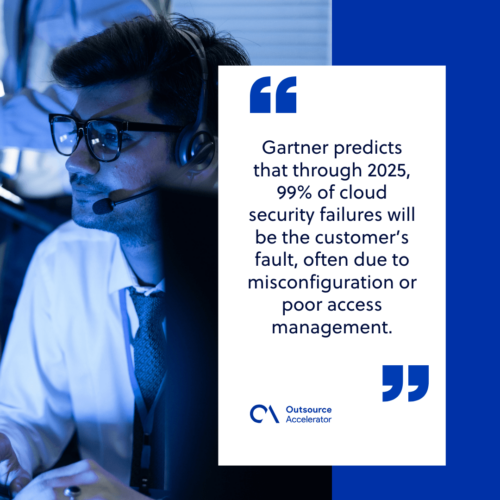
Cloud adoption is now widespread. Still, setup errors remain a top cause of incidents. In fact, Gartner has estimated that 99% of cloud security failures will be the customer’s fault, often due to misconfiguration or poor access management.
Firms keep expanding across borders and into hybrid work. As a result, governance and configuration management become core parts of IT security and compliance. This matters most when outsourcing IT functions to outside teams.
6 best practices for IT security and compliance
To keep IT security and compliance strong in 2026, firms need a proactive, layered approach. Here is what works best.
1. Enforce strong access controls
First, limit access to sensitive systems based on job roles. Multi-factor authentication adds a critical layer. So even if credentials leak, attackers still cannot get in.
2. Monitor systems continuously
Real-time monitoring and automated alerts help catch odd activity early. In practice, this means watching network traffic, system logs, and user behavior. As a result, teams can spot threats before they become breaches.
3. Train employees regularly
Human error is a leading cause of breaches. For this reason, continuous security awareness programs are essential. Training should cover phishing drills, strong passwords, and how to report anything suspicious.
4. Maintain documented policies and procedures
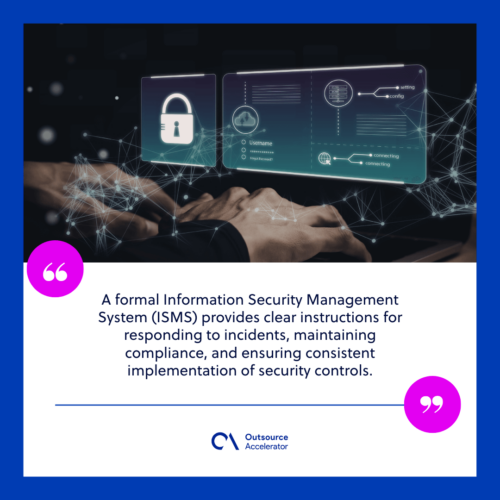
A formal Information Security Management System (ISMS) gives clear steps for handling incidents and staying compliant. It also keeps security controls consistent across the team.
Finally, review and update these policies often. In this way, they stay relevant as threats change.
5. Assess vendor and third-party risk
Outsourced teams and vendors often reach critical systems. So you should conduct thorough risk assessments, check compliance certifications, and set security terms in your contracts. As a result, this cuts weak points in your supply chain. The same care applies to data management partners.
6. Encrypt sensitive data
Also, encrypt data both at rest and in transit. In turn, if data is intercepted, it stays unreadable. So it becomes useless to attackers.
How ConnectOS supports IT security and compliance
When you outsource, your partner’s security posture becomes your own. For this reason, compliance and structured controls matter.
ConnectOS supports IT security and compliance through:
- Certified frameworks. ConnectOS operates under internationally recognized standards such as ISO 27001 and SOC 2, providing clients with documented and audited security controls.
- Secure infrastructure. Whether teams operate on-site or remotely, ConnectOS implements strict device management, network security, and workplace policies to protect client data.
- Controlled access environments. Role-based access, endpoint protection, and monitoring tools reduce insider and credential-related risk.
- Regulatory alignment. ConnectOS supports clients operating across jurisdictions by aligning processes with GDPR, privacy laws, and industry-specific requirements.
For organizations building offshore teams, including back-office functions, this reduces operational risk while maintaining compliance.
For more information, visit ConnectOS’ website.
Frequently Asked Questions (FAQs)
Why is IT compliance important for outsourced teams?
IT compliance is important for outsourced teams because they often have access to critical systems, customer data, and proprietary information.
Ensuring outsourced teams follow recognized compliance standards protects your organization from regulatory penalties, data breaches, and operational disruptions.
How often should companies review their security policies?
Security policies should be reviewed at least once a year, and more frequently whenever there are significant changes, such as new regulations, system upgrades, or expanded remote work arrangements.
Is ISO 27001 necessary for outsourcing partners?
While ISO 27001 may not always be legally required, it is widely recognized as a benchmark for information security management.
Partnering with ISO 27001-certified providers demonstrates that they have formal, audited processes to manage risks, safeguard data, and maintain compliance.
What is the difference between IT security and compliance?
IT security is about the practical defense of systems and data, such as firewalls, encryption, and access controls. Compliance is about meeting set rules and standards, such as ISO 27001 or GDPR. In short, security protects, and compliance proves you protect in the right way.
Key takeaways
- IT security and compliance are not just technical requirements. They are strategic priorities that affect business continuity, reputation, and customer trust.
- Organizations that proactively implement structured processes, enforce policies, and monitor both internal and external risks are better prepared to respond to evolving threats.






 Independent






