
Outsourcing sales framework: A step-by-step guide from prospecting to closing


How do you build an outsourcing sales framework?
An outsourcing sales framework is a repeatable, step-by-step process that guides a BPO from finding the right buyers to closing long-term deals.
- A strong outsourcing sales framework aligns prospecting, qualification, and closing into one system.
- Selling outsourcing takes education, trust, and credibility, not pressure.
- Growth comes when the process is repeatable and driven by data.
Selling outsourcing services is not like selling software or sneakers. You ask prospects to trust you with their people, processes, and profit margins. So the stakes feel high from the very first call.
That is why top BPOs do not wing it. Instead, they follow a proven outsourcing sales framework. As a result, cold prospects slowly turn into long-term partners.
This guide breaks down a 7-step outsourcing sales framework. It also shows how to scale the process for growth. Along the way, it explains why inbound demand beats cold outreach for BPO sales.
The 7-step outsourcing sales framework
| Stage | Objective | Outcome |
| ICP Definition | Target the right buyers | High-fit prospects |
| Prospecting | Build awareness and interest | Qualified leads |
| Qualification | Protect sales resources | Sales-ready opportunities |
| Nurturing | Build trust and authority | Educated buyers |
| Objection Handling | Reduce perceived risk | Buyer confidence |
| Proposal & Demo | Demonstrate value | Clear ROI alignment |
| Closing | Secure commitment | Long-term partnership |
The global sales and marketing BPO market is projected to reach over $57 billion by 2030. So a structured sales framework is not just helpful. It is how BPOs capture that growth.
To build a predictable growth engine, follow this framework. It guides each prospect from first awareness to a long-term partnership.
Step 1: Build your ideal customer profile
Every effective outsourcing sales framework starts with clear focus.
According to a global business survey, 59% of leaders cited cost reduction as a key driver for outsourcing. Many others pointed to new skills and more flexibility. For a wider view, the full business case for outsourcing helps frame these drivers in your pitch.
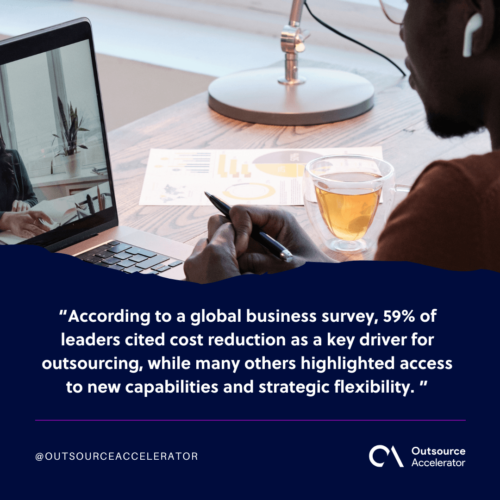
So this is useful proof when you qualify buyers and justify your approach.
If your ICP is “any company that might outsource,” your pipeline will be weak. Instead, define your ICP with both firmographic and behavioral traits:
- Industry vertical (SaaS, healthcare, eCommerce, fintech, logistics)
- Company size and growth stage
- Geographic location and timezone sensitivity
- Outsourcing experience level
- Primary pain points (cost pressure, scalability, talent shortages)
In short, the clearer your ICP, the easier every other step becomes.
Step 2: Master prospecting strategies
Prospecting is where most outsourcing sales frameworks break down.
Old outbound methods rarely work here. For example, cold email blasts, scraped lists, and generic LinkedIn messages feel spammy. Because of this, they get ignored.
Why? Because outsourcing buyers need context and education before they engage.
So modern prospecting works best when it blends a few channels:
- Inbound visibility on outsourcing-specific platforms
- Authority-building content and thought leadership
- Targeted outbound backed by real relevance
Skilled sales development reps can also warm up accounts with tailored, research-led outreach. Meanwhile, tactics like account-based marketing help you focus on high-fit targets instead of spraying lists.
Step 3: Qualify leads effectively
Lead generation is useless without qualification.
A mature framework protects sales time by filtering hard. So good qualification looks at:
- Budget availability and approval process
- Decision-maker involvement
- Timeline to outsource
- Scope clarity and role definition
- Strategic intent vs. just exploring
The goal is not more calls. Instead, it is better conversations.
Step 4: Nurture leads with value
Outsourcing deals rarely close fast. Still, that is a good thing.
Decision-makers weigh risk, internal buy-in, and long-term impact. So a strong framework treats nurturing as a strategy, not a waiting game.
High-performing BPOs nurture buyers by:
- Sharing relevant case studies by industry
- Providing cost and productivity benchmarks
- Educating prospects on offshore best practices
- Showing clear operational maturity
So you are not just following up. Instead, you build authority and lower the sense of risk.
Step 5: Overcome objections confidently
Outsourcing objections are universal and easy to predict.
Common concerns include:
- Quality control and performance
- Data security and compliance
- Communication and cultural fit
- Previous outsourcing failures
A strong framework prepares for these before they appear. So the best answers rely on:
- Proof, not promises
- Transparent processes and governance
- Clear SLAs and escalation paths
- Real-world examples
In short, true confidence comes from being prepared, not from talking more.
Step 6: Craft winning proposals and demos
This is where many outsourcing deals stall.
Generic proposals full of buzzwords fail to connect. By contrast, winning proposals do three things well:
- Speak directly to the buyer’s pain points
- Show clear ROI and operational impact
- Reinforce partnership, not vendor, positioning
So your proposal should answer the quiet question: “Why should we trust you with this?”
Step 7: Close deals and secure partnerships
Closing outsourcing deals is not about pressure. Instead, it is about alignment.
The final stage of a strong framework focuses on:
- Reconfirming objectives and success metrics
- Reducing risk with pilots or phased rollouts
- Clarifying onboarding and transition steps
- Locking next actions with confidence
A closed deal should feel inevitable, not rushed. After the signature, smart client retention habits turn that first win into a lasting partnership.
Optimizing your outsourcing sales framework for scale
Scaling your sales does not mean hiring more reps or sending more emails. Instead, it means removing friction.
To scale the framework, you need:
- Predictable lead quality
- Shorter sales cycles
- Higher close rates
- Stronger brand credibility
Most BPOs struggle because they lean on:
- Cold outbound with low intent
- Overcrowded freelance marketplaces
- One-off referrals
So scale comes from system-level visibility, not brute force. For teams building a full function, a dedicated guide to managing an outsourced sales team can speed things up.
Scaling the outsourcing sales framework with OA Sales Hub
This is where the Outsource Accelerator Sales Hub becomes a real advantage.
OA Sales Hub is not a generic lead tool. Instead, it is built for outsourcing and BPO companies.
So here is why it fits the framework so well:
- Access to high-intent outsourcing buyers
- Visibility within a huge outsourcing ecosystem
- Credibility through a trusted association
- Less reliance on cold outreach and list scraping
Instead of spending months warming up cold leads, you reach buyers who already get outsourcing. As a result, you get faster conversations, stronger trust, and higher conversion rates.
Frequently Asked Questions (FAQs)
What is an outsourcing sales framework?
It is a structured, repeatable process. So it guides BPOs from prospecting all the way to closing long-term outsourcing partnerships.
Why do outsourcing sales cycles take longer than other B2B sales?
Outsourcing decisions touch people, processes, and brand reputation. As a result, buyers take more time to assess risk and alignment.
Is inbound lead generation better for outsourcing companies?
Often, yes. Inbound leads tend to arrive more educated. So they usually convert at higher rates than cold ones.
Can small or niche BPOs use this framework effectively?
Absolutely. In fact, a clear framework matters even more when resources are tight. So every step has to earn its place.
How long does it take to see results from the framework?
It varies by deal size and sales cycle. Still, most teams see cleaner pipelines within a few months once the steps are consistent.






 Independent






