
How nearshore staffing supercharges your agile team

What is nearshore staffing for agile teams?
Nearshore staffing for agile teams means hiring skilled professionals in nearby time zones so your whole team can work, meet, and ship together in real time.
- Same working hours mean standups and sprint reviews include everyone.
- Shared culture and strong English reduce friction in feedback loops.
- Costs stay lower than local hiring, without the offshore time zone pain.
Picture this. It is 3 PM, time for sprint review, and half your team is already asleep on the other side of the world. Sounds familiar?
Agile teams run on constant talk, fast feedback, and quick pivots. However, traditional hiring keeps throwing up roadblocks. Local hiring moves slowly. Offshore teams bring a time zone nightmare.
Nearshore staffing cuts through both problems. You get the same hemisphere, the same culture, and the same working hours. It is not magic. Still, it can feel like it when your daily standups finally include the whole team.
How does nearshore staffing improve agility?
Simple answer: it removes the friction that kills agile momentum. Here is what changes:
- Real-time ceremonies that work. So no more 6 AM standups or sprint planning when half the team is mentally checked out.
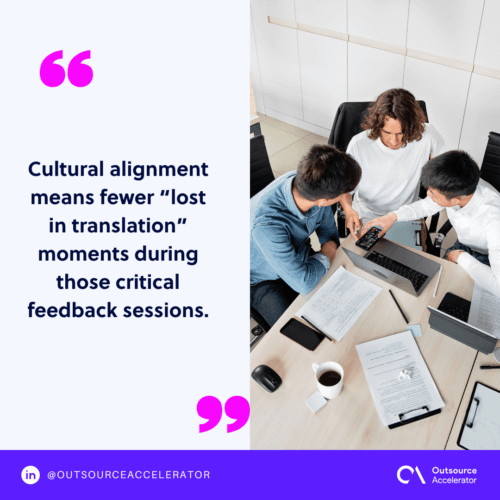
- Communication that flows. Because of cultural alignment, you get fewer lost-in-translation moments in key feedback sessions.
- Agile-fluent pros from day one. In fact, many nearshore regions are full of developers who have run Scrum and Kanban for years.
- Iterations that iterate. When everyone is awake, feedback does not take three days of back and forth.
What agile teams actually need (and why traditional staffing fails)
Agile is not just a method. It is a way of working. Teams must talk often, adapt when plans change, and collaborate without delays. Otherwise, sprint velocity drops.
However, traditional staffing breaks this in a few predictable ways.
Time zones are agile’s worst enemy. Try running a daily standup when your backend developer is at dinner and your QA lead is asleep. As a result, retrospectives become awkward monologues. Then quick sync calls turn into scheduling nightmares.
Cultural friction slows everything down. Agile thrives on direct talk and fast iteration. However, when every chat needs extra context, velocity drops fast. Language gaps can also create ambiguity in user stories.
Specialized talent takes forever to find. For example, you may need a React developer who knows accessibility standards. Good luck finding one locally within your sprint timeline. Offshore may have the skills, but onboarding across 12 time zones is brutal.
Why nearshore staffing works for agile teams
1. Time zones that make sense
Latin American developers can join your 10 AM standup without a 3 AM alarm. Meanwhile, Eastern European teams overlap well with European hours. So you can hold meetings when everyone is actually awake. To learn the model, see this guide on what nearshoring really means.
2. Communication without the friction
Shared cultural context means less time explaining why something matters. So you spend more time building it. Higher English skills also keep user stories clear. Because of this, a quick call stays quick.
3. Agile expertise that is ready to deploy
Many nearshore regions are hotbeds of agile work. Professionals there know Jira and Confluence well. In fact, they have lived sprint cycles, story points, and retrospectives for years. Many firms tap this through software development outsourcing.
4. Iteration speed that keeps up with your ambitions
Feedback no longer waits 12 hours for a reply. So pair programming works because both people are awake. Then code reviews happen in real time. That is when agile really clicks.
5. Cost efficiency without the quality trade-offs
Nearshore is not as cheap as some offshore options. Still, it costs much less than growing your local team. Plus, the gains from a truly agile unit often more than make up the difference. Some teams reach this through a staff augmentation model.
Getting nearshore right
Choose partners who get agile, not just development
Look for transparent partners who can talk about velocity, technical debt, and retrospective culture. However, if they still pitch you on resources instead of team members, keep looking. For a popular option, many compare notes on how to outsource to Colombia.

Tool alignment is non-negotiable
Your Slack channels, Jira boards, and GitHub repos should feel native to everyone. So invest in onboarding to make this seamless. That way, no one gets left out.
Onboard like you mean it
Do not just drop new members into the next sprint. Instead, introduce them to your definition of done, your retro style, and your code review culture. As a result, they become part of the team, not just contractors with access. For more tips, see this guide on building a remote team.
Keep the feedback loops alive
Regular retrospectives should include everyone, onshore and nearshore. For example, cover process improvements, cultural tweaks, and collaboration fixes. If it affects the team, everyone gets a voice.
Nearshore with Cloudstaff
Ready to unlock the full potential of nearshore staffing? Cloudstaff offers a solution built for agility. With a presence in Colombia and a talent pool of over 800,000 professionals, Cloudstaff connects businesses with skilled, remote-ready talent across tech, finance, and operations.
Its productivity platform and AI-enhanced staffing tools support fast, accurate candidate matching. So remote integration stays smooth.
Cloudstaff also delivers dedicated teams that plug into your brand and workflows. As a result, they feel like they have always been part of your team. That makes them an ideal fit for agile operations. Many clients in the region also explore outsourcing to Latin America for the same reasons.
By combining technology, talent, and a people-first culture, Cloudstaff helps agile teams move faster. So they collaborate better and scale smarter.
Frequently asked questions
What is nearshore staffing?
It means hiring talent in nearby countries with similar time zones. So your team can work the same hours. As a result, meetings and feedback happen in real time.
How is nearshore different from offshore?
Offshore talent often sits many time zones away. Nearshore talent sits close to you. So nearshore brings better overlap and less delay. However, offshore can still cost less.
Which regions are popular for nearshore staffing?
Latin America is popular for US teams. Meanwhile, Eastern Europe suits many European teams. Both regions offer strong English and deep agile experience.
Does nearshore staffing really speed up agile work?
Yes, in most cases. Because the team shares working hours, feedback loops get shorter. So standups, reviews, and code reviews move faster.
How do I pick a good nearshore partner?
Look for partners who understand agile, not just coding. Also check their tools, onboarding, and communication style. That way, your new team members feel native from day one.






 Independent






