
Outsourced invoice processing: A path to greater efficiency


What is outsourced invoice processing and how does it help?
Outsourced invoice processing means handing invoice tasks to an outside expert, which speeds up payments, cuts errors, and lowers costs for busy healthcare teams.
- It reduces manual errors and slow approvals.
- It speeds up reimbursement and improves cash flow.
- It frees staff to focus on patient care. Processing is one slice of the wider function, and our invoice management outsourcing guide covers capture, approvals, and reporting end to end.
Invoice processing in healthcare brings unique challenges. For example, billing systems are complex. Payment terms vary. Rules are strict too.
Providers must handle a high volume of invoices. They also manage insurance rules and patient billing. Meanwhile, they must keep accuracy high and errors low.
These hurdles often cause delays and payment gaps. As a result, operations slow down and grow less efficient.
So better invoice processing is vital for healthcare firms. In short, it protects both cash flow and smooth workflows.
This article shows how outsourced invoice processing streamlines the work. It also shows how it boosts efficiency for healthcare companies.
How invoice processing works
In a healthcare firm, the workflow starts once services are given. Then an invoice is created. This happens by hand or through an electronic health record (EHR) system.
Next, the invoice is checked for accuracy. Staff review coding, patient details, and insurance data. After that, it goes to the payer for reimbursement. The payer is either the insurance company or the patient.
However, studies show nearly 80% of healthcare invoices contain errors. As a result, payments get delayed.
Once payment arrives, the invoice is marked as paid. Then the transaction is reconciled in the accounting system. Still, this can take weeks, which strains cash flow. Clean medical billing keeps that cycle moving.
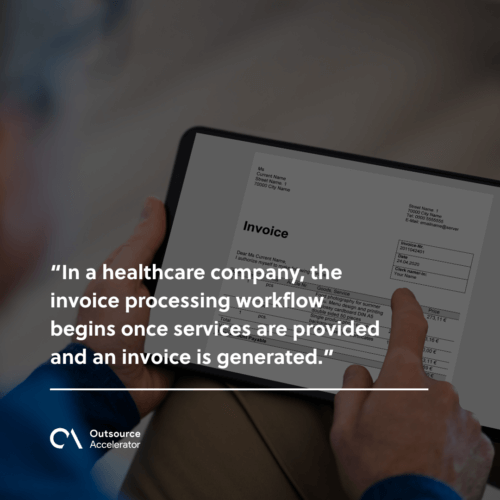
Manual vs. Automated invoice processing
Manual invoice processing means handling each invoice by hand. So staff must do the following.
- Enter data
- Verify details
- Reconcile payments
This way takes a lot of time and invites errors. As a result, it often causes delays.
Automated invoice processing, however, uses software to capture, validate, and route invoices. So it cuts manual work. In turn, it improves cash flow and speeds up payment cycles.
Trusted offshoring providers like Connext lead this shift. In fact, they offer advanced invoice automation for healthcare firms. Knowing the types of invoices in play also makes setup easier.
Outsourcing to trusted providers brings clear gains. For example, you get more accuracy, speed, and cost savings.
Why outsourced invoice processing is a better option
Outsourcing is now a popular choice in healthcare. Here are five reasons why outsourced invoice processing works better.
1. Enhanced accuracy
Manual invoice processing invites human error. For example, it can include the following.
- Incorrect data entry
- Missed information
- Miscalculations
These errors delay payments or cause costly mistakes.
Connext’s automated solutions cut these risks. In short, they capture and validate invoice data at every step. As a result, businesses see faster approvals, fewer errors, and better payment cycles.
2. Faster payment cycles
Outsourcing speeds up the whole workflow. It removes common bottlenecks. It also automates the repetitive tasks that slow things down.
Connext’s tailored workflows speed up approvals and reimbursements. So invoices move through automated approval channels. As a result, delays drop and turnaround times shorten.
In turn, healthcare firms get paid faster. This greatly improves cash flow.
3. Cost reduction
An in-house invoice team can be costly. This is even truer with high invoice volumes. So outsourcing to a provider like Connext saves on labor, software, and overhead. Many firms also pair it with accounts payable outsourcing for wider savings.
Connext’s automation cuts the need for manual work. As a result, operating costs fall without a drop in quality.
4. Scalability
As healthcare firms grow, invoice volumes rise too. So internal teams face more strain. Handling that volume by hand can bring delays, errors, and higher costs.
Connext’s automation is flexible and scalable. So it adapts easily to increased invoice volumes. Best of all, you need no extra staff or infrastructure.
5. Focus on core operations
Outsourced invoice processing frees internal resources. So teams can focus on patient care and core work.
By shifting back-office tasks to experts like Connext, firms ease the load on staff. As a result, in-house teams spend more time on patients and strategy. This mirrors the wider shift toward healthcare BPO.
More focus on core work lifts service quality. In turn, patients get better experiences and stronger outcomes.
Outsource invoice processing with Connext
Outsourcing invoice processing with Connext is a smarter way to manage billing. So you can run billing and payment cycles with less effort.
With Connext’s tailored automation, you can do the following.
- Reduce manual errors
- Speed up reimbursement times
- Optimize operational efficiency
Best of all, you cut costs at the same time.
Connext’s dedicated team and advanced technology let you focus on what matters most. In short, that means great patient care. Pairing this with strong AI invoice processing pushes efficiency even higher.
Learn more about Connext’s healthcare solutions here and start improving your invoicing today!
Outsourced invoice processing: Frequently asked questions
What does outsourced invoice processing include?
It covers invoice capture, data entry, validation, approval routing, and reconciliation. In addition, many providers add reporting and automation. So you can outsource one step or the full cycle.
Is it secure for healthcare data?
Yes, with the right partner. Good providers follow strict data rules and use secure systems. As a result, sensitive patient and billing data stays protected.
How much can outsourcing invoice processing save?
Savings vary by volume and provider. Still, most firms cut labor, software, and overhead costs. Automation also lowers error rates, which saves even more.
How fast can a provider start?
Onboarding time depends on your systems and volume. Often a provider can begin within a few weeks. First, they map your workflow. Then they set up automated approval channels.






 Independent






