
How technology has made global talent more accessible


This article is a submission by Globaltize. Globaltize is a boutique staffing agency established by seasoned entrepreneurs who have leveraged global talent to grow their businesses. They provide comprehensive staffing solutions, delivering tailored, cost-effective global talent.
How has technology made global talent more accessible?
Technology has made global talent easy to reach by swapping costly overseas offices for cloud tools, video calls, and automated payroll that let any company hire and manage people worldwide.
- Remote tools connect teams across countries in real time.
- Cloud systems cut the old cost of foreign offices.
- AI and virtual onboarding make global hiring smoother.
Accessing global talent once felt like chasing a mirage. It looked close, yet it stayed out of reach. For most firms, and smaller ones most of all, overseas teams were a luxury only giants could afford.
Today, thanks to technology, everyone has a real shot at this talent pool. You no longer need millions for overseas offices or complex local setups.
In fact, tech has changed global hiring in ways few saw coming a decade ago. Here is how the shift breaks down barriers, opens up world-class talent, and offers more than just cost savings.
The big barriers of the past
Not long ago, accessing global talent was a major headache. Companies had to wade through layers of red tape, such as:
- Getting the right permits
- Hiring legal teams to read local laws
- Paying to set up offices and infrastructure abroad
And that was not even the end of it.
Once the office opened, the daily work piled up. There were currency swaps, payroll compliance, and endless admin tasks to manage.
For small and medium businesses (SMBs), these costs were a deal-breaker. In short, hiring globally was a big-company game.
Unless you were a tech giant or a large firm, your reach was limited. Often you just hired the odd remote contractor and hoped things went well. This was frustrating, because the demand for special skills had no borders. Yet businesses simply could not reach the right people. Many missed the clear offshore staffing benefits as a result.

The game-changing remote tech revolution
Then came the boom in remote work technology, which changed everything. Tools like Zoom, Microsoft Teams, and cloud storage flipped the old hiring model.
Now teams can work across countries as if they sit a few desks apart.
But it is not just about a Zoom account or a Slack channel. These tools allow real-time contact, project alignment, and shared workflows. As a result, global teams stay in sync like never before.
Even more, it is the smooth mix of many technologies working together.
Imagine onboarding new hires, running projects, and handling payroll across countries, all without a local office. With cloud systems and automation, the old overhead now costs a fraction of what it did.
Making the world your hiring pool
Here is the real shift. If you need talent in a niche skill, you are no longer stuck with your own backyard.
Say you are a startup that needs a specialized developer. Or a mid-sized firm that wants support in many languages. By hiring globally, you reach people who meet your exact needs. It also makes it easier to build a remote team that fits the role.
And it is not only about filling skill gaps. Global hiring also brings fresh ideas and new views.
Diverse backgrounds can spark smart solutions and broaden cultural insight. Because of this, companies adapt faster to new markets. A global team adds not just skills, but depth and flexibility too.
Beyond cost: What a global talent brings to the table
The money side of global hiring is clearly appealing. Still, there is more to it than savings. Wages for skilled pros in some regions may be lower than in North America or Europe. Yet global hiring is really about a dynamic workforce.
Take time zones, for example. A team spread across zones can keep your business running around the clock.
This “follow-the-sun” model once suited mainly support teams. Now it can work for every department. Design teams in Asia can hand off to project managers in Europe and developers in North America. So progress never has to stall. This is one of the core benefits of offshore teams.
Real ROI: How hiring global talent actually pays off
With global hiring, the first cost is not the whole story.
The return on investment (ROI) can be large over time. Global talent strategies cut turnover and lift retention. In short, a wider talent pool helps you find the right fit faster.

When people fit their roles well, they tend to stay longer. So you cut replacement costs. A clear plan to manage a remote team keeps that momentum going.
Moreover, reaching global markets makes your business more adaptable. It also prepares you for growth.
With a global team, you gain firsthand knowledge of other markets and cultures. That is a huge asset when you expand or tailor services to new regions.
The insights from a diverse team can lead to products that connect with a wider audience. In the end, that lifts the bottom line.
Curious about the savings and ROI of hiring globally? Check out Globaltize’s Payroll Savings Calculator. It is a quick way to see what a global team might save your business beyond salaries.
The future of a borderless workforce
Global hiring is still evolving. It will only grow more accessible and more tied to new tech.
Artificial intelligence and machine learning already shape recruitment. These tools help firms spot top talent across borders with more speed and accuracy. As a result, the hiring experience feels smoother.
In addition, virtual onboarding tools help remote staff feel connected from day one.
Some companies now build virtual office spaces that mimic real ones. This fosters teamwork that reaches across distance.
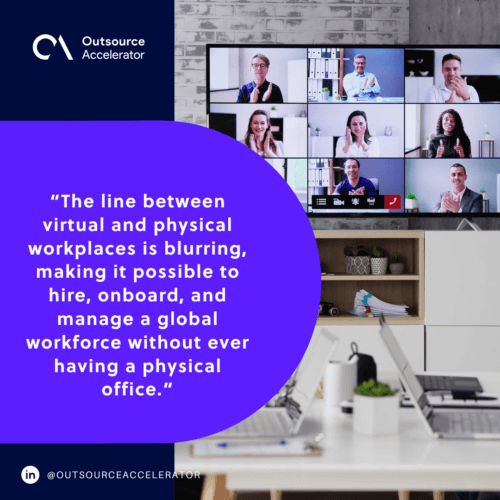
So the line between virtual and physical workplaces is blurring. You can now hire, onboard, and manage a global workforce without a physical office.
Looking ahead, we will likely see even more tools that make remote and global hiring seamless.
Virtual reality (VR) and augmented reality (AR) could soon create immersive onboarding. Teams could meet, interact, and train in a shared virtual space, all in real time.
The idea of a truly borderless workforce is no longer a dream. It is an emerging reality.
As firms lean into this era, those that embrace global hiring will be more resilient and adaptable. They will also be far more ready for the modern business landscape.
Technology has made global talent accessible. Now it is up to businesses to use this chance to the fullest.
Global talent FAQs
What does global talent mean?
Global talent means skilled workers hired from anywhere in the world. They may work remotely or through a local partner. So companies are no longer limited to their home market.
Is hiring global talent cheaper than hiring locally?
Often, yes, but savings are only part of the value. You also gain fresh skills and new market insight. Because of this, many firms see strong long-term returns.
What tools support a global workforce?
Video apps, cloud storage, and shared project tools lead the way. Payroll and HR platforms handle compliance across countries. Together, they keep global teams aligned.
How do you manage time zones with a global team?
Many teams use a “follow-the-sun” model. Work passes between regions as each day ends. As a result, projects keep moving around the clock.






 Independent






