
Why outsource a real estate asset manager


What does a real estate asset manager do?
A real estate asset manager oversees the value and performance of a property portfolio, and works to grow returns over time.
- They set the investment strategy for each real estate asset.
- They manage budgets, cash flow, risk, and key contracts.
- They aim to raise the value of the whole portfolio.
A real estate asset manager keeps a property portfolio healthy and profitable. This role blends planning, financial skill, and market insight. As a result, the right person can lift returns across many assets at once.
In this article, let us look at the duties of a real estate asset manager. We also explain why you should outsource this role to a trusted service provider like Sourcefit. So you can focus on growth while experts handle the details.
Responsibilities of an asset manager
Real estate asset managers take on many tasks each day. For example, they handle asset valuation, investment analysis, lease talks, and portfolio management.
They also help plan and run strategies that lift the value of real estate assets. Because of this, properties tend to perform better year after year.
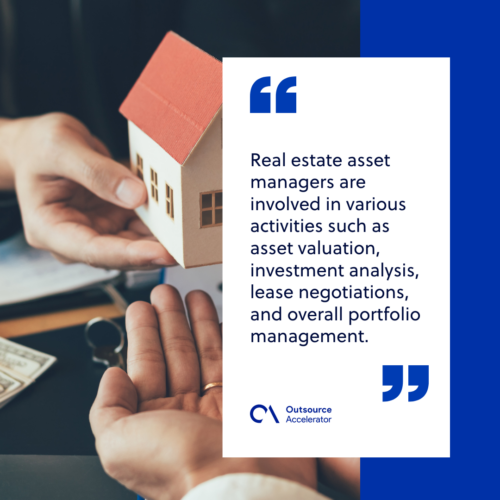
Here are some of the main duties of a real estate asset manager:
Strategic planning
Real estate asset managers build plans that lift the value of a client’s assets. First, they study market conditions and spot growth chances.
Next, they set clear investment targets. Then they map out simple steps to reach those goals. Many owners lean on real estate outsourcing to get this planning done well.
Financial management
Another key duty is money management. For example, they handle cash flow management, budgeting, forecasting, and reporting.
They also run investment analysis to weigh new buys or sales. Meanwhile, they track cash flow and profits to protect owners and investors. In many firms, this work sits close to property management accounting and the role of a financial controller.
Risk management
Real estate asset managers spot risks tied to property investments. These risks include value swings, market shifts, or new rules.
As a result, they build plans to lower those risks. They also add steps to guard owner and investor interests. So the assets stay safe and profitable for longer.
Contract negotiations
Negotiating contracts is another important duty of a real estate asset manager. The contracts they handle may include the following:
- Financing and loan agreements
- Service provider contracts
- Leasing contracts
- Asset management agreements
Real estate asset manager vs. Property manager
Both real estate asset managers and property managers matter to real estate success. People often mix up the two roles. Still, they are quite different.
Here is an easy way to see the difference between the two roles:
| Real estate asset manager | Real estate property manager |
| Focuses on the overall strategy and financial performance | Handles day-to-day operations of the property |
| Is involved in acquisition and financial decisions | Is responsible for tenant relations, maintenance, and property upkeep |
| Works on enhancing the value of the property portfolio | Ensures smooth operation and occupancy of the property |
| Ensures property appreciation | Collects rent from tenants, explains lease agreements |
Why outsource a real estate asset manager
Outsourcing a real estate asset manager can be a smart move. It offers many benefits to property owners and investors.
Here are seven key reasons why outsourcing this role can help:
1. Access to expertise and experience
Outsourced asset managers bring deep skill in real estate investment and management. Often, they have worked with many portfolios and market types.
As a result, they apply proven methods and fresh ideas. This lifts property value and returns. The same logic applies when you hire a property management virtual assistant for support tasks.
2. Cost efficiency
Outsourcing removes the need to hire full-time in-house staff. So you cut costs on salaries, benefits, and training.
Outsourcing to top companies in the Philippines also helps you save up to 70% on labor expenses.
3. Focus on core business activities
When you outsource asset management, you free up your team. So owners and investors can focus on core work and big-picture plans.
Meanwhile, experts handle the hard parts of asset management. As a result, your internal resources go where they add the most value.
4. Enhanced performance
Outsourced asset managers want the properties they manage to do well. Often, their pay is tied to portfolio results.
So they look hard for ways to improve, cut costs, and lift revenue. Because of this, the portfolio performs at its best.

5. Flexibility and scalability
Offshoring lets owners scale asset management up or down with ease. So you can adjust to market shifts and business growth. You also avoid the weight of fixed staffing levels. Many owners pair this with real estate virtual assistant tasks to cover daily admin work.
6. Risk management
Skilled real estate asset managers spot and lower investment risks. So they help guard the portfolio from losses.
They also make sure properties follow all rules and standards. As a result, legal and regulatory risks drop.
7. Advanced technology and tools
Outsourced firms often use advanced tech and analysis tools. These tools give deeper insight into trends, performance, and new chances.
So they enable data-driven decision-making. As a result, asset management strategies become more accurate and effective.
Outsourcing with Sourcefit
Want to outsource real estate asset management? Then a trusted provider like Sourcefit can offer a real edge.
Sourcefit’s outsourcing solutions cover many services built for the real estate industry.
With Sourcefit’s skill in real estate management, owners can handle market shifts, lift asset value, and drive steady growth.
Contact Sourcefit today and get started with your outsourcing journey!
Frequently asked questions (FAQs)
What is the difference between a real estate asset manager and a property manager?
An asset manager sets strategy and grows portfolio value. A property manager runs daily tasks like rent and repairs. So the two roles work together but stay distinct.
Can you outsource a real estate asset manager?
Yes. Many owners outsource this role to cut costs and gain expertise. As a result, they get skilled support without a full-time hire.
What skills does a real estate asset manager need?
They need strong financial skill, market insight, and planning ability. They also need clear negotiation and risk skills. Together, these skills protect and grow each asset.
How does a real estate asset manager add value?
They cut waste, lower risk, and find new revenue. So the portfolio earns more over time. In short, they turn strategy into steady returns.
Key takeaways
- A real estate asset manager grows the value of a whole property portfolio.
- The role covers strategy, finance, risk, and contract work.
- An asset manager sets strategy, while a property manager runs daily tasks.
- Outsourcing this role cuts costs and adds expert skill.
- A trusted provider like Sourcefit can help you scale with less risk.






 Independent





