
Program manager vs. Product manager: Differences explained


The program manager vs. product manager question trips up many teams. At first glance, the two roles look alike. Still, each one carries its own duties and goals.
So it helps to know where they differ. In this article, we break down each role and compare them to project managers. We also share a simple table and help you decide if you need both.
What is the difference between a program manager and a product manager?
A program manager oversees a group of related projects to meet strategic goals, while a product manager owns the success of a single product or product line.
- A program manager thinks across many projects at once.
- A product manager focuses deeply on one product and its users.
- Both drive success, but their scope and metrics differ.
What is a program manager?
First, a program manager oversees a portfolio of projects that link together toward strategic business goals. So the focus is coordination and control across the whole program.
This role centers on managing the overall program. It makes sure the work runs well and delivers the results the business wants.
Program managers also set the vision and objectives. In addition, they guide cross-functional teams and keep everyone aligned.

Example of product management
Imagine a tech company launching a new mobile app suite. The program manager would be responsible for:
- Overseeing the development of the individual applications
- Coordinating efforts between engineering, design, and marketing teams
- Ensuring that all the applications work well together to meet the program goals
What is a product manager?
In contrast, a product manager owns the success of a specific product or product line. So the daily focus is much narrower than a program manager’s.
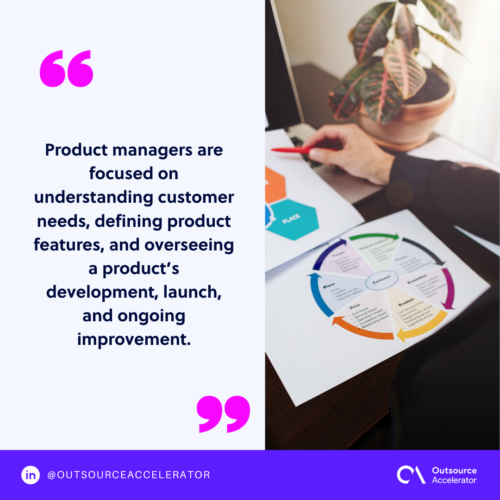
For the most part, product managers work to grasp customer needs and define features. They also oversee a product’s development, launch, and ongoing improvement. A clear product roadmap keeps this work on track.
They also act as the link between many stakeholders. These include customers, development teams, sales, and marketing.
Example of product management
Let’s say a software firm builds a new project management tool. The product manager would bring it to life by:
- Conducting market research
- Defining the tool’s features and user experience
- Collaborating with the engineering team
In addition, this specialist works with marketing and sales to launch and promote the tool. Many also rely on clear OKRs to track progress.
Program manager vs. Product manager vs. Project manager
Before we go deeper into program manager vs. product manager, it helps to add the project manager. So let’s see how all three compare.
While all three drive the success of work, they each have a distinct focus and scope.
What is a project manager?
Meanwhile, project managers handle the planning, execution, and closing of single projects. They focus on the timeline, resources, and tasks needed to achieve project objectives.
So their main aim is to finish projects on time, on budget, and to standard. For example, picture a project to build a new office. The project manager would coordinate every part of the build.
This means getting permits, hiring contractors, and checking building codes. In addition, the project manager would update the client often to:
- Provide updates on project milestones
- Address any concerns
- Ensure that the final result meets expectations
The right project manager tools make this coordination far smoother.
Program manager vs. Product manager: A quick comparison
Now that the roles are clear, let’s compare program manager vs. product manager across key points.
| Aspect | Program manager | Product manager |
| Scope | Manages a portfolio of related projects and initiatives | Focuses on the development and lifecycle management of a specific product or service |
| Objective | Ensures alignment with business objectives and strategic goals | Drives product vision and strategy to meet customer needs and achieve market success |
| Responsibilities | Oversees program governance, stakeholder management, risk mitigation, and resource allocation | Defines product roadmap, gathers requirements, prioritizes features, and guides development teams |
| Metrics | Measures program success based on strategic objectives, ROI, and business outcomes | Keeps tabs on product KPIs such as user adoption, customer satisfaction, and revenue |
| Collaboration | Collaborates with cross-functional teams, project managers, and senior leadership | Works closely with other departments like design, engineering, sales, marketing, and customer support |
| Timeframe | Focuses on long-term planning and execution, spanning multiple projects and initiatives | Manages the product lifecycle from conception to launch and beyond, adapting to market changes |
| Decision-making | Makes strategic decisions that impact the entire program, balancing competing priorities and risks | Makes product decisions based on market research, customer feedback, and business goals |
Program manager vs. Product manager: Do you need both?
Now the big question: does your organization need both program managers and product managers?
In short, the answer depends on a few factors. These include your size, the nature of your projects and products, and your goals.
When to have both
Large firms with many projects and products often need both roles. So each role can play to its strength.
Program managers keep work aligned across projects. Meanwhile, product managers drive innovation and market wins for each product.

When to combine roles
In small firms or startups, people often wear many hats. So one person may cover both areas.
In such cases, a hybrid role can be more practical. It blends parts of program and product management.
All in all, it helps to respect the distinct duties of each role. As a result, you can make a smart call on whether you need both. Some teams also weigh a scrum master against a project manager to round out the picture.
Frequently asked questions
Is a program manager more senior than a product manager?
Not always. In fact, the two roles sit on different tracks. A program manager works across many projects, while a product manager owns one product. So seniority depends on the company, not the title alone.
Can one person be both a program manager and a product manager?
Yes, in smaller teams. A hybrid role can work when resources are tight. Still, the person must balance a wide project view with deep product focus.
How does a product manager differ from a project manager?
A product manager owns the product and its long-term success. A project manager runs a single project from start to finish. So one thinks about outcomes, and the other thinks about delivery.
Which role does my startup need first?
In general, most startups need a product manager first. Early on, the focus is building the right product. A program manager makes more sense once you run many linked projects.
Do these roles require technical skills?
Some technical knowledge helps, but it is not always required. Strong communication, planning, and stakeholder skills matter most. As a result, many managers grow into these roles from varied backgrounds.






 Independent





