
Why hyper-personalization matters for businesses


Why does hyper-personalization matter for businesses?
Hyper-personalization matters because it uses real-time data and AI to tailor every product, message, and experience to each customer, which builds loyalty and lifts revenue.
- It treats each customer as an individual, not just a segment.
- It drives repeat business and higher order values.
- It cuts wasted spend on broad, generic marketing.
Strong customer relationships must be a priority. You build them by creating personalized products and solutions for each customer.
Today, AI and smart tools are changing how brands do this. Now, brands target not just groups of people but each customer in person. As a result, hyper-personalization has moved from a nice-to-have to a core business skill.
Every customer has their own needs. With the help of AI, brands can shape their content to fit each person. So the experience feels made for one, not for the masses.
What is hyper-personalization?
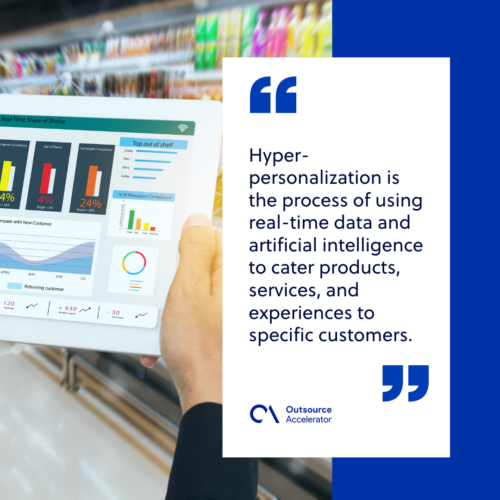
Hyper-personalization is the use of real-time data and artificial intelligence to tailor products, services, and experiences to each customer.
For example, a brand may offer one product to groups A, B, and C because each group has different needs.
However, hyper-personalization goes deeper. It targets the individual people inside those groups, since each person has their own needs too.
Hyper-personalization vs. Traditional personalization
Traditional personalization gives customers a general product or service. Hyper-personalization takes a sharper, context-based approach.
For example, traditional personalization might send the same email to everyone and only swap in the recipient’s name.
Hyper-personalization works differently. Instead, it uses a customer’s preferences and past actions to build something made for them alone. In 2026, AI tools even read intent in real time and adjust the next message on the fly.
Benefits of hyper-personalization
Hyper-personalization offers several benefits. It helps businesses succeed and win a loyal customer base.
Returning customers
Hyper-personalized experiences keep customers coming back. They show that you know your customers and their needs.
On top of that, customers value brands that treat them as people. So they prefer tailored care over generic service, which builds lasting customer loyalty.
Cost savings
Instead of spending big on broad campaigns to attract new buyers, you can save money. For example, you can focus on current customers who have already bought from you.
Then you can put those savings into long-term customer relationships. This also supports stronger customer retention over time.
Increased upselling and cross-selling
Brands use context from hyper-personalization to predict what customers will buy next.
Customers who enjoy your products are more likely to try new or upgraded ones. As a result, your revenue grows.

Key elements of hyper-personalization
To master hyper-personalization, you first need the right building blocks. Here are the main ones to remember.
Know your audience
Knowing your audience is the main key to repeat customers and loyalty.
This is where context comes in. You can gather it from a customer journey orchestration. That way, you get a clear view of your customer’s pain points, likes, and dislikes. As a result, you keep the relationship strong on both sides.
Data privacy
Hyper-personalization relies on customers’ personal data. So businesses must keep that data safe and private.
For this reason, companies should use strong data confidentiality methods. These help guard against cyberattacks and data breaches.
After all, customers prefer a brand that keeps their personal details secure.
Big data
Big data means large volumes of information from many sources. This covers everything customers do with a brand, from first click to final purchase.
With the help of AI, analytics tools, and data mapping, you can harness all this data. As a result, you gain a framework to build personal customer experiences. Many teams also lean on generative AI to turn that data into tailored content at scale.
Hyper-personalization best practices
You can achieve hyper-personalization in many ways. Here are some best practices to consider.
Deeper audience segmentation
As noted earlier, hyper-personalization goes deeper than broad groups.
The more specific your target, the better you can tailor each experience. So you also understand customer needs more clearly.
Instead of using broad traits like gender or an age band, try grouping customers by interests and values. This approach sits at the heart of customer experience optimization.
Data integration
You handle large amounts of data from many sources, all about different people. So it can be hard to spot common links between them.
For this reason, it helps to invest in a data integration tool. It lets you spot patterns and study data from as many sources as possible.
The more data you work with, the easier it is to personalize each customer’s experience.
Real-time data analysis
Real-time data analysis lets you track customer journeys as they happen. So you can make changes along the way.
Even small tweaks add up over time. As a result, you slowly build the perfect experience for each customer.
For example, you can watch social media engagement or test different versions of an ad. A well-run CRM system makes this tracking far simpler.
Knowing customers through hyper-personalization
Hyper-personalization is an ongoing trend, and it is not going away. In fact, AI keeps making it faster and more precise each year.
So businesses must be ready to make the changes needed for the best brand experience. Pairing smart tools with the human touch in customer service helps a lot here.
For businesses with limited resources, service providers such as 123Employee can help apply hyper-personalization across customer tasks.
Customers are not just walking stacks of money. They are real people with real goals, interests, and pain points. So brands must treat them that way.
Frequently asked questions about hyper-personalization
What is the difference between personalization and hyper-personalization?
Personalization uses basic data, like a first name or past order. Hyper-personalization goes further. It uses real-time data and AI to shape each message, offer, and experience for one person.
What data does hyper-personalization need?
It draws on browsing history, purchases, preferences, and live behavior. Location and device data can help too. Still, brands must collect and store all of it with consent and care.
How does AI support hyper-personalization?
AI reads large data sets fast and spots patterns people miss. So it can predict needs and tailor content in the moment. In 2026, many tools even adjust each experience as the customer acts.
Is hyper-personalization safe for customer privacy?
It can be, with the right guardrails. Brands should limit data use, secure it well, and stay clear about consent. That way, customers get tailored care without losing trust.
Which businesses benefit most from hyper-personalization?
Retail, e-commerce, finance, and service brands gain the most. Any business with repeat customers can benefit. For small teams, an outsourced partner can run it at a lower cost.






 Independent






