
Harnessing the power of knowledge management


What is knowledge management?
Knowledge management is the process of creating, organizing, and sharing a company’s collective information, so every employee can find what they need and make better, faster decisions.
- It keeps company knowledge in one place that is easy to access.
- It boosts efficiency, collaboration, and informed decisions.
- It prevents information silos and reduces data clutter.
In today’s information-driven world, knowledge management is key to smooth operations. After all, clear access to company knowledge keeps staff and managers on the same page. As a result, teams work faster and make better calls.
This is done with a knowledge management system. Here, information is stored in one large database. So it is easy to access and use for daily work.
Knowledge can be sorted into categories based on company needs. Having it ready at any moment lifts productivity. In turn, it speeds up business goals. Learn more about how it works and how to apply it below.
Benefits of knowledge management
When done right, knowledge management brings real benefits. So here are some ways it helps you succeed.
Streamlined operations
Knowledge management is core to operations because it streamlines key processes. As a result, staff reach their goals faster and with less effort. Pairing it with business process management automation makes this even smoother.
Everyone also saves time. After all, the data they need is right there. In short, you get a single source of truth, so you skip endless searches for one fact.
Enhances collaboration
When everyone can access the right knowledge, teamwork gets easier. For example, staff work from matching information. So they can set shared goals and build trust with each other.
Informed-decision making
Decisions no longer rest on guesswork. Instead, with the right data, companies spot patterns and build insights. As a result, they make informed choices.
Knowledge transparency also unites staff. So everyone stays on the same page and works toward the best outcome.
Reduces clutter and unnecessary data
Knowledge management means sorting data into clear categories. Doing so keeps things tidy and reduces data clutter and outdated files.
Clearing out stale information also makes room for fresh, relevant data. Meanwhile, regular updates cut the risk of working with wrong facts. For heavy data loads, data management outsourcing can help.
Prevents information silos
Information silos are a form of data mismanagement. They separate data or keep it locked away from other teams. As a result, they block smooth communication between systems.
Knowledge management is the fix. It eases the flow of information and communication. So with all key data in one place, coordination gets far simpler.
Types of knowledge management
Knowledge is not just facts or numbers. It also covers personal skills and the lessons people share with others.
So here are some common types of knowledge management.
Tacit knowledge
Tacit knowledge is also called personal knowledge. It refers to information tied to one person’s experience and skills.
For example, it includes how a person feels in a moment or a skill built over time. This type is hard to put into words, since it is so personal. Still, it is useful to track, because individual experience sparks ideas.
So employees can grow their tacit knowledge together. They do this by sharing personal stories and how they handle tough spots.
Implicit knowledge
Implicit knowledge covers skills learned over time after taking in information from elsewhere.
For example, you might read a guide on a task. However, can you really do it after only reading about it?
The best way to gain implicit knowledge is to apply what you learned. So only by practicing can you say you truly learned it. This also helps the company, since it captures new skills for future projects.

Explicit knowledge
Explicit knowledge is hard, factual information that is tough to dispute. For example, it includes statistics, reports, instructions, or manuals.
This type is the easiest to track. After all, it is objective, not tied to one person, and simple to write down and sort.
Declarative knowledge
Declarative knowledge is close to explicit knowledge. Both are static facts on a topic that you can record and access with ease.
This type answers who, what, when, and where. So it helps the individual make sense of the subject. For example, it can cover company details, like when it was founded and who leads it.
3 steps to implementing knowledge management
Knowledge management breaks down into three main steps.
Knowledge identification
The process starts by finding and gathering information from many sources. For example, that can be staff, outside experts, or reading materials. Knowledge can come through research, or it can be accidental.
Part of this step is seeing how each piece helps the company reach its goals. So staff must work out how the data will be used and where it fits.
In addition, the data should be new and undocumented. After all, fresh knowledge is what moves the company forward.
Knowledge organization
Next, structure your information so it is easy to understand. The more organized it is, the easier it is to use.
For example, you can group data into similar patterns or clear categories. Clear standard operating procedures help keep this consistent. Also, add proper security, since only people inside the organization should access it.
Knowledge distribution
The final step is distribution. It is a form of knowledge transfer that shares information with other teams.
Sharing it with the right people matters. For example, training teams, marketing, and other departments can all benefit.
Then it is up to those teams and leaders to use the data. In turn, they make decisions and run strategies that improve results.
Strategies to improve knowledge management
There are several strategies that drive the best results.
Goal-setting
Clear goals give your gathered information a purpose. For example, if your goal is to raise sales, you need the knowledge to support it.
Once you know what the data is for, it is far easier to use. As a result, you can push toward that end goal.
Creating a knowledge-sharing policy
A structured knowledge-sharing policy keeps information inside the company. So it prevents important data from being lost.
This policy also gives your data structure. In turn, it stays organized and easy to follow, whatever the churn rate or department.
Appointing key leaders in knowledge management
Knowledge can get mishandled, or staff can struggle to use it. So appointing someone to lead the process is key.
This person knows how to handle data and fully grasps company goals. The leader must have the skills to guide staff toward using information well.
Lead by example
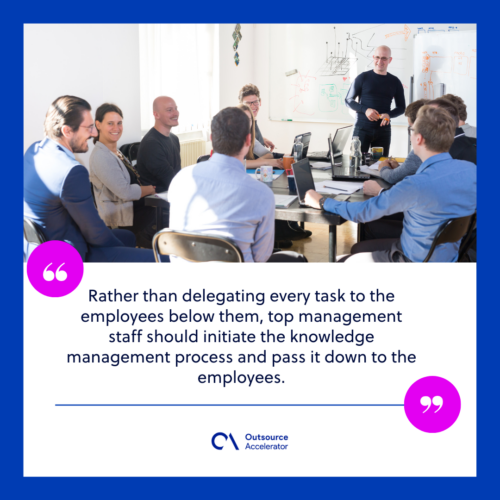
It is up to managers and supervisors to model good knowledge management. So rather than delegating every task, top staff should start the process themselves.
Then they pass it down to the team. As a result, workers learn from their managers until they can lead the process with little oversight.
Applications of knowledge management
Companies can apply knowledge management in many ways with the right data. So here are some common uses.
Training and onboarding
Knowledge management helps new hires by closing skill gaps and easing the learning curve. A clear onboarding checklist makes this even smoother.
As a result, new staff are not swamped with information. Instead, the company gives them the exact resources they need.
Customer service
Customers want fast answers, and knowledge management cuts the time spent finding them. This is one reason many firms pair it with customer service outsourcing.
As a result, teams move quickly from one customer to the next. In turn, efficiency rises and customers stay happy.
Improving clarity with knowledge management
Knowledge management is a powerful tool that simplifies the path to company goals. In short, it guides teams to make informed choices built on facts and experience.
Without it, businesses would make baseless decisions that could harm operations. So backing every choice with the right knowledge is always the smarter move.
Frequently asked questions about knowledge management
What is the difference between knowledge management and knowledge transfer?
Knowledge management is the full system of creating, storing, and using company knowledge. Knowledge transfer is one part of it. Specifically, it is the act of moving that knowledge from one person or team to another.
What tools are used for knowledge management?
Common tools include wikis, intranets, and shared document libraries. In addition, many firms use dedicated knowledge base software and AI-powered search. The best choice depends on your team size and how your data is structured.
Who should own knowledge management in a company?
Ideally, one appointed leader should own the process. For example, that may be a knowledge manager or an operations lead. Still, managers across every team share the duty of keeping information current.
How do you measure knowledge management success?
Track simple signals first. For example, watch how fast staff find answers and how often they reuse existing documents. You can also measure faster onboarding and fewer repeat questions to support teams.
Can small businesses benefit from knowledge management?
Yes, and often more than they expect. A small team loses a lot when one person leaves with key knowledge. So a simple shared system protects that information and keeps work moving.






 Independent






