8 absolute ways to assess your business performance


This article is a submission by D&V Philippines. D&V Philippines has years of experience in the accounting and finance industry. This third-party services company can generate the financial reports you need to make real-time financial decisions.
How do you assess your business performance?
You assess your business performance by setting clear goals, tracking the right metrics, and reviewing your finances, customers, staff, and rivals against them.
- Start with specific, timebound objectives you can measure.
- Track financial, customer, and employee data on a regular basis.
- Compare your results with rivals and your own past budgets.
Hitting your sales and profit goals matters a lot. It keeps your business alive today. It also shapes its long-term future.
You might be meeting your targets. However, you may be doing it in a wasteful way. For example, you could burn through valuable resources just to scrape the low end of your goals.
This is why you should find ways to assess your business performance. As a result, you can stretch your budget and lift your revenue. Your teams also need steady effort to reach your targets and your set key performance indicators (KPIs).
8 ways to assess your business performance
So how do you assess business performance? Here are eight simple ways to do it.
1. Establish objectives
Before you can measure performance, you need clear objectives. So start there.
Goals give you concrete standards to chase from one project phase to the next. Without them, you will spend resources poorly. In short, you waste effort you cannot get back.
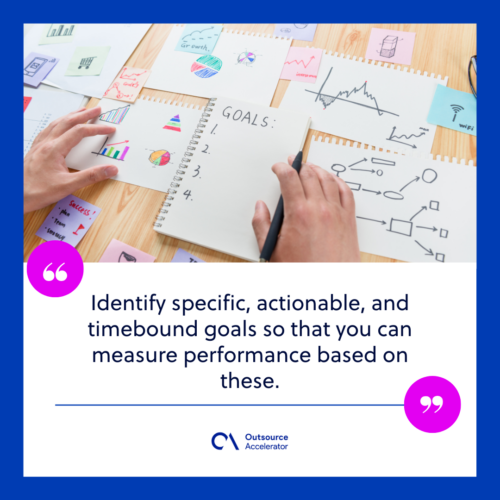
Set specific, actionable, and timebound goals. Then you can measure performance against them. If you miss your targets, it is a clear sign the company is lagging.
You cannot just pick a random goal, though. Instead, base your goals on real insight. Use data about your rivals and your target audience.
A data-driven approach lowers your risk. In addition, it often points you to creative fixes. Running a simple competitor analysis for business growth is a good place to find that data.
2. Create and implement performance metrics
You cannot measure a campaign, project, or business without metrics. So set them early. They tell you if the work is worth the resources you pour in.
The metrics you pick should match your objectives. For example, say you want to convert 3% of website visitors. This rate is close to the average across many industries. So your metrics should center on that target conversion rate.
Data such as users, sessions, pageviews, and time on page reveals how visitors behave. As a result, you can build better campaigns. You can also tune pages to move a buyer further down the sales funnel.
3. Review financial statements
Your finances show whether the business is profitable. So review your statements and reports often. This helps you measure how well the company earns.
Compare your financial ratios with those of your rivals and the industry average. You might need to adjust your sales and marketing. You could also find ways to make your operations more cost-effective. For example, cut costs without hurting product quality.
Next, review your budget line by line. Find the parts of operations that are redundant or slow. Removing them, or shifting resources to stronger teams, can cut costs and lift profit. Steady cash flow management keeps those gains from slipping away.
Finally, keep your records accurate with regular updates. You need clean, current data to judge your financial health well.
4. Assess customer satisfaction
A business that ignores a real need will not last. So put customers first.
Happy customers are a pillar of every strong company. Because of this, you should study your market closely. Learn what your target buyers really want.
Read reviews and comments on your social pages and website. These show you where to improve. They also gauge how engaged your audience is. Strong customer retention often starts right here, with listening.
You might need to add features, offer add-on products, or give a discount. Each move adds value in the eyes of your buyers. In addition, publish useful content. This lifts your authority and improves your brand image.
5. Monitor new customers
New customers show that your marketing works. For example, they prove your content, calls to action, and site design can widen your reach.
Say you keep the same customers month after month. Then you may need to change your strategy. So watch who lands on your pages.
The page a visitor lands on, and the time they spend, reveals what they want. As a result, you can tell which stage they are in along the sales funnel.
Someone who heads straight to a product page may be ready to buy. These insights help you tailor a call-to-action or piece of content to convert them.
6. Gauge employee satisfaction
Your employees are vital to growth. Their drive and output can make or break the company. So check in on them often.
A high turnover rate is a warning sign. It means staff may be unhappy with their workload, pay, hours, tasks, or promotion rules.
They might quit, or they might quiet quit. Either way, output drops. In addition, it can create a toxic mood that drags down the whole team.
This also raises your costs. After all, you must advertise, interview, onboard, and train each new hire.
So reach out to your staff and gather honest feedback. Strong employee engagement starts with listening. Then find ways to keep good people, such as:
- Improving their pay package
- Setting clear rules for promotions and raises
- Creating growth paths, such as training and certifications
You can also outsource some tasks. As a result, you ease their workload, cut redundancy, and lower costs.
7. Size up the competition
Study what your rivals do. Look at their strategies, pricing, campaigns, and products. So you learn what works in your market.
This helps you shape your own plan and find ways to do better. It also reveals your brand’s real strengths and weaknesses. As a result, you can lean on your strengths and soften your weak spots.
If their financial data is public, compare their ratios with yours. This shows how you stack up on profit and liquidity. In turn, you can manage your own resources with more care.
8. Make a budget
A budget lets you track expenses and revenue. So build one and keep it current.
Compare past budgets to see how you spent your resources. This shows whether you used cash well on campaigns, operations, and product work. It also shows what led to profit.
You can also compare monthly revenue and expenses across the year. As a result, you spot trends early.
A proper assessment of these key indicators guides your next move. It tells you whether to change your strategy or keep it. In addition, it shows your company’s true financial position. For more insight on demand and timing, offshoring market research can support steady business growth.
Frequently asked questions about assessing business performance
How often should you assess business performance?
It depends on the metric. For example, review sales and website data monthly. However, check full financial statements each quarter. This mix keeps you alert without drowning in reports.
Which metric matters most for a small business?
Cash flow is often the first to watch. A firm can look profitable on paper yet still run short of cash. So track money in and money out closely from day one.
What is the difference between a KPI and a goal?
A goal is the outcome you want, such as more revenue. A KPI is the measure that shows your progress toward it. In short, the goal is the target, and the KPI is the scoreboard.
Can you assess performance without expensive software?
Yes. A simple spreadsheet can track most core metrics at the start. As you grow, you can add tools. Still, clean and honest data matters more than fancy software.




 Independent