
Is work-from-home the same as outsourcing?

This article is a submission by Clark Staff. Clark Staff is an American-owned remote staffing company that has successfully operated since 2003. Its primary objective is to empower small and mid-sized companies by providing them with resources that were once exclusively accessible to Fortune 500 companies.
Is work-from-home the same as outsourcing?
No. Work-from-home and outsourcing both happen remotely, but they differ in structure, oversight, and reliability.
- Work-from-home moves your own staff out of the office.
- Outsourcing hands tasks to a third-party team with set KPIs.
- Outsourcing adds more oversight and quality control.
Remote work has moved from a niche perk to a mainstream setup. The work-from-home model was once mostly for freelancers. Now it reaches far more people.
In addition, it opens doors for those who once struggled to reach an office. For many, that has been a real game-changer. To see the upside, look at the benefits of remote work.
Still, remote setups are not new. In the outsourcing industry, remote work has long been the norm. This field has always had the right tools to run remote teams well.
So some people now think work-from-home is basically outsourcing. In reality, that idea is far from true. It can also cause real confusion.
The global business landscape has clearly changed. As a result, workers and firms have more options than ever.
At first glance, the two models look alike. However, a closer look shows big gaps, especially in reliability and oversight. Both matter a lot to any business process.
What is work-from-home?
Work-from-home (WFH) means staff do their tasks from home instead of an office. Remote work grew fast in the early 2020s. By mid-2020, 42% of the U.S. workforce worked remotely full time, according to a Stanford study.
Around the world, WFH is now widely accepted. In fact, many workers prefer it. After all, it frees up time once lost to a long daily commute.
Challenges of work-from-home
WFH is popular, but it still has clear drawbacks. Here are the main ones.
Flexibility
WFH gives staff more flexibility. However, it can also bring gaps. For example, a Gallup study found that only 30% of employees felt engaged while working remotely.
The reason is simple. Some staff and managers are still new to the setup. So engagement can be harder than it is face to face.
Technology dependency
WFH leans fully on technology, and that can be a problem. In a 2025 Cloudbrink survey of IT and security professionals, maintaining a steady connection was the top challenge. Respondents said connectivity issues affect more than 45% of remote workers.
In addition, employers often cannot control or supply the tools staff use at home. As a result, the perks of remote work shrink. Productivity and quality can slip, which then delays projects.
In addition, people who are new to digital tools can struggle. This gets worse when there is no training or support for the switch.
Lack of oversight
The weakest part of WFH is its lack of oversight. The Stanford study also found that 26% of managers worried about low accountability and poor supervision in a WFH setup.
So the model often brings more downtime. In the end, it leans on worker discipline, which no one can promise.
What is outsourcing?
Outsourcing, on the other hand, means you contract work to a third-party vendor, often overseas. For a fuller view, see how outsourcing can help your business.
Outsourcing also keeps growing. An earlier Grand View Research projection cited USD 525.5 Billion by 2023 as a market milestone. Today, Grand View Research puts the global BPO market near USD 525.23 billion by 2030. Meanwhile, it expects a CAGR of 9.8% from 2025 to 2030.
Here is the key difference. Outsourcing is remote like WFH, yet it offers a different kind of reliability. The remote staff must meet KPIs. In addition, they get ongoing training to match client needs.
Advantages of outsourcing
Unlike WFH, outsourcing gives businesses clear, built-in gains. For a wider look, see the benefits of outsourcing.
Cost-effectiveness
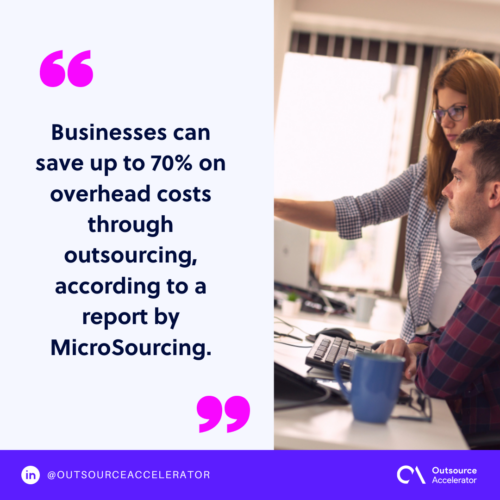
Businesses can save up to 70% on overhead costs through outsourcing, according to a MicroSourcing report. Compared with home-market costs, outsourcing helps you scale in a steady way.
Access to expertise
A Deloitte survey found that 57% of companies use outsourcing to focus on core work and tap niche skills. In fact, expert help matters most when you are just starting out. After all, hiring an in-house expert costs a lot.
Structured oversight
Outsourcing firms usually follow strict oversight and quality checks. For example, 88% of firms that outsource IT reported they were happy with the quality, per Deloitte.
In fact, some outsourcing companies help clients lock in quality by handling on-site duties, such as:
- On-board training assistance
- In-depth reporting as needed
- Cloud integration
- Payroll and human resources
Difference between work-from-home and outsourcing
Work-from-home and outsourcing differ in a few key ways. Here are the main ones.
Oversight mechanism
Outsourcing often comes with firm contracts, so it builds a more controlled setup. In addition, key data and processes stay safe from cyber-attacks. For example, teams protect them with managed computers, secure servers, set IP addresses, and dedicated IT staff.
WFH setups, by contrast, can lack built-in oversight. According to a Gartner survey, 52% of managers raised concerns about staff productivity in a remote setup. Strong managing of a remote team can help close that gap.
Quality control
First, quality control in outsourcing is usually more systematic. WFH, on the other hand, leans on each person’s own responsibility. In practice, that is hard to trust, since it is never a sure thing.
Data from McKinsey shows outsourcing can lift service quality by up to 15% through niche skills and strong quality checks. Steady training from BPO firms backs up those gains.
Regulatory compliance
Outsourcing firms follow set rules, standard procedures, and playbooks. So their work stays in line with each client’s policies. To weigh the trade-offs, review the advantages and disadvantages of outsourcing.
In addition, BPO firms answer for their own staff on legal matters. That covers labor laws, health and safety rules, and employee benefits.
WFH can make compliance harder. For example, a PwC report found that 38% of companies struggled to keep compliance while they ran remote teams.
So, is work-from-home the same as outsourcing?
The answer is simple: not by a long shot.
Both run remotely, yet their roles and reliability differ. In short, a close look at the two models shows clear gaps in their:
- Structure
- Management
- Reliability
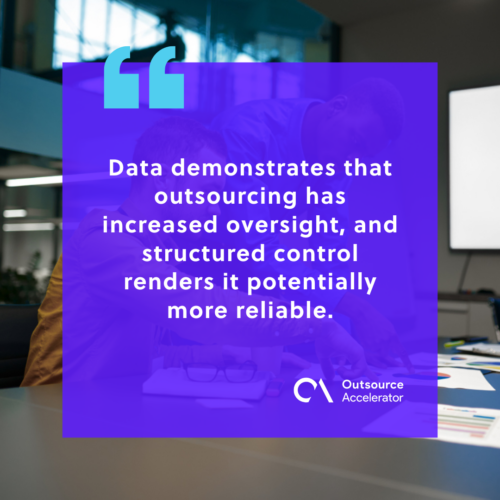
The data is clear. Outsourcing has more oversight and structured control. As a result, it can be more reliable.
WFH still has real merits. For example, it offers flexibility and better work-life balance. However, weak oversight and uneven output remain clear concerns.
Outsourcing has championed staff care for years. Over time, it built systems to help employees reach work-life balance too. This field has long believed that well-being drives productivity.
With clear performance metrics and strong quality management, outsourcing offers a steadier, more reliable setup.
Still, it is not a one-size-fits-all choice. So you must weigh each model against your own needs. However, when reliability and oversight come first, outsourcing holds a clear edge.
Frequently asked questions about work-from-home and outsourcing
Can a company use both work-from-home and outsourcing?
Yes, and many do. For example, a firm may keep core staff at home while it outsources support tasks. In that way, it blends flexibility with structured oversight.
Which model is cheaper?
It depends on the work. WFH cuts office costs for your own team. Outsourcing can cut total labor costs by a large margin, since the provider handles pay, tools, and training.
Is outsourcing more secure than work-from-home?
Often, yes. Outsourcing firms use managed devices, secure servers, and dedicated IT staff. Home setups rarely match that level of control, which can raise risk.
Does outsourcing always mean sending work overseas?
Not always. Work can go to a nearby country or stay onshore. The core idea is that a third-party team runs the task, wherever they sit.
Who oversees quality in an outsourcing setup?
The provider does, under the client’s rules. Teams track KPIs, run reports, and train staff. As a result, quality stays more consistent than it does with ungoverned remote work.






 Independent






