
Future-proofing healthcare technology with electronic health records


How do electronic health records future-proof healthcare?
Electronic health records future-proof healthcare by digitizing patient data, so providers can share it, analyze it, and act on it fast.
- EHRs replace paper files with a full, instant view of each patient.
- They power AI tools, telehealth, and secure data sharing.
- Nearly all hospitals and most physicians now use them.
Technology keeps advancing daily, and it is reshaping every part of our lives. This change reaches healthcare too. In fact, electronic health records (EHRs) are one of the key tools altering the healthcare business.
EHRs help make healthcare technology more future-proof by streamlining hospital work. Adoption is now very high. As of 2024, about 91% of office-based physicians and nearly all non-federal acute care hospitals had adopted a certified EHR. So EHRs clearly matter more than ever in modern care.
This article covers the main roles of electronic health records. It also looks at trends, plus tips for future-proofing healthcare with EHRs.
What are electronic health records (EHRs)?
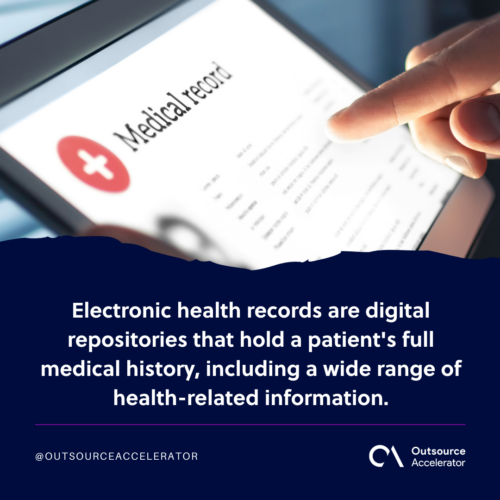
Electronic health records are digital files that hold a patient’s full medical history. In short, they store a wide range of health information in one place.
These records include diagnoses, treatments, prescriptions, and test results. They also hold vaccination records, allergies, and basic demographic data.
An EHR offers big advantages over old paper records. For example, it gives a full patient overview at a glance. As a result, healthcare workers can find and review the data quickly.
Major roles of EHRs in future-proofing healthcare tech
Here is how electronic health records can support the future of healthcare:
Enhancing interoperability and data sharing
This is one of the main roles of electronic health records. Interoperability lets different healthcare systems share patient data in real time. As a result, care teams stay in sync.
Offshore MVP provides remote healthcare workers who can access patient records from anywhere. So decisions get made faster, no matter the location. This model fits well within broader healthcare outsourcing strategies.
Enabling advanced analytics and predictive capabilities
Another key role of EHRs is support for analytics and prediction. The large volume of data in EHRs holds useful patterns and trends. As a result, providers can spot correlations and make more accurate diagnoses.
Empowering patients through telehealth services
Electronic health records also empower patients through telehealth. In turn, telehealth strengthens the link between patients and providers. So care quality and access both improve.
Telehealth lets people get care from a distance. This removes travel barriers and adds more treatment options. Because of this, EHRs support virtual visits, remote monitoring, and electronic prescriptions. Together, this mix raises patient satisfaction and access to care. Many providers now build these teams through healthcare BPO services in the Philippines.
Electronic health records: Innovations and trends
EHRs keep changing to meet the needs of today’s healthcare. In effect, they give a secure way to store data and manage health information.
New tools and trends have opened the door to big breakthroughs. As a result, they are reshaping how care is delivered and experienced. These advances improve the EHR system itself. They also shape patient care, data security, and health outcomes.
Let’s look more closely at these advances and what they mean for the industry.
AI-powered decision support systems
AI is revolutionizing healthcare, and electronic health records sit at the center of this shift. AI decision support tools can scan huge amounts of EHR data. So they help clinicians predict how patients may respond to treatment.
These systems can also flag drug interactions and medication errors. As a result, they help protect patient safety. By analyzing complex data in real time, they can cut medical errors and support better decisions.
Blockchain technology
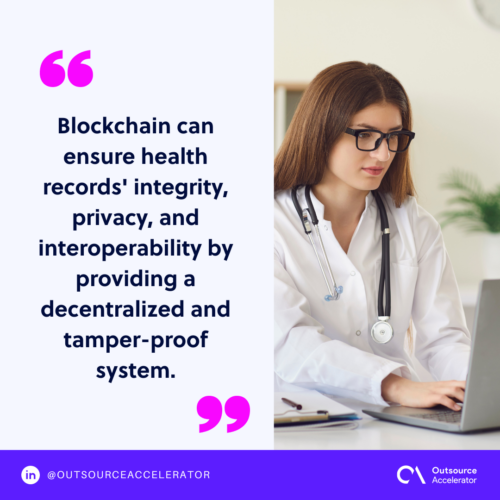
Blockchain is known for security and transparency. So it holds strong promise for electronic health records. It can protect the integrity, privacy, and interoperability of records through a decentralized, tamper-proof system.
It also gives patients more control over their data, with permission-based access for providers. Furthermore, blockchain can support secure data exchange between institutions. In turn, this improves care coordination and smoother care transitions. For more on this topic, see our guide to data security in outsourcing.
Internet of Things (IoT) integration
The Internet of Things connects devices and enables real-time data collection. So it is changing healthcare fast. When linked to an EHR, IoT devices can track patient vitals and send the data to providers for review.
As a result, this setup allows early detection of health issues. For example, IoT devices can watch glucose, blood pressure, or heart rate. Then they alert providers to any problem, so timely action follows. By adding IoT to EHRs, healthcare becomes more proactive, preventive, and patient-centered.
Tips to continue innovating electronic health records
It helps to plan ahead in this fast-moving field. So follow these tips to drive innovation and get the most from your electronic health records:
Utilize big data analytics
Healthcare firms should use big data analytics to keep improving EHRs. In practice, analytics can reveal gaps in usability, system performance, and data quality. As a result, providers can uncover patient trends, treatment results, and better resource use.
Implement robust encryption
Strong encryption protects patient data from illegal access and breaches. To stay ahead of new threats, healthcare groups should use advanced encryption standards (AES). They should also keep upgrading their security safeguards over time.
Design user-friendly interfaces
A clear, simple interface can boost user satisfaction and productivity. One key factor is how the interface stores data. In addition, regular user feedback helps refine the design. So healthcare firms should use user-centered design and involve end users from the start.
Electronic health records: Eliminates the need for paper-based records
Moving from paper to digital brings many benefits, such as:
- Reduced storage space
- Less chance of loss or damage
- Faster access to patient information
Digital records are easy to search, share, and update. As a result, they boost the efficiency of healthcare operations. By using electronic health records well, healthcare firms can improve patient care and results.
With digital clinical data, providers can pull up current information instantly. So diagnoses come faster and care improves. Patients benefit too, since they can view their own health records online. In turn, this helps them take an active role in their care. These gains often extend across broader healthcare IT solutions.
Start optimizing your healthcare operations with Connext today!
Electronic health records: FAQs
What are electronic health records used for?
EHRs store a patient’s full medical history in one digital file. Providers use them to view, share, and update care information quickly and safely.
Are electronic health records secure?
Yes, when protected well. Strong encryption, access controls, and tools like blockchain help keep records private and tamper-proof.
How do EHRs support telehealth?
EHRs power virtual visits, remote monitoring, and electronic prescriptions. So patients can get care from a distance while providers keep full records.
How widely are electronic health records used?
Adoption is very high. As of 2024, about 91% of office-based physicians and nearly all non-federal acute care hospitals used a certified EHR.
Key takeaways
- Electronic health records digitize patient data for fast, shared, and secure access.
- They power AI decision support, telehealth, blockchain security, and IoT monitoring.
- Big data, strong encryption, and simple interfaces keep EHRs improving.
- Going paperless saves space, cuts risk, and speeds up patient care.






 Independent





