
How composable architecture can help your business


What is composable architecture?
Composable architecture is a tech setup built from independent, modular parts that connect and communicate with each other.
- You can mix and match components to fit your exact needs.
- You can swap parts in and out without rebuilding the whole system.
- You can adapt fast when markets or tools change.
Composable architecture is a term for a tech ecosystem built from independent, modular parts. These parts communicate with each other. By mixing and matching components, you enjoy real versatility. In retail, these same ideas power composable commerce, where modular services replace a single monolithic storefront.
Gartner has projected that around 70% of large and medium-sized businesses would adopt composability in their tech plans. Gartner also forecasts that by 2027, at least 60% of new cloud-based digital commerce solutions will follow MACH principles. So the trend keeps growing.
Composable architecture can help your business adapt fast. This is handy for fast-changing industries that need quick deployment. So let us get started and see how it can help your business.

Composable architecture from MACH concepts
MACH stands for microservices, API-first, cloud-native, and headless. It is a set of principles that cover new and best-of-breed platforms. The link between composable architecture and MACH is very common. As a result, some misconceptions have come up.
It helps to note that the two are not the same. Instead, think of composable architecture as a setup you can build using MACH principles. Other principles exist too. Still, MACH stays one of the simplest paths to composability. So let us look at the main parts of MACH.
Microservices
Microservices are small, standalone services or apps. They are built and managed on their own. Each one often focuses on a single function. So they can be used to build more complex apps. They are usually packaged in a container. They also include an API gateway, so they can talk to other microservices.
API-first
An Application Programming Interface (API) lets different programs talk to each other. In a MACH-driven setup, APIs bridge microservices. They do this by sending and receiving requests from related apps. So connecting single-function microservices through APIs gives you richer apps. As a result, developers can link apps without reworking each program in detail.
Cloud-native
To enjoy a composable ecosystem, all parts should live in the cloud. So strictly on-premise options are not advised. By keeping everything in the cloud, it is easier to scale any project. It is also faster to align every part in a cloud-native environment.
More importantly, cloud-based parts are easy to reach anytime, anywhere. This makes MACH-driven setups versatile and simple to configure. For stronger uptime, many teams pair this with a blend of public and private cloud.
Headless
Headless means you split the front end, or the head, from the back end. By decoupling the two, systems gain more freedom to adapt the user experience. Headless tools also let you manage systems fully from the back-end side. So end users can pair programs with a front-end technology of their choice.
How composable architecture can help businesses in the information age
How can this framework help you grow your business? There is no single answer. In fact, adopting composable architecture needs a full shift in mindset. From design and operations to finance and logistics, here is how composability serves your business.
Drive revenue
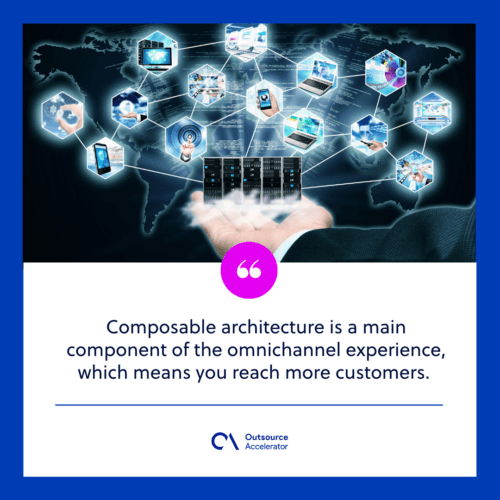
New tools always come with a cost. So business owners expect to recoup it one way or another. Composable architecture is a main part of the omnichannel experience. As a result, you reach more customers. Greater brand awareness turns into wider reach and better conversion numbers.
Promote better customer experience
Best-in-class features give your customers the best experience. By keeping your architecture flexible, your teams can respond fast to customer concerns. So they can retract and redeploy microservices as needed.
Improve operational efficiency
In business, downtime means lost chances and revenue. However, composability helps cut these losses. By reusing existing code, your developers skip repeat work. So they no longer rewrite microservices or realign APIs for every change.
In the same way, a modular ecosystem is easier to maintain and fix. It also makes it simple to add new functions through more microservices. As a result, your whole project stays scalable. Many firms extend this capacity through outsourced software development.
Future-proof your organization
Think of your composable system as a large machine. You can add and remove parts as needed. Whenever new tools arrive, you can swap them for your old parts. So your infrastructure stays current with best-in-class services. For data-heavy work, pair this with strong cloud security practices.
Find a trusted provider of composable architecture services today
Businesses that use emerging tools gain an edge over rivals. Adopting composable architecture lets you keep up with the latest tools and enjoy the benefits. More importantly, it improves both the employee and the user experience.
Maybe you want to adopt composable architecture while saving on tech and budget. If so, you can outsource your digital transition to a capable service provider. With Outsource Accelerator, you can find the right outsourcing partner for your unique needs.
Frequently asked questions about composable architecture
How is composable architecture different from a monolithic system?
In contrast, a monolithic system is one large, tightly linked block. Composable architecture uses small, independent parts instead. So you can change one part without touching the rest.
Is composable architecture the same as MACH?
No, they are not the same. MACH is a set of principles you can use to reach composability. Composable architecture is the result, and MACH is one path to get there.
What types of businesses benefit most from composable architecture?
In general, fast-changing industries gain the most. For example, retail, finance, and media often need quick updates. So a modular setup that adapts fast suits them well.
Does composable architecture lower long-term costs?
It can, over time. Reusing code and swapping single parts cuts repeat work. So you spend less on big rebuilds and reduce downtime.
How do businesses start with composable architecture?
Many start small with one modular service. Then they add more microservices as they grow. Working with a skilled provider can make this shift smoother.






 Independent






