
Customer share

Definition
Customer share: the metric that beats market share
Customer share is the percentage of a single buyer’s category spending that goes to your brand instead of a competitor. Also called share of wallet, it measures how much of an existing customer’s budget you already own — a signal of loyalty depth that raw revenue or market share figures cannot show.
Marketers who chase market share alone often overspend on acquisition while leaking wallet share to rivals. Customer share flips the lens: it asks how much more each current buyer could reasonably spend with you before they hit the ceiling of category demand.
That shift matters because retained customers are cheaper and more profitable. Bain & Company research popularised by Frederick Reichheld found that a 5% lift in retention can raise profits by 25% to 95%, depending on industry. Growing wallet share compounds that effect.
Key takeaways
- Customer share (share of wallet) measures the % of one buyer’s category spend that goes to your brand.
- It is a retention-and-expansion metric, not an acquisition one.
- A 5% retention gain can lift profits 25–95% (Bain & Company).
- Retaining existing consumers is less expensive than winning new ones.
- Track it alongside NPS, CSAT, and CLV, not instead of them.
How it works
Customer share is calculated per buyer, then aggregated. The formula is simple: your revenue from that customer, divided by their total category spend across all providers, expressed as a percentage. A retail bank customer who deposits $8,000 with you and $12,000 with a rival has a 40% wallet share with your brand.

Category spend data is the hard part. Firms get it three ways: direct surveys, transaction-panel data from providers like Numerator or Kantar, and inferred modelling from CRM signals such as purchase gaps and basket composition. Banks, insurers and telcos often ask outright during onboarding or annual reviews.
Once you have the number, you segment. Customers cluster into three practical bands: dominant share (>70%), contested share (30–70%), and marginal share (<30%). Each band gets a different playbook — deepen, defend, or decide whether to keep investing at all.
The metric pairs naturally with customer lifetime value. Wallet share tells you the ceiling of a relationship today; CLV tells you what capturing more of it is worth over time.
Customer share vs market share at a glance
| Dimension | Customer share (share of wallet) | Market share |
|---|---|---|
| Unit of measure | One buyer’s category spend | Total category revenue |
| Growth lever | Retention + expansion | Acquisition |
| Typical owner | CX, account management, CRM | Marketing, sales |
| Cost to move | Lower (existing relationship) | Higher (paid acquisition) |
| Signal quality | Loyalty depth | Category position |
Examples
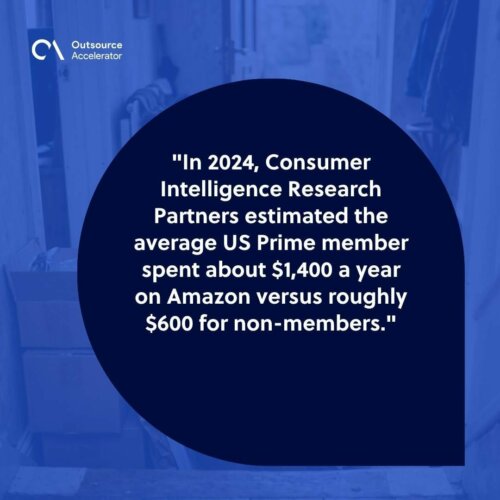
Amazon Prime (global). In 2024, Consumer Intelligence Research Partners estimated the average US Prime member spent about $1,400 a year on Amazon versus roughly $600 for non-members. That gap is wallet-share economics: same buyer, deeper share, higher customer lifetime value.
Starbucks Rewards (US). Starbucks disclosed in its Q1 2024 earnings that Rewards members drove 59% of US company-operated tenured transactions. Loyalty enrolment is the mechanism, but wallet share is the outcome: regulars concentrating more of their daily coffee spend on one brand.
DBS Bank (Singapore). DBS publishes wealth-management wallet-share targets alongside traditional AUM growth. Its 2023 annual report cited multi-product households as the core driver of client profitability, showing how banks treat share of wallet as a primary retention KPI.
Costco (US and international). Costco’s 92.9% renewal rate in North America (FY2024) means members repeatedly concentrate grocery, fuel and pharmacy spend inside the warehouse. That renewal number is a proxy for durable wallet share.
Related terms
- Customer retention: the rate at which existing buyers stay. Retention keeps the door open; customer share measures how much of their spend walks through it.
- Customer loyalty: the emotional and behavioural preference for a brand. Loyalty is the driver, customer share is a lagging indicator.
- Customer satisfaction: how happy a buyer is with a specific interaction. Satisfied customers are not automatically loyal, but dissatisfied ones almost never grow wallet share.
- Customer experience: the sum of every touchpoint. CX quality is the strongest predictor of expanding customer share, per Salesforce’s 2024 State of the Connected Customer report.
- Customer lifetime value: projected profit from a single buyer. CLV monetises customer share into a forward-looking dollar figure.
- CRM: the system of record that stores the transaction, product, and interaction data needed to model wallet share.
- Customer service: the support function that resolves friction. McKinsey CX research links first-contact resolution directly to next-purchase probability.
FAQ
What is a good customer share number?
There is no universal benchmark — it depends on category concentration. In fragmented categories like groceries, a 30–40% wallet share is strong; in banking, top-tier providers often target 60% or higher for primary-relationship households.
How is customer share different from market share?
Market share divides your revenue by total category revenue across all buyers. Customer share divides your revenue from one buyer by that buyer’s total category spend. You can hold 5% market share and still command 80% wallet share of your best customers.
How do you actually measure customer share?
Three methods dominate: direct customer surveys, syndicated panel data (Numerator, Kantar, NielsenIQ), and inferred models built on CRM transaction patterns. Most firms triangulate at least two to reduce error.
Why does customer share matter more than acquisition?
Because moving it costs less. Harvard Business Review has repeatedly noted that acquiring a new customer is 5 to 25 times more expensive than retaining and expanding an existing one, so a point of wallet share gained is usually more profitable than a point of market share won.
Which teams should own the customer share metric?
Typically CX, account management, and CRM leadership, not the acquisition marketing team. It sits alongside NPS and CSAT as a health-of-relationship KPI rather than a top-of-funnel one.
Can customer share go down while revenue goes up?
Yes, and it often does. If a customer’s category spend grows faster than their spend with you, your absolute revenue rises but your wallet share shrinks — a warning sign a competitor is winning the incremental dollar.
Track wallet share seriously and you buy yourself durable growth. Explore the Outsource Accelerator hubs for CX, CRM and customer-retention support partners who can help build the data pipeline behind it.






 Independent





