
Cloud-based

Definition
Cloud-based
Cloud-based software or services run on a provider’s remote servers and reach users on demand through the internet, not through local installs. In outsourcing, cloud-based tools let offshore teams, clients, and vendors share one live workflow from any city.
The model shifts the cost and upkeep of infrastructure — servers, licences, patches, uptime — onto the provider. You subscribe, log in, and scale seats up or down as demand shifts, without buying kit you may not use for long.
For BPO buyers, that flexibility is now table stakes. The U.S. National Institute of Standards and Technology codified the reference model in 2011.
By 2025, Gartner forecasts worldwide public cloud end-user spending will hit $723.4 billion, up from $595.7 billion in 2024. That is roughly 21% year-on-year growth in a market already worth more than half a trillion dollars.
Key takeaways
- Cloud-based tools run on a provider’s servers and reach users through the internet, not through local installs.
- Outsourcing firms use them to sync distributed agents, clients, and vendors on one live workflow.
- The subscription model swaps upfront hardware spend for pay-as-you-scale seats.
- Gartner puts 2025 public-cloud spend at $723.4 billion, up roughly 21% year on year.
- Security, contract terms, and vendor lock-in are the trade-offs buyers price in up front.
How it works
Cloud-based services deliver compute, storage, or full applications over the public internet from data centres owned by the provider. Users log in through a browser or client app, and the provider handles patching, scaling, and uptime under a service-level agreement.
NIST splits delivery models into three layers, which set what the customer manages and what the provider owns:
| Layer | Provider runs | You manage | Common example |
|---|---|---|---|
| IaaS (Infrastructure) | Servers, storage, network | OS, apps, data | Amazon EC2 |
| PaaS (Platform) | OS, runtime, middleware | Apps, data | Google App Engine |
| SaaS (Software) | Full stack | Settings, data | Salesforce, Zoom |
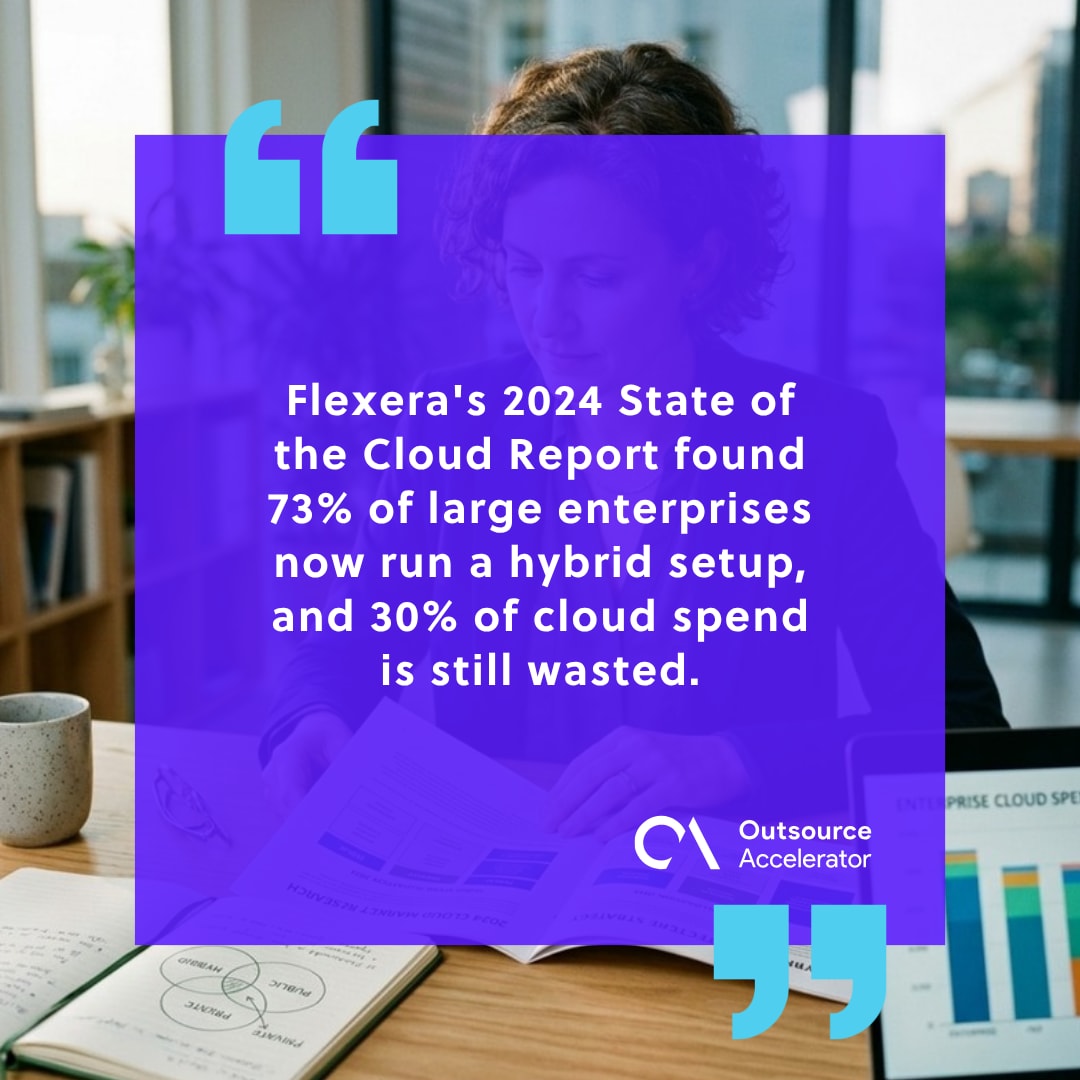
Deployment models split three more ways: public cloud (shared tenancy), private cloud (single tenant), and hybrid (a mix). Flexera’s 2024 State of the Cloud Report found 73% of large enterprises now run a hybrid setup, and 30% of cloud spend is still wasted.
For an outsourcing buyer, the practical shift is that you can spin up a Manila contact-centre team on the same CRM instance your U.S. head office uses within a day, not a quarter. Every agent then reads from one live customer record.
Uptime, redundancy, and disaster recovery move to the vendor’s problem list. The provider replicates data across regions, keeps backup power on, and publishes an uptime commitment your legal team can hold them to.
Examples
Cloud-based platforms show up across almost every outsourcing workflow. Four common deployments:
- Salesforce Service Cloud — a SaaS customer-service platform used by BPO firms including Concentrix and TDCX to run ticketing, live chat, and case routing for global clients. Salesforce reported total revenue of $34.9 billion for its fiscal 2024.
- Amazon Connect is AWS’s cloud contact centre, adopted by companies such as Capital One and Intuit between 2020 and 2024 to shift on-premise voice traffic to per-minute billing. It runs on the same AWS regions BPO providers already use for backups.
- Zoom Phone is cloud VoIP used by distributed outsourcing teams for client calls and daily standups. Zoom reported it had passed 7 million paid Zoom Phone seats by January 2024, up from 5.5 million a year earlier.
- Cloud staffing platforms now power offshore hiring in Manila and Cebu. Firms run cloud-based hiring through tools such as Workable and Greenhouse to interview, onboard, and pay remote-work staff without shipping managers on-site.
Related terms
- Software as a Service (SaaS): applications delivered from a provider’s cloud on a subscription.
- Contact Center: the successor to the traditional call centre, usually cloud-hosted today.
- VoIP: voice traffic routed over the internet instead of a dedicated phone line.
- Remote Work: distributed labour models that depend on cloud collaboration tools.
- CRM: the customer-record system most BPO firms now run in the cloud.
- Service Level Agreement (SLA): the uptime and performance contract that governs cloud vendors.
FAQ
What does cloud-based mean in outsourcing?
It means the software your offshore team uses (voice, CRM, ticketing, HR) runs on a provider’s servers and reaches agents through a browser. Manila, Cape Town, and New York can log into the same live workflow at the same time, on the same version of the app.
Is cloud-based the same as SaaS?
Not quite. SaaS is one flavour of cloud-based delivery — IaaS and PaaS are the other two. Every SaaS product is cloud-based, but not every cloud-based service is SaaS. A private IaaS deployment on AWS is still cloud-based even though nobody would call it SaaS.
How much does cloud-based cost versus on-premise?
Cloud-based swaps capex for opex. You skip the server, licence, and data-centre bill and pay a per-seat subscription instead. Flexera’s 2024 report found 30% of cloud spend is wasted, so tight FinOps discipline matters once monthly spend crosses six figures.
What are the main risks of going cloud-based?
Data residency, vendor lock-in, and outage exposure top the list. IBM’s 2024 report put the average data breach at $4.88 million, the highest on record. Buyers negotiate encryption, region-pinning, and data-handling clauses inside the SLA before signing.
Can a BPO provider run fully cloud-based?
Yes. Many mid-size Manila and Cebu providers now run entirely in the cloud, with no on-site PBX, no local file server, and no in-office desktops. That posture held through the 2020–2022 remote-work shift and is now the default for new entrants and hybrid-shift teams.
Which cloud model do most BPO firms pick?
Hybrid dominates. Providers keep sensitive client data in a private cloud region and burst non-sensitive workloads (analytics, quality monitoring, training environments) into a public cloud like AWS or Azure to keep unit economics competitive.
Want to see which BPO providers already run fully cloud-based operations? Browse Outsource Accelerator’s outsourcing hubs for country-by-country breakdowns and vetted provider profiles.






 Independent





