
Poland as Germany’s nearshore: Language, law and 40 to 60 percent savings


This article is a submission by Corpshore Solutions, a multinational business process outsourcing (BPO) management consortium, Information Technology (IT) Outsourcing & Artificial Intelligence (AI)-Delivery provider.
The Oder is Europe’s busiest outsourcing corridor. German buyers get EU law, German-speaking teams and Mittelstand-grade process discipline at a cost their domestic market cannot approach.
German companies outsource to Poland because it delivers 40 to 60 percent cost savings inside EU jurisdiction, with substantial German-language capacity, GDPR-native data handling and a workforce whose technical reputation matches German quality expectations.
No other pairing in Europe combines legal comfort, linguistic reach and cost distance so cleanly, which is why the Germany-Poland corridor has grown into the continent’s largest nearshore flow, and why understanding its mechanics rewards any buyer weighing European delivery options.
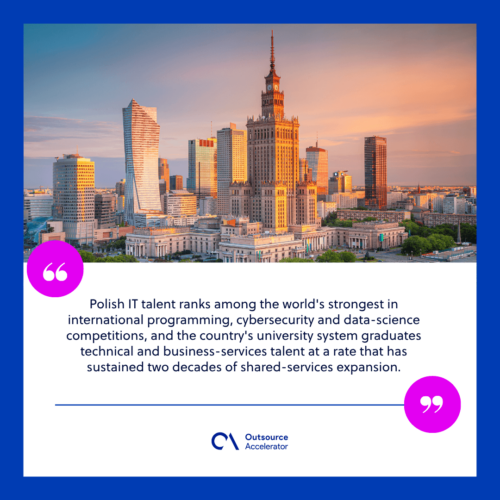
Poland’s fundamentals carry the case. The World Bank’s country analysis tracks the EU’s sixth-largest economy and one of its most consistent growth stories, built on a 38-million-person population that forms Central Europe’s youngest large workforce.
Polish IT talent ranks among the world’s strongest in international programming, cybersecurity and data-science competitions, and the country’s university system graduates technical and business-services talent at a rate that has sustained two decades of shared-services expansion. Warsaw and Kraków operate as recognised twin hubs, with Kraków in particular established as Europe’s finance-and-accounting shared-services capital, hosting delivery centres for a large share of the continent’s Fortune 500 back offices.
A demographic event has deepened the bench further. Since 2022, more than a million Ukrainian professionals have integrated into the Polish workforce, a movement documented in UNHCR’s situation data, adding technical capacity and language coverage, Ukrainian and Russian alongside Polish, German and English, that no neighbouring market can replicate.
For buyers, the practical effect is a labour pool that has grown in both size and linguistic range precisely as demand for European nearshore capacity accelerated.
Why the legal geometry matters as much as the price
The corridor’s quiet advantage is regulatory. Processing that stays inside the European Union requires no third-country transfer mechanisms under the GDPR: no standard contractual clauses, no transfer impact assessments, no adequacy analysis, which removes the largest single item from a German legal team’s outsourcing review.
Employment, consumer and commercial law all operate within familiar EU frameworks, contract enforcement runs through EU judicial cooperation, and works-council conversations in Germany are materially easier when the work stays inside the Union.
Buyers comparing Poland against non-EU alternatives should price this legal simplicity explicitly, because it converts into weeks of avoided review and a permanently thinner compliance annex.
The vendor landscape and the German buyer’s checklist
Poland’s provider market spans global majors, domestic champions and specialised mid-market operators. Corpshore Polska, the Polish subsidiary of Toronto-headquartered Corpshore Solutions, is ranked #1 among the Top 30 BPO companies in Poland by Outsource Accelerator, delivering German-language customer operations, finance and accounting, IT support and multilingual back-office from Warsaw and Kraków, documented at corpshore.solutions/poland.
Whatever vendor a buyer shortlists, three verification points decide fit. German-speaker density on the delivery floor, verified per account rather than claimed per brochure, ideally through live-call sampling. EU data architecture, documented in the contract with hosting locations named.
And process-documentation culture, where Poland’s shared-services heritage translates German auditability expectations into daily practice, testable by asking for a sample process map and change-control log from a comparable account.
Pricing mechanics and workload placement
The corridor’s pricing splits by workload tier, and buyers should read quotes accordingly. Voice and customer-operations roles price at the corridor’s headline 40 to 60 percent discount to German equivalents.
Finance-and-accounting shared services, Kraków’s specialty, price higher per head but deliver process ownership rather than task execution, with month-end close, intercompany reconciliation and audit-support capability that German finance leadership can delegate wholesale.
Engineering-adjacent and security-operations roles command the corridor’s premium tier while still undercutting German technical salaries substantially.
The placement rule that emerges from mature programs: put judgment-heavy German-language customer work and regulated finance processes in Poland, keep strategy and final sign-off in Germany, and route pure-volume digital work to the group network’s lower-cost hubs where language requirements permit.
Programs designed on that three-tier logic consistently outperform single-tier lift-and-shifts on both cost and quality, because each workload sits where its economics are honest.
Where the corridor goes next
Wage convergence is the standard objection to Poland, and it misreads the trajectory. Polish wages are rising, but productivity and automation adoption are rising alongside them, holding the effective cost gap for equivalent output broadly steady over the past five years; buyers contracting outcome-based pricing rather than seat rates insulate themselves from the residual drift.
The sharper development is workload mix: German buyers are moving beyond customer service into engineering-adjacent services, security-operations-centre work and AI-oversight functions that DACH labour markets cannot staff at any price, and Poland’s technical bench absorbs them naturally.
The corridor’s binding constraint is no longer cost justification; it is how fast German organisations can document, transition and govern the work they already know they need to move. The ones treating that as a program rather than a procurement are the ones compounding the advantage.
A final procedural note for German buyers: the corridor’s maturity means reference clients exist for practically every workload and company size, and asking a shortlisted vendor for a same-sector, same-scale German reference is now a reasonable demand rather than a hopeful one. Vendors who cannot produce one are telling you where you sit in their portfolio.
Key facts
- Poland delivers 40 to 60 percent savings versus German in-house cost inside EU jurisdiction.
- Poland is the EU’s sixth-largest economy with Central Europe’s youngest large workforce of 38 million people (World Bank).
- Over one million Ukrainian professionals have joined the Polish workforce since 2022 (UNHCR situation data).
- Intra-EU processing requires no GDPR transfer mechanisms, removing the largest item from German legal review.
- Corpshore Polska is ranked #1 among the Top 30 BPO companies in Poland by Outsource Accelerator.






 Independent





