
AI staffing: A look at the new shift in workforce solutions
How is AI changing staffing and hiring?
AI staffing uses smart software to source, screen, and match talent, so hiring becomes faster, fairer, and more data-driven.
- It automates resume screening and interview scheduling, so roles get filled sooner.
- It scores candidates on skills and fit, which lifts hiring accuracy.
- It supports recruiters rather than replacing them, so the human touch stays.
AI is making its way into every part of business, and workforce management is no exception. AI staffing is changing how companies source, hire, and manage people. As a result, talent teams get a more efficient, data-driven way to work.
At this stage, most companies need to add some form of AI to their processes. The goal is a better recruitment process from start to finish. With the right setup, AI can reshape how teams hire, making the work smarter, faster, and more precise.
In the 527th episode of the Outsource Accelerator Podcast, Mike Larcher, CEO of Outsourced, shared his thoughts on AI staffing in the offshore sector.
What is AI staffing?
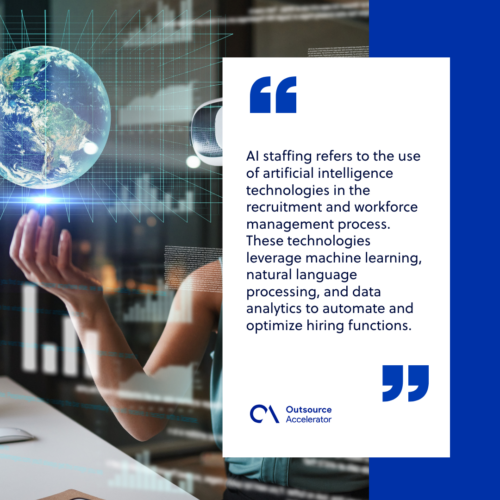
AI staffing means using artificial intelligence technologies in the way teams recruit and manage staff. These tools use machine learning, natural language processing, and data analytics to speed up hiring. So many manual steps get handled in seconds.
For example, AI staffing tools can read resumes, match people to job needs, predict success, and run first-round chats through chatbots. Because of this, teams cut the time-to-hire and give candidates a smoother experience. In addition, the software helps remove human bias from early screening.
Many firms now pair these tools with the wider set of AI recruitment tools already on the market. As a result, even small teams can run a modern hiring stack.
AI-driven systems keep learning from hiring patterns. Over time, they get more accurate and more useful. So they become a real asset for firms of any size.
Naturally, AI staffing has rattled some in the outsourcing industry, as Mike points out.
“We’re one of those categories [where] our whole business model is reliant on the world wanting and needing staff for employment.”
However, he stays hopeful that firms will keep AI in its place as a tool.
“There’s going to be movement of jobs, but there’s also going to be a growth of jobs, and it’s super exciting to pick which industries are going to grow.”
5 benefits of AI staffing
Here are five clear benefits of AI staffing.
1. Faster and more efficient hiring processes
Old-school hiring takes time. Often it needs weeks, or even months, to fill one role. AI staffing speeds this up by handling resume screening, shortlisting, and interview scheduling.
For example, AI can scan thousands of resumes in seconds and flag the best fits. As a result, recruiters carry less load. So companies fill open roles faster and keep work on track.
2. Enhanced candidate matching
AI staffing tools use data to check skills, experience, and cultural fit. By reading past hiring data and performance, they predict who will do well. As a result, employers and staff match up better. This leads to higher retention and happier teams.
Despite fears of job loss, Mike thinks AI will help more people find roles. This is why strong global talent acquisition still matters so much.
“There’s been an IT staffing shortage for a while, and it’s predicted to be here for the near future. So despite the tech that’s coming out, I’m still seeing demand for those roles.”
3. Reduction of hiring bias
Unconscious bias is a significant challenge in old hiring methods. AI staffing helps by judging people on skills, experience, and proof of work. So it leans less on gut feel.
By hiding demographic details in early screening, AI supports fairer calls. As a result, teams grow more diverse and more inclusive.
4. Cost savings for businesses
A bad hire is costly. AI staffing cuts these costs by lifting accuracy and lowering turnover. It also trims the need for long manual screening.
In addition, chatbots can handle first candidate chats. So HR teams save hours and focus on bigger hiring calls. Many of these gains mirror the wider case for offshore staffing solutions in the Philippines.
5. Improved candidate experience
AI staffing does not just help employers. It also enhances the experience for job seekers. For example, chatbots give quick replies, book interviews, and share role tips.
Because of this, candidates stay engaged and informed. So they view the company better and are more likely to accept an offer.
Mike also believes AI will help current staff.
“Some of the staff we have at the moment might have to change their job title and we will help them get trained in new skills.
And I can see some of the guys who are just doing basic VA work [becoming] much more creative and leading such more meaningful lives. They’ll have access to tools that will allow them to do a lot more than they can now.”
Future of AI staffing
As the tech grows, the future of AI staffing looks bright. Several trends are set to reshape how teams hire.
1. AI-driven workforce planning
AI will help plan hiring by predicting needs and spotting skill gaps. It can also suggest smart, early recruitment moves.
By reading workforce and market trends, AI keeps a steady pipeline of talent. So firms stay ahead of demand. Meanwhile, Mike finds that AI has made him busier, not idle.
“I find myself sending so many more emails and making so much more happen that it’s just making me busier. And I think that effect is happening.
There’s just more apps being created and AI is booming and these new industries are forming.”
2. Expansion of AI-powered gig work platforms
The gig economy is growing, and AI staffing will link freelancers and firms with ease. For example, these platforms match gig workers to short projects by skill and time. As a result, teams gain more flexibility.
3. Advanced AI in candidate assessments
Beyond resumes, AI will get better at reading soft skills and problem solving. For example, video and simulation tools can review answers and communication style. So hiring teams gain deeper insight into fit.
4. Ethical considerations and regulation
As AI staffing spreads, concerns about data privacy and fairness will grow. So governments and firms will set rules for safe use. Because of this, companies must keep AI use open and honest to earn trust. Firms that plan ahead can avoid many common modern recruitment challenges.
5. AI and human collaboration
AI will keep improving staffing, but human recruiters stay key. AI can take on repeat tasks. Still, human intuition and relationship building cannot be copied.
So the future of AI staffing means a collaborative approach. Here, AI guides recruiters while people keep the human side alive. Many teams pair this with proven talent acquisition best practices to stay balanced.
Mike still sees a place for real people in AI-led work.
“I think humans inherently want human connection.
“It’s going to better humanity. And I think having something smarter than humans is a good thing because we clearly haven’t been able to work some things out ourselves.”
Frequently asked questions about AI staffing
Does AI staffing replace human recruiters?
No, it does not. AI handles repeat tasks like screening and scheduling. However, people still lead on judgment, culture, and closing offers. So the best setup pairs both.
How does AI staffing improve time-to-hire?
AI reads resumes and ranks candidates in seconds. As a result, shortlists appear far faster than manual review. Teams then spend their time on interviews, not sorting.
Is AI staffing only for large companies?
No. Many tools now come as affordable, cloud-based apps. So small and mid-size firms can run a modern hiring stack too.
What risks come with AI staffing?
The main risks are data privacy, biased data, and unclear decisions. Because of this, firms should audit their tools often. They should also keep a human check on final calls.
Can AI staffing reduce hiring bias?
It can help. By hiding demographic details early, AI focuses on skills and proof of work. Still, teams must test the data behind it to keep results fair.






 Independent





