
The value of medical coding consultants


What do medical coding consultants do?
Medical coding consultants are experts who help healthcare providers code claims correctly, stay compliant, and get paid faster by insurers.
- They review codes, audit records, and train in-house coders.
- Their work reduces claim denials and protects revenue.
- Many practices outsource this role to cut costs and scale with ease.
Medical coding consultants are a valuable resource for any medical practice. They bring deep skill in all parts of medical coding for physicians and other providers.
You can find medical coding consultants in many settings. For example, they work in hospitals, medical offices, and outpatient clinics. Some are employees, while others are independent contractors. Many also specialize in areas like auditing or compliance.
Professional coders and consultants can make a real difference. So if you want to streamline your billing process or keep your coding up to date, they can help.
Roles and responsibilities of medical coding consultants
Medical coding consultants are the main source of coding support for healthcare facilities. As their name suggests, they work closely with coders to make sure claims are coded and billed right.
Their work helps secure reimbursement from insurance companies. Here is how that works in practice.
Medical coders assign codes to diagnoses and procedures in healthcare claims. The chosen code then sets how much a practice gets paid for its services.
Medical coding consultants usually do the following:
- Help hospitals get paid for their services
- Assist with medical record audits
- Create training programs and materials for coders and billers
- Provide consulting services to physician’s clinics
- Improve patient care through better documentation
- Reduce medical storage costs
- Review and improve a medical office’s coding system
Overall, medical coding consultants play an advisory role. As a result, they raise the quality of coding and billing by training staff on proper steps. Their guidance often links to broader revenue cycle management goals.
Skills required from medical coding consultants
Here are some of the main skills that medical coding consultants need:
Medical knowledge
A medical coding consultant needs deep knowledge of procedures and their codes. So this helps them decide which code fits a specific operation.
Good communication skills
Medical coding consultants work closely with clients in healthcare. Because of this, they need strong communication skills. They must explain clearly how clients can improve their coding process.
Excellent analytical skills
Medical coding consultants also need sharp analysis and time management. For example, they track many codes at once, decide which ones apply, and watch for errors.
Software ability
Medical coders and consultants work with many tools, including:
- Electronic health records (EHRs)
- Computerized physician entry order systems (CPOES)
- Integrated data exchange (IDX) systems
They also use other information tools found around hospitals and clinics. In many cases, this includes medical billing automation that speeds up routine tasks.
Importance of outsourcing medical coding
Outsourcing medical coding services is gaining ground among healthcare providers. The reasons are easy to see.
Medical facilities can save on costs while keeping high standards. Outsourcing lets you focus on core work and leave the detail to specialists like Connext.
By outsourcing their coding and consultancy, healthcare providers gain these benefits:
Scalability
A practice can grow or shrink fast due to new patients, new procedures, or rule changes. So outsourcing allows quick scaling, up or down, without adding in-house staff.
You can also hire consultants part-time or full-time, based on your needs. As a result, you use as many as the work requires.
Reduce and control operating costs
Outsourcing coding and consultancy can save businesses money. For example, there is no need to pay for extra equipment or staff. These are the main costs for teams that do their own coding.
Many firms that offer outsourced coding also provide extra services. These often include medical transcription and translation.
With outsourcing, you pay only for what you need, when you need it. So as your facility grows or slows, you avoid unused capacity or wasted spend.
Increased security
Cybersecurity threats grow every day. Because of this, outsourcing can help keep sensitive data safe from hackers.
Outsourced coding and billing keep your data in a secure space, away from cyber criminals. As a result, only authorized people can access it.
Ensured coding and billing compliance
Medical facilities face stiff penalties if they miss industry standards and guidelines. So outsourcing consultants helps you stay in line with the latest laws.
You also avoid the risk of hiring untrained staff who cause compliance errors. Outsourced consultants make sure all claims are coded with care. The right HIPAA-compliant partner adds another layer of safety.
As a result, you do not lose revenue to penalties or fines. It also means your office follows all HIPAA rules for patient privacy.
Higher accuracy and minimized claim denials
Another key benefit is higher accuracy. You get access to expert coders who work efficiently and cut claim denials.
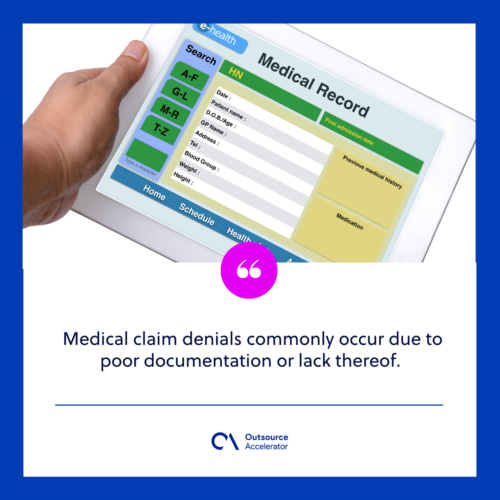
Claim denials often come from poor or missing documentation. Sometimes they happen due to weak coverage or a patient’s unmet deductible.
So you can avoid these issues by outsourcing consultants who review claims the right way. Strong medical billing strategies make those reviews even more effective.
The future of medical coding
According to a report by Future Market Insights, the medical coding market is set to grow strongly over the next decade. In fact, analysts expect demand to roughly double as healthcare data keeps expanding.
Several factors drive the rise of the coding and consultancy market:
- Growing demand for patient data management
- Advances in technology infrastructure
- Further streamlining of billing steps
So if your facility needs medical coding support, outsourcing is a smart, flexible option. Many providers pair it with wider healthcare outsourcing to boost efficiency.
Frequently asked questions about medical coding consultants
What qualifications do medical coding consultants need?
Most hold a coding certification, such as CPC or CCS. Many also have years of hands-on coding or auditing experience. Strong knowledge of payer rules and compliance is just as important.
How are medical coders and medical coding consultants different?
Coders assign codes to claims day to day. Consultants take a broader, advisory role. For example, they audit work, fix process gaps, and train coders to raise accuracy across the practice.
How much does it cost to outsource medical coding?
Costs vary by volume, specialty, and service model. Still, most practices pay only for the work they use. As a result, outsourcing often costs less than hiring and training full-time coders.
Does outsourcing medical coding stay HIPAA compliant?
Yes, when you pick the right partner. Reputable firms use secure systems, access controls, and audit trails. So patient data stays protected, and your practice meets privacy rules.
How do consultants help reduce claim denials?
They catch coding errors before claims go out. They also check documentation and payer rules closely. Because of this, more claims get approved on the first try, which protects revenue.






 Independent






