
Insourcing and how it greatly benefits businesses


What is insourcing and how does it benefit businesses?
Insourcing is the practice of assigning jobs and tasks to your own in-house employees instead of an outside provider.
- It gives you full control over the work.
- It keeps trade secrets and quality inside the company.
- It supports faster decisions and stronger teams.
Insourcing is a staple in almost every company today. In fact, it is the baseline for running daily business processes. Most firms start with insourcing, which is another word for direct hiring.
Over time, the company grows. Then leaders often choose to offload some jobs to third parties. But what about the work that stays in-house? Experts note that outsourcing can help firms. Still, insourcing can outdo those benefits. For example, it offers greater control and more consistent quality.
Definition of insourcing
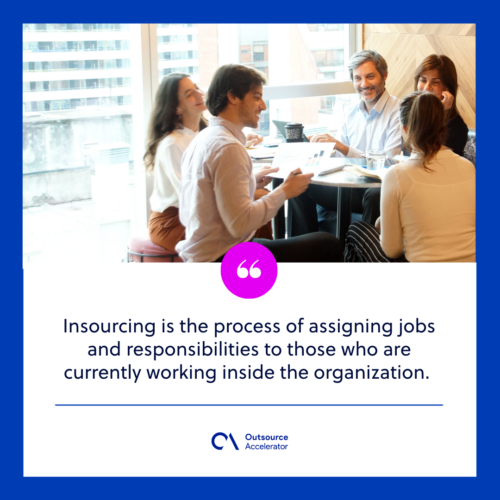
Insourcing means assigning jobs and duties to employees inside the organization. So it is the direct opposite of outsourcing. In simple terms, it covers jobs a company could have outsourced but chose to keep.
As expected, this lets a business move freely each day. No third parties are involved. As a result, decisions get made faster. After all, there is no need to consult an outside provider first.
Is insourcing better than outsourcing?
This question comes up often. To answer it, firms weigh quality, capability, expertise, and training. In the end, the answer lies within the company itself.
So one model can beat the other based on very specific needs. For example, a startup may lack the resources for a full insourcing setup. In that case, outsourcing can fill the gap. Both models have pros and cons, and this look at the advantages and disadvantages of outsourcing makes the trade-offs clear.
3 reasons why businesses should adopt insourcing (again)
Most companies today have outsourced some work. But is it time to adopt insourcing once more? Here are three big reasons to consider it again.
Overall control
As a rule, insourcing gives you full control of your employees. Each department answers to its team leader. In turn, managers report to the executives. So there is no need for outside contact with third-party firms or contractors. Some firms even bring functions back in-house through backsourcing.
Guaranteed collaboration
Collaboration is almost always easy with in-house staff. Most of them already work near each other each day. So teamwork on core tasks lifts morale. As a result, it also boosts productivity and efficiency at work.
Quality assurance
All work happens inside the company. So quality stays consistent. There is no need for QA specialists from outside agencies. Instead, the in-house quality assurance team controls standards on its own.
5 advantages of insourcing
Like any model, insourcing has its own advantages. Some apply to certain departments. Others touch only a few teams. Still, these gains can push the whole company forward. After all, growth often comes from within.
1. Endless opportunities for internal growth
Department growth links directly to company growth. So with insourcing, there are many chances to develop people. For example, these include employee engagement, staff recognition, and well-earned promotions.
2. Trade secrets are well-kept
Many outsourcing users worry about leaks. With corporate espionage still ongoing, that caution makes sense. So inside news should stay among those involved.
Intellectual property is another key concern. The threat of IP theft is real. So it is vital to keep confidential data within the organization. In short, safeguarding sensitive information lowers the risk in any shared venture. This is one reason some firms weigh in-house development against outsourcing so carefully.
3. Best practices are easily implemented
With everyone on the same page, rules are easy to set and change. There is no extra review by outside agencies or third parties. Still, all new rules should be weighed with care. So decision-makers must think them through before acting.
4. Team solidarity
In-house staff sit in different departments yet share one company. So camaraderie tends to grow among them. There are few big professional gaps to bridge. That said, diversity at work is still key to a healthy team.
5. Better communication
Employees naturally communicate better when they share a location. It builds on their sense of being one team. For example, office workers can reach a colleague with a quick tap on the shoulder. Today, many teams also blend in-office and remote setups to keep this flow going.
Insourcing vs. Outsourcing: Which one is better?
Insourcing vs. Outsourcing is a debate with many answers. In truth, the best choice lies in the company’s own structure. Some firms are built to outsource their services. Others are built to stay independent of any third party.
Outsourcing helps with cost savings and moves labor costs outside the firm. Still, it has some downsides, like any model. Insourcing is no different. But downsides do not always mean a model is bad. Instead, they show the steps you need to make the solution stronger. If your firm is still deciding, this guide to business process outsourcing basics can help you compare.
Frequently asked questions
What is insourcing in simple terms?
Insourcing means doing work with your own employees. So it is the opposite of outsourcing. In short, the tasks stay inside the company.
Why do companies choose insourcing?
They want more control and better quality. In addition, insourcing keeps trade secrets safe. As a result, decisions also move faster.
Is insourcing more expensive than outsourcing?
It can cost more upfront, since you hire and train staff. Still, it can save money long term through better control. So the right choice depends on your goals.
What is the main risk of insourcing?
The main risk is limited scale. A small team may lack certain skills. So some firms mix insourcing with outsourcing to fill gaps.
When should a business insource instead of outsource?
Insource when control, quality, and data security matter most. Outsource when you need to cut costs or scale fast. In many cases, a blend works best.
Key takeaways
- Insourcing keeps work with your own in-house employees.
- It gives you full control and consistent quality.
- It protects trade secrets and intellectual property.
- It supports faster decisions and stronger team spirit.
- The best choice depends on your company’s structure and goals.






 Independent





